Strymon Volante
The Strymon Volante delivers top-tier analog-voiced delay with hands-on control, studio-grade sound, and strong creative potential.
★★★★★ 4.9/5 · 57 buyer reviews · 7 min read · updated 2026-10-06 · Tested by Cal Whitaker
Introduction: Magnetic Delays and Modern Versatility
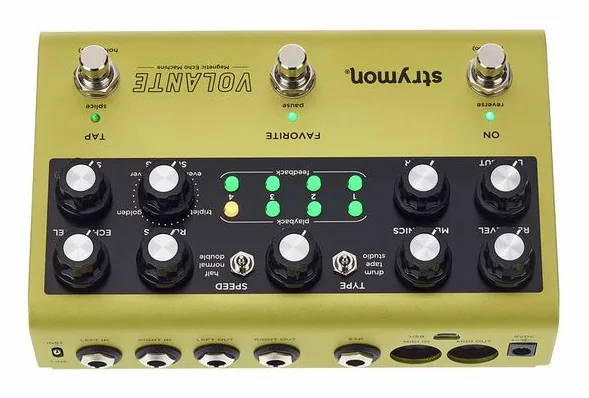
The Strymon Volante is positioned as a magnetic echo workstation, offering drum, tape, and studio delay modes packed into a meticulously engineered enclosure. It lists at $398 and covers both classic echo textures and creative modern sound design, serving guitarists, synth players, and studio engineers alike. Key hardware specs include dual inputs and outputs (quarter inch), an expression pedal jack, complete MIDI input/output, and USB connectivity. The pedal combines immediate hands-on control with presets and deeper control via MIDI, all within a robust and tactile interface.
Build and Physical Design
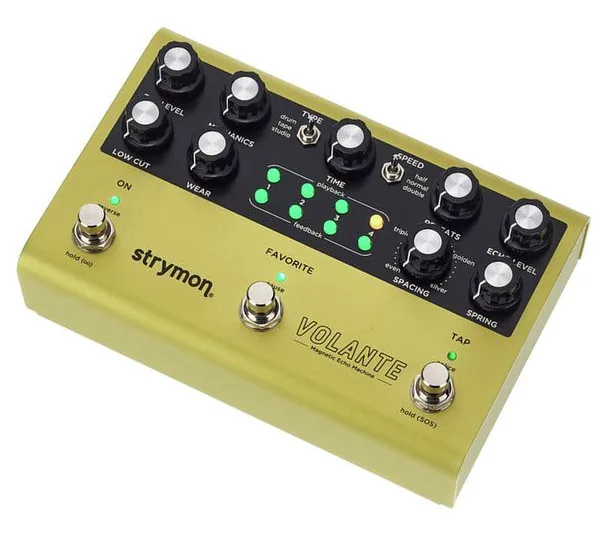
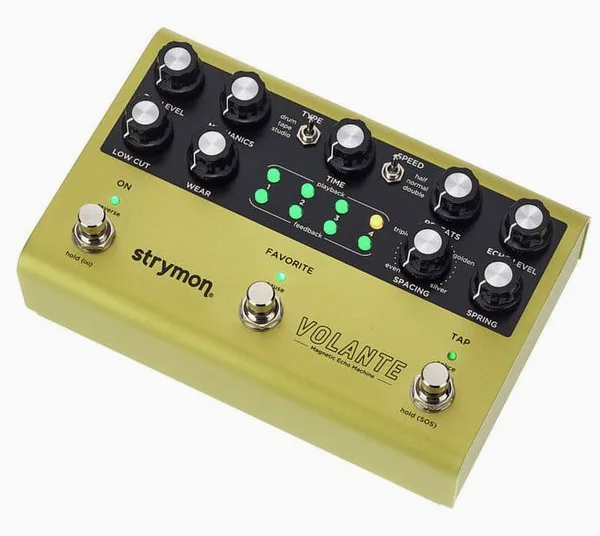
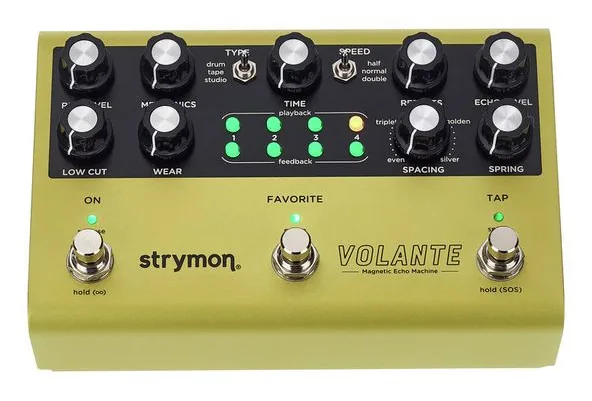
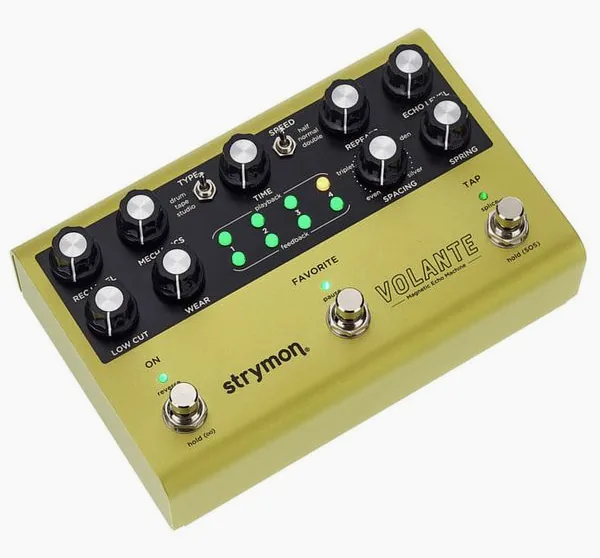
At 7 by 4.5 inches and weighing 200 grams, the Volante's footprint is moderate given its stereo architecture and crowded feature set. The aluminum chassis feels solid with soft-touch, responsive rubberized knobs and switches. Each control is clearly labeled, mapping directly to essential functions, recording level, echo repeats, tap tempo, time, wear, mechanics, distance, spring, reducing the need for menu diving. True bypass and switchable buffered bypass are selectable, accommodating a range of pedalboard philosophies and signal chains.
Delay Engines: Drum, Tape, and Studio Modes
The Volante offers three magnetic echo emulations:
- Drum: Emulates vintage disk echo. It produces gritty, unpredictable repeats and is especially suited for lo-fi textures, swirling repeats, and rapid self-oscillation when mechanics and wear are increased. The modulatability here stands out for experimental users.
- Tape: A precision recreation of classic reel-to-reel tape echo. It covers everything from pristine to worn-out, dirty echo, with no maintenance or mechanical noise. This mode shines with tape age and mechanical irregularities, useful for those chasing Binson or Roland flavors in stereo with zero hiss or service needs.
- Studio: The cleanest algorithm, offering low coloration and minimal modulation. It is useful when you want a transparent, modern delay with vintage character only when desired. Despite lacking "analog" grunt, it interfaces well with synths, acoustic instruments, and vocals in a studio context.
In each mode, you have four virtual playback heads that can be independently panned in the stereo field and assigned half-volume, supporting highly rhythmic or ambient effects. The spacing control determines the intervals between heads, and each head's activity is managed by illuminated buttons, remaining visible and tweakable during live use.
Control, Saturation, and Sound Shaping
Adjustments to recording level, wear, and mechanics let you drive the repeats from clear into saturated territory, without affecting the dry signal, which stays entirely analog. The low cut filter carves out bass from the delay, making room in dense mixes or sculpting for atmospheric work. The mechanics and wear knobs dial in pitch drift, wow and flutter, and "age", allowing users to move between ultra-clean and chaotic, warbling extremes.
The spring control introduces spring reverb that, while not the most authentic, adds space and blends well in both clean and washy settings. The reverb can be engaged independently, adding shimmer even with all delay heads off.
Immediate Interaction, Hidden Depths
Nearly every major parameter is accessible via a dedicated knob or switch. A few advanced features (like adjusting the number of loop repeats, selecting subdivision ratios, or configuring MIDI) are accessed through secondary functions but are largely intuitive. Hands-on workflow is a strong point, with minimal "function stacking." A footswitch enables bypass, while on-board buttons provide favorite recall, tap tempo, effect engage, type, and speed selection.
Looper and Sound-on-Sound Mode
Strymon incorporates a looper under the "Sound on Sound" function. What sets it apart is real time access to tape-style controls, changing loop speed (fractional to triple), reverse playback, and head selection, all while processing the loop through the magnetic echo engine. Parameters like low cut, wear, and mechanics also affect the recorded loop, making it far more than a typical digital overdub looper.
Live, the ability to overlap delay and looping is a major creative tool. For studio users, recording hands-on manipulations across loops opens up performance-based sound design. Note: The infinite "no degradation" claim is not absolute, repeats gradually lose some fidelity, so the SOS mode behaves more like a true vintage magnetic looper than a static digital memory slot.
Connectivity and Integration
Dual input/output jacks support mono, stereo, or summing operations. The Volante can be switched between instrument and line-level operation, making it equally at home on a pedalboard or inserted in a studio rack or DAW setup. MIDI implementation is extensive, offering up to 128 memory locations via program change; however, on-board access to presets is limited, only one favorite slot can be recalled with the footswitch, while the rest require MIDI or a manual "favorite" button press. USB is present but used for firmware and MIDI, not audio streaming.
- Expression pedal input (for sweeping any parameter, programmable)
- MIDI in/out for remote control and preset switching
- True and buffered bypass modes
Limitations and Critiques
While workflow is mostly direct, some advanced options are less accessible, such as live preset switching or reverse on non-looping delays. No onboard battery option. The power supply draws 300 mA and is not included, a quality, isolated 9V DC supply is required, which adds to the cost. Live preset recall is limited versus some multi-effect competitors, and there is no spillover when changing presets over MIDI, repeats cut off abruptly. A few users have experienced noise issues in buffered mode, though this is rare.
Summary
The Strymon Volante offers an uncompromising toolkit for anyone searching for magnetic echo color, extensive hands-on manipulation, and a studio-worthy stereo signal path. The classic tape, drum, and studio modes, alongside spring reverb and expressive looping, put decades of analog vibe in a modern form. While not the cheapest or most plug-and-play, the tactile control, connection options, and sound shaping are second to none at this level, making it a top recommendation for both performers and recordists needing vivid, characterful delay.
Shipping and duties
The retailer ships from its warehouse in Germany. Prices are shown in US dollars and do not include import duties. Orders under roughly $800 usually clear US customs without duty; above that, a duty of a few percent may be collected on delivery. 30-day money-back and a 3-year warranty apply.
Scores by area
Where it shines, where it stumbles
What convinced me
- Exceptional sound quality with highly convincing magnetic echo emulation
- Dedicated controls for each sound-shaping parameter, very minimal menu diving
- Powerful integration: stereo operation, line/instrument level switch, MIDI and USB connectivity
- Intuitive to operate despite complexity, with most features accessible directly on the panel
- Robust build quality and premium components
What bugged me
- Preset management is limited: only one favorite accessible via foot, others require hands or MIDI
- Learning curve: hidden secondary functions and abundant features require manual consultation
- No onboard power supply included, high power draw demands a quality adapter
- Spring reverb is decent but not class-leading
- No direct reverse delay (reverse only for Looper) and limited spillover when changing presets
Is it the right one for you?
Good pick if
Ideal for musicians seeking authentic magnetic echo, hands-on sound sculpting, and exceptional stereo delay, guitarists, synth players, or studio producers. Those who value creative flexibility, analog-style workflow, and premium build will find it rewarding whether for live rigs or studio work.Look elsewhere if
Not for players who need rapid preset switching solely by foot or require a basic, plug-and-play setup. Those on a tight budget, needing small form factor, or uninterested in detailed parameter editing may prefer simpler solutions.Suggested level: Intermediate
Specifications
- Analog
- No
- Tap feature
- Yes
- Battery operation
- No
- Psu included
- No
What other players say
Customer reviews highlight the Volante's genuine tape and drum echo emulations, intuitive control set, and stellar stereo sound. Users praise the creative hands-on options, flexible routing, and analog-inspired workflow. Some users feel the preset access and hidden functions can limit live usability. Most agree the sound quality justifies the price, with consistently positive impressions regarding versatility, build, and musical inspiration, regardless of whether it's used with guitar, synths, or as a production tool.
The quality of the delays is just breathtaking and highly tweakable.
You get everything you want in the digital domain, it sounds great, is stress-free and above all fun.
My experience with effect devices is limited, but the operation is surprisingly intuitive. The sounds are just stunning quality, the build is top notch.
Up close
Watch and listen
Questions players ask
How easy is it to switch between presets during a live performance?
Only one favorite preset can be accessed via footswitch; switching to other presets requires using the buttons by hand or an external MIDI controller, which may not be ideal for live use.
Can the Volante handle both guitar and synth or line level signals?
Yes, it features an input level selector for easy adaptation between instrument and line-level signals, making it well-suited for guitar, synths, and studio applications.
What kind of sounds can I achieve with the different magnetic delay modes?
You can emulate drum echo, tape echo, and studio delay types, ranging from clean and precise to warm, modulated, and degraded repeats, offering distinct sonic characters for diverse genres.
Is the looper on the Volante flexible and hands-on?
The looper is tightly integrated, allowing creative use of delays and spring reverb along with overdubbing, reverse, and speed changes; most controls are accessible on the panel without menu surfing.
Are there any drawbacks to using the Volante with a full stereo rig?
No major audio drawbacks; the unit supports true stereo operation, flexible panning, and retains high signal integrity, but preset handling and MIDI clock sending are somewhat limited.
The last word from the bench
The Strymon Volante is a standout magnetic-echo delay pedal, offering an impressive combination of versatility, character, and build quality. While it demands some learning investment, its creative range and pristine audio make it a go-to for vintage-inspired textures and modern workflows. Limitations in preset access and a few UI quirks are noticeable but rarely deal-breakers. For musicians valuing both studio quality and tactile playability, it's among the best in its class.
Hanging next to it
Before you decide
Strymon Volante
Today's price and delivery time are shown at the retailer. Affiliate link, your price does not change.
 Guitar Gear Reviews