Darkglass Microtubes X Ultra
Darkglass Microtubes X Ultra delivers cutting-edge versatility and tone for demanding bassists, excelling in both distortion and clean applications.
★★★★★ 4.8/5 · 40 buyer reviews · 8 min read · updated 2026-10-06 · Tested by Cal Whitaker
Darkglass Microtubes X Ultra: A Versatile Bass Preamp and Distortion Platform
The Darkglass Microtubes X Ultra sits at the top of the Finnish brand's pedal lineup. It brings together several features from the Microtubes X7 and expands the package with a six-band graphic equalizer, impulse response speaker simulation, an auxiliary input, and an independent clean channel. Billed as a one-box solution for modern bassists, it promises a full sonic toolset for stage, studio, and home practice, offering fine-tuned distortion, precise EQ, and a practical practice environment.
Physical Build and Layout
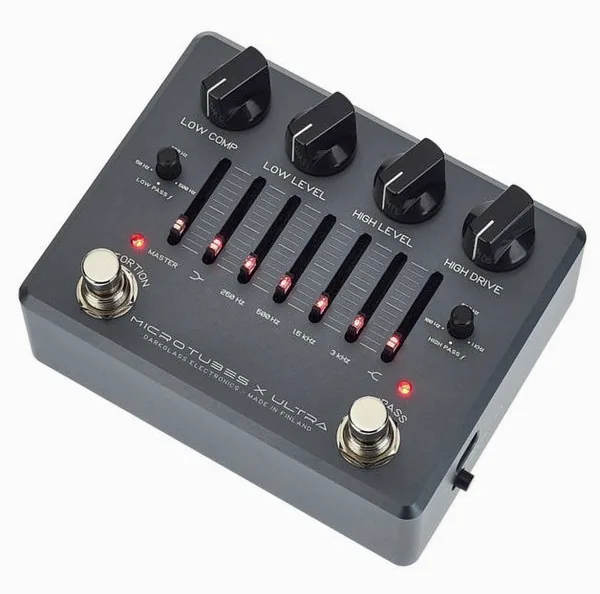
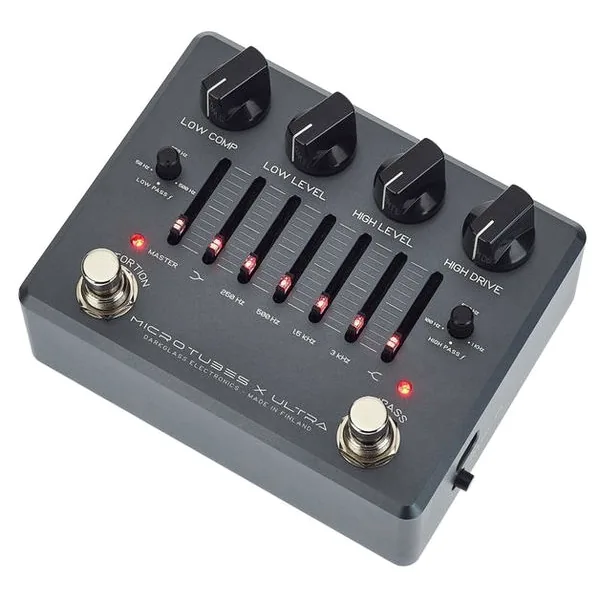
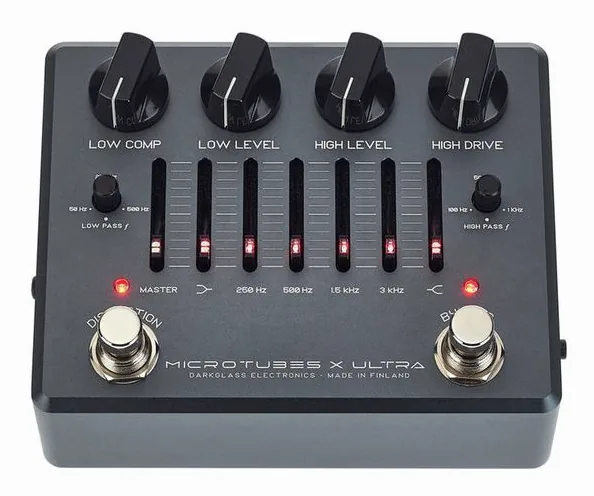
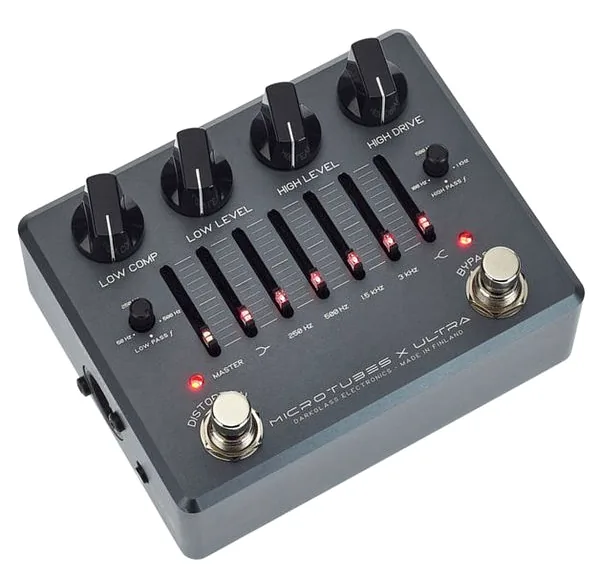
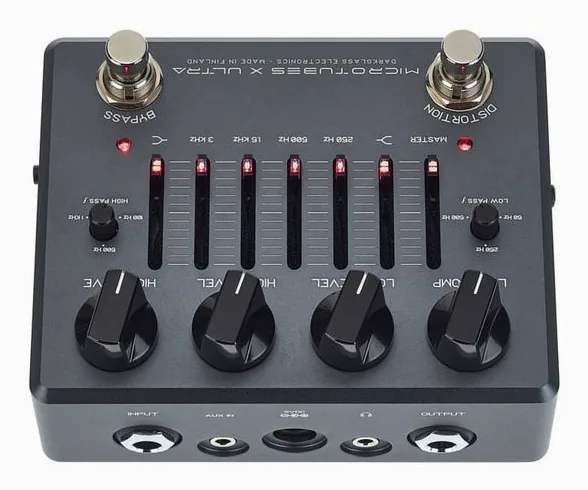
Measuring 125 mm wide, 96 mm deep, and 57 mm high, and weighing in at 430 grams, the Microtubes X Ultra has a rugged metal chassis that feels solid and tour-ready. The control surface is dense but stays manageable: all crucial functions are accessible from the top panel. A row of push-buttons allows quick selection of cutoff frequencies for both high-pass (100 Hz, 500 Hz, 1 kHz) and low-pass (50 Hz, 250 Hz, 500 Hz) filters, plus a cab sim on/off switch. There is a bypass footswitch for easy live toggling. The standard quarter-inch input and output jacks are joined by an XLR direct out and USB port for connection to computers and the Darkglass Suite app.
Signal Path and Core Features
The central concept is dual-band processing: you can split your clean lows from your distorted and compressed high and mid frequencies. This allows you to maintain fundamental weight and punch without letting distortion muddy the low end. Controls for high-drive, high-level, and high-pass frequency give you complete control over saturation and focus; low-comp, low-level, and low-pass frequency shape your compression and bottom end. A master control lets you set your global output.
The six-band graphic EQ (with sliders at 80 Hz, low shelf, 250 Hz, 500 Hz, 1.5 kHz, 3 kHz, and a high shelf) offers deep control for sculpting your sound. Each EQ band is illuminated, making adjustments on a dark stage manageable. Although some users note that the midrange sliders act more like switches than continuous potentiometers, their effect is mostly at the ends of their travel, the overall flexibility is substantial.
Impulse Response Speaker Simulation and Connectivity
Impulse response speaker simulation is a standout feature, adding real-world cabinet flavor to both the XLR and headphone outputs. Using the Darkglass Suite software (Mac/PC, accessible via USB), you can load factory or custom cabinet simulations in seconds. This is invaluable for direct recording, silent practice, or sending polished sound straight to front-of-house. User feedback confirms rapid loading, real sonic transformation, and reliable results across various genres.
Alongside the auxiliary input for practicing with tracks and a headphone out (volume adjustable via software), the Microtubes X Ultra proves equally useful in the studio, at home, or on tour. The absent dedicated tuner output is a minor complaint, but the rest of the connectivity covers practical bases.
Compressor Modes and Clean Applications
In addition to its multiband approach, the pedal offers a full-band compressor mode (switchable via the bypass footswitch, holding it engages the mode). This lets you compress the entire frequency spectrum, not just the lows. Both standard multiband and full-band (blue LED) modes provide quality compression suitable for clean or saturated bass. The ability to disengage the distortion and use only the compressor and EQ effectively turns the pedal into a transparent preamplifier, a notable flexibility over the Microtubes X7 and a clear advantage for varied setlists or changing needs onstage.
Distortion Quality and Tone Shaping
Distortion is the star: it can range from subtle edge to full-on metallic grit, always maintaining punch and clarity. The circuit can isolate which frequencies get distorted, so you can dial in a fierce upper grind without losing definition in the lows. This suits aggressive music but works for clearer, rounder bass tones as well. The overdriven character is modern and articulate, testimony from various users points to solid Ampeg-style rock tones, intricate djent-ready growl, and even satisfying warmth for jazz and indie. The lows stay unflappable; the highs can be dialed in to shimmer or snarl as needed.
For tone shaping, the six-band EQ covers everything from deep bottom to sparkling presence. Some report that the upper treble can add hiss if pushed far, but under real-world bass settings, this rarely poses a problem. The frequency selection knobs for filtering are more functionally dynamic than a simple blend knob, but their small size makes them hard to read in low light, a practical gripe, though seldom a dealbreaker in use.
Field Experience: Practice, Recording, and Performance
The Microtubes X Ultra's utility shines in rehearsal, practice, or gigging. The headphone out, paired with cab simulation and an auxiliary in, enables silent practice with inspiring tone. Musicians appreciate the pedal's ability to replace amp rigs for direct recording and live setups, with several reporting consistent, high-quality FOH sound using only the pedal's DI output. The USB connectivity to Darkglass Suite isn't just a flashy extra: users routinely praise the speed and reliability of loading new cab sims, making the unit a future-proof choice for evolving tastes and setups.
Constructive Critiques
On the flip side, some users miss features like separate pre/post EQ XLR outs, a dedicated pad switch for active/passive instruments, or a dedicated tuner out. The minuscule size and subdued markings of filter knobs can frustrate those needing rapid adjustments on dimly lit stages. Reports of subtle hiss at extreme gain and some redundant midrange EQ sliders round out the list, but do not detract substantially from the pedal's overall stature.
Verdict: Premium, Modern, and Adaptable
For bassists seeking cutting-edge tone shaping, distortion with surgical frequency control, modern cab simulation, and high-end build quality, the Darkglass Microtubes X Ultra is a powerhouse. Its price reflects its flexibility and performance: it can replace a whole stack of gear for many players, whether your stage is a club, your home, or a DAW session. Not all features are perfect, but the balance of sound, control, and connectivity make it a dominant solution for serious bass players, especially in modern and heavy genres, yet with enough clean and precision options to handle nearly any style.
- Pros: Complete tone control, dynamic distortion, integrated IR cab sims, quality compression, robust build, ideal for live, studio, or practice
- Cons: Small filter knobs hard to see, some mid EQ bands are abrupt, lacks some utility outputs, hiss at extreme settings
In summary, the Microtubes X Ultra stands out as a modern bass preamp and multiband distortion that can serve as the heart of any professional or serious hobbyist's bass rig.
Shipping and duties
The retailer ships from its warehouse in Germany. Prices are shown in US dollars and do not include import duties. Orders under roughly $800 usually clear US customs without duty; above that, a duty of a few percent may be collected on delivery. 30-day money-back and a 3-year warranty apply.
Scores by area
Where it shines, where it stumbles
What convinced me
- Extremely versatile, covering clean preamplification, powerful compression, and intense distortion
- Integrated impulse response speaker simulation and headphone/aux outputs for silent practice
- Detailed tone sculpting with 6-band graphic equalizer and precise frequency selection
- Excellent build quality and robust construction
- Suitable for live, studio, and home use without the need for an amp
What bugged me
- Small frequency selector knobs and slider markers are difficult to view on stage
- Some users note limited midrange EQ adjustability
- Requires a dedicated power supply for noise-free operation
- No dedicated tuner or pad switch; some missing routing features for DI
Is it the right one for you?
Good pick if
Ideal for bassists performing rock, metal, progressive, or funk styles who demand versatile tones and robust build, studio engineers seeking a flexible DI solution, and musicians wanting quiet and convenient practice capability with high-grade cab simulation. Perfect for those who regularly switch between clean and distorted sounds and require deep tone shaping.Look elsewhere if
Not recommended for players desiring a minimalist single-function pedal, those uncomfortable with complex controls or frequent parameter tweaking, or musicians seeking features like a built-in tuner or simpler direct-out routing. Also less suited for those looking for the most budget-friendly solution or who primarily play genres where such detailed tone shaping isn't necessary.Suggested level: Professional
Specifications
- Overdrive
- No
- Distortion
- Yes
- Fuzz
- No
- Metal
- No
- Effect types
- Distortion
What other players say
Customer feedback highlights the pedal's exceptional ability to function as a flexible distortion, compressor, and preamp with exemplary tone-shaping tools. The build quality, cab simulation, and usability with both clean and dirty sounds are consistently praised, as is its usefulness for live, recording, and practice scenarios. Minor complaints center on difficult-to-see controls, preference for additional routing options, and rare issues with powering or noise. Nevertheless, satisfaction rates are very high for users seeking modern, customizable, and premium-quality bass processing.
I can get a great clean tone for rock and soft sections in metal, and I've even recorded some smooth indie and jazz stuff with this thing!
Built like a tank but still not heavy at all. Metal housing and all over quality hardware.
The feature I love the most is the possibility to choose the exact frequency to be distorted and to be preserved clean.
Up close
Watch and listen
Questions players ask
Is the Microtubes X Ultra suitable for clean bass tones as well as distortion?
Yes, it offers both pristine clean preamp functionality and powerful distortion. Users can engage only the EQ and compression by disabling distortion, making it highly flexible for any playing style.
How effective is the impulse response speaker simulation?
The impulse response speaker simulation is widely praised for realism and customizability through the Darkglass Suite software, allowing for loading third-party or custom IRs for versatile direct recording or live situations.
Can I use this pedal for silent practice with headphones?
Absolutely. The integrated headphone output and aux input allow for direct practice with high sound quality, making it ideal for practicing at home without an amplifier.
Does it work well as a DI box for live or studio use?
Yes, the XLR DI output with cabinet simulation makes it excellent for stage and recording environments, ensuring consistent, high-quality bass tone direct to the PA or interface.
Are there any build or usability drawbacks?
Several users mention that the small frequency selector knobs and markings can be hard to see on stage, and some wish for additional features like a tuner out or more flexible DI routing.
The last word from the bench
The Microtubes X Ultra stands out as a full-featured platform for modern bassists, combining top-tier distortion, advanced compression, and comprehensive cab simulation in a sturdy, compact unit. Its intuitive interface, depth of control, and practical extras make it an outstanding choice for stage, studio, and silent practice. While the price is premium, its flexibility and quality justify the investment for most users. Bass players seeking a powerful all-in-one solution will rarely look elsewhere.
Hanging next to it
Before you decide
Darkglass Microtubes X Ultra
Today's price and delivery time are shown at the retailer. Affiliate link, your price does not change.
 Guitar Gear Reviews