Empress Effects Echosystem
With unmatched flexibility, pristine sound, and the ability to run two independent delays, the Empress Effects Echosystem stands as one of the ultimate delay pedals available.
★★★★★ 4.8/5 · 49 buyer reviews · 8 min read · updated 2026-10-07 · Tested by Cal Whitaker
Empress Effects Echosystem: Modern Delay Pedal Redefined
The Empress Effects Echosystem stands out as one of the most comprehensive delay pedals on the market today, blending deep sound design capabilities with robust hardware and a surprisingly compact footprint. Released in May 2017 and hand-built in the USA, this pedal targets demanding musicians and studio users seeking everything from pristine digital delays to gritty tape and vintage analog textures, all in one box. Priced at $515, the Echosystem carries a premium tag, but its ambition is to replace an entire board's worth of delay units with a singular, streamlined device.
Extensive Sound Engines and Algorithms
Central to the Echosystem is its remarkable library: 35 unique delay algorithms spanning classic digital and tape to creative, multimode options. Each is a deep emulation, from clinical studio repeats to organic tape warbles or degraded analog coloration. The sound quality is consistently high, no unwanted noise, and the repeats retain clarity and character. The Echosystem also includes its own original delay modes, not simply imitating legends, but offering fresh creative directions. Many users describe its clarity as intimidating to its rivals, especially when stacking two engines for spatial or ambient applications.
Dual-Engine Architecture: Serial, Parallel, or Stereo
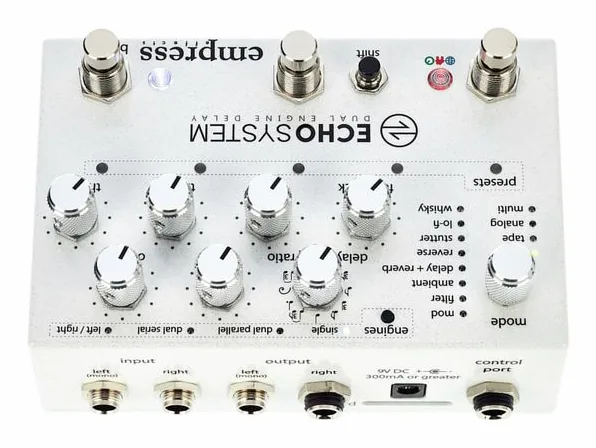
Perhaps the defining feature is the dual-engine architecture. You can simultaneously run any two delay engines, set in serial, parallel, or true stereo (one delay on left, one on right). This alone unlocks combinations that would require two or three pedals in a conventional setup. In a stereo rig, the pedal shines: blend a lush, modulated ambient delay on one side with a brittle lo-fi echo on the other, or layer subtle tape repeats with aggressive digital slicing for experimental textures. Thanks to its stereo ins and outs, the pedal is equally at home in front of a boutique amp or as part of a sophisticated studio effects chain.
- 35 programmable presets (user-assignable and overwrite-ready)
- Full stereo input/output, with flexible routing
- Series, parallel, or split/dual-channel operation
- Algorithms for vintage tape, analog, modern digital, shimmer, reverse, and more
Hands-on Interface and Control
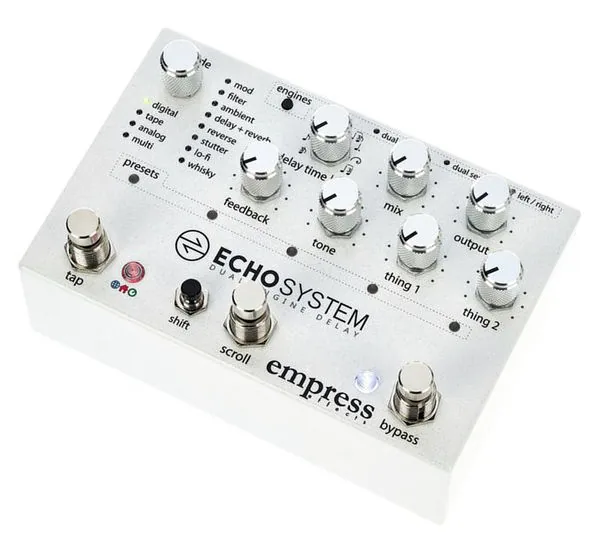
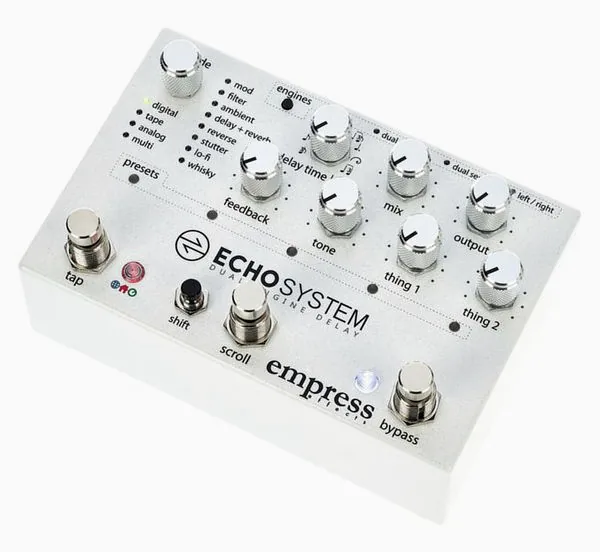
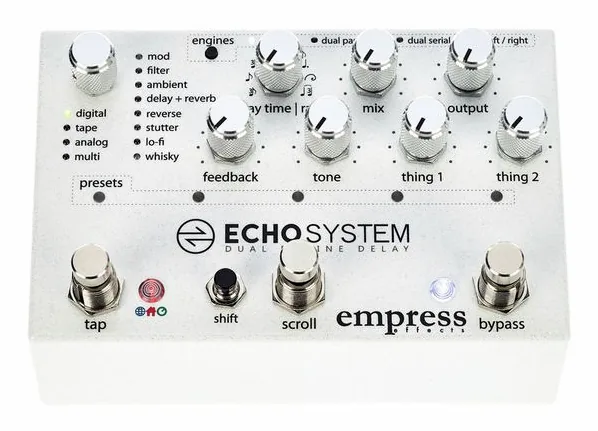
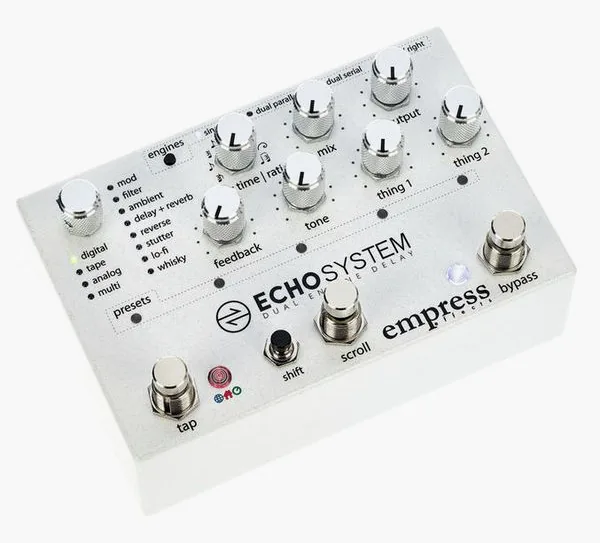
The Echosystem's control surface consists of six main knobs (Mix, Output, Feedback, Tone, Thing 1, Thing 2), mode selectors, and three footswitches (On/Off, Scroll, Tap). There is no display; instead, LEDs in various colors signify modes, presets, and status. While some lament the lack of a screen, many appreciate the tactile immediacy, what you see is what you get. Learning the system takes a bit of time: navigation relies on these LEDs and knob assignments, which shift depending on the current mode. Users repeatedly note a noticeable but rewarding learning curve. After a few days, recalling and editing presets or switching between dual-engine structures feels surprisingly natural.
- Tap tempo (precise, responsive, supports subdivisions)
- Expression pedal (assignable to multiple parameters)
- True bypass or high-quality buffered bypass settings
- No menu diving, parameters are knob-accessible
Features for Creative Workflows
A feature that sets the Echosystem apart: onboard firmware is user-updatable via SD card (V30-rated or better), allowing Empress to release new delay types and optimizations over time. The looper, available through firmware update, adds further versatility. Integration with MIDI (via TRS, with optional Empress MIDI box) and control voltage expands the pedal's role into the territory typically reserved for rack gear. Users report great results across instruments: from electric guitar and bass to synthesizers and studio outboard.
Sound and Performance in Real Settings
Feedback from professionals and enthusiasts consistently highlights the Echosystem's sonic quality and flexibility. The classic vintage emulations (Binson, Echoplex, tape, and bucket brigade delays) are praised for their warmth and authenticity. Modern, experimental algorithms, pitched, reversed, stutter, bit-crushed, or shimmer delays, are equally convincing, with organic transitions and inspiring unpredictability. In band settings, the Echosystem cuts through the mix with definition, and in studio use, it respects source tone, never masking or muddying the signal, whether on guitar, synth, or even vocals.
Stereo capabilities are a standout, enabling dramatic ping-pong effects or complex spatial textures across two amps or channels. The pedal's ability to assign two engines to completely independent paths opens up both classic and innovative sounds. Factor in the intuitive handling of tap tempo and parameter changes via expression pedal, a boon for live use and improvisation.
Build Quality and Real-World Usability
Physically, the unit is rugged. The compact enclosure (145 x 95 x 44 mm, 1.5 lbs) is tank-like, owing to a solid chassis and durable switches. Still, the closely set knobs and footswitches can crowd large feet, especially on packed pedalboards. The absence of a power supply in the box is a notable quirk given the price, purchase a standard 9V DC adaptor separately.
Some users criticized the feel of the rotary encoders, finding them a touch loose, but reliability is generally excellent. Should issues arise, Empress support earns high marks for responsiveness and firmware updates routinely add new features or fix minor bugs.
Drawbacks and Learning Curve
No pedal is perfect. The lack of a text screen makes precise management of numerous presets or detailed time settings less immediate compared to competitors (like the Strymon Timeline, for instance). Preset recall depends on learning the LED color scheme. Advanced functions (like firmware updates or deep MIDI configuration) do require visits to the online manual and patience, especially for those unfamiliar with SD card formatting or MIDI routing.
Despite the initial overhead, the interface rewards users who invest time. If you crave quick, plug-and-play classic slapback and nothing more, Echosystem may feel like overkill. For those hungry for infinite delay combinations, custom routing, and evolving sound possibilities, there's nothing else that comes close.
Conclusion: The Echosystem in the Modern Setup
Empress Effects' Echosystem is a creative engine in pedal form, powerful enough to anchor any board or studio effects chain. It balances fidelity, depth, and flexibility in a way few rivals can match. Yes, there are quirks: you'll need to study the manual and provide your own power supply. But for players seeking expressive, evolving delays and unmatched sonic territory, the Echosystem is a benchmark, one that continually grows with each firmware revision. Highly recommended for the dedicated musician or producer with a taste for both classic staples and boundary-pushing sounds.
Shipping and duties
The retailer ships from its warehouse in Germany. Prices are shown in US dollars and do not include import duties. Orders under roughly $800 usually clear US customs without duty; above that, a duty of a few percent may be collected on delivery. 30-day money-back and a 3-year warranty apply.
Scores by area
Where it shines, where it stumbles
What convinced me
- Exceptionally wide range of delay types, from studio-quality digital and tape to experimental textures
- Dual delay engines can be routed in series, parallel, or stereo for unparalleled sound design
- Extremely versatile, suitable for guitar, synths, vocals, and studio work
- Strong, compact build quality with robust casing
- Firmware updates add new features and delay modes, ensuring long product life
What bugged me
- Learning curve is steep due to lack of display and high feature count
- Preset selection can be cumbersome live, as color-coded LEDs replace a more readable screen
- No power supply included despite high price, increasing overall cost
- MIDI requires an external box for full implementation; only one jack for MIDI or expression
- Some factory presets and parameters (like minimal delay times) are hard to fine-tune
Is it the right one for you?
Good pick if
Ideal for advanced or experimental musicians, studio producers, and anyone who needs a vast palette of delay effects in one reliable unit. Particularly suitable for those willing to invest time in learning its interface and for multi-instrumentalists using stereo rigs or complex pedalboards.Look elsewhere if
Not recommended for players needing ultra-simple, plug-and-play operation or those who change settings frequently on stage without external controllers. If you primarily want analog delay sounds or require a built-in display for easy editing, alternatives may offer a better fit.Suggested level: Professional
Specifications
- Analog
- No
- Delay time
- 2,8 s
- Tap feature
- Yes
- Battery operation
- No
- Psu included
- No
What other players say
Feedback from users overwhelmingly emphasizes the Echosystem's unparalleled range of high-quality delays, dual-engine flexibility, and robust construction. Many say it replaced multiple pedals on their boards and works seamlessly for guitar, synths, and studio applications. Experienced users praise the intuitive knob-based controls after an initial learning period, while newcomers caution about a steep learning curve and less convenient live preset recall. Some mention minor hardware concerns and frustration with the lack of an included power supply, but overall impressions are very positive, with particular appreciation for ongoing firmware updates and customer support.
I was able to take 3 delays pedals off my board because of what the Echosystem can do.
The ability to run two delays (any two you want) in parallel, series or split (one left one right).
You get one delay with clear repeats, and one that smooches on in the background!
Up close
Watch and listen
Before you decide
Questions players ask
Is the Empress Echosystem suitable for live performance?
It is fully capable for live use, but preset switching can be less immediate than screen-based pedals, so users performing live may want to consider external MIDI controllers.
Does it support true stereo operation?
Yes, it features stereo inputs and outputs, and lets you apply separate delays to left and right channels for expansive soundstage effects.
How difficult is the interface to use?
The knob-based interface becomes intuitive with practice, but initial setup and navigation require learning the color code system and functions due to the lack of a display.
Can firmware updates really add new sounds or features?
Yes, Empress regularly provides updates that introduce new delay algorithms and functions, but you need a compatible SD card to perform updates.
Does the Echosystem ship with a power supply?
No, a 9V DC power supply must be purchased separately, which some users find frustrating given the premium price.
The last word from the bench
The Empress Effects Echosystem is a powerhouse delay unit that excels in both sound quality and creative potential. Its dual engine design and huge variety of algorithms set it apart for players seeking depth and versatility, across genres and instrument types. While its interface requires investment to master, users report ongoing rewards and inspiration. The only drawbacks are a more involved workflow and the absence of a power supply at purchase, but for most, the sonic possibilities far outweigh these caveats.
Hanging next to it
Empress Effects Echosystem
Today's price and delivery time are shown at the retailer.
 Guitar Gear Reviews