Boss MS-3 Multi Effects Switcher
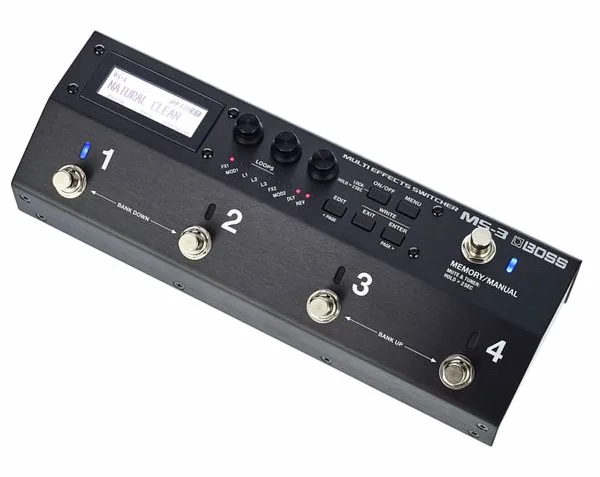
The Boss MS-3 delivers big flexibility in a small form, combining high-quality effects and robust switcher features for guitarists and bassists who want hybrid, organized pedalboards.
★★★★★ 4.6/5 · 45 buyer reviews · 8 min read · updated 2026-10-07 · Tested by Cal Whitaker
Overview: A Compact Pedalboard Core
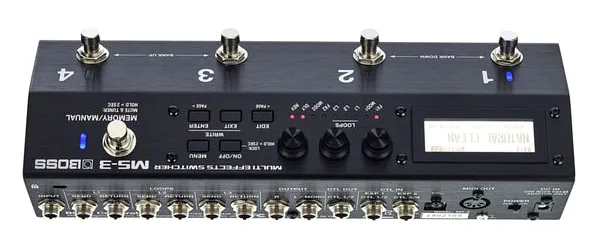
The Boss MS-3 Multi Effects Switcher is engineered as the heart of a flexible pedalboard, merging multi-effects processing with three external loop paths and extensive control options. Launched in 2017, the MS-3's solid metal floorboard design houses a wide array of Boss effects alongside connectivity for MIDI, USB, and external switches, all in a device that fits in most gig bags, weighing just 1.1 kg with dimensions of 275 x 97 x 68 mm. It targets musicians who want both the depth of programmable effects and the ability to seamlessly integrate their favorite analog pedals.
Main Features and Connectivity
- Effects Engine: Includes nearly the entire Boss catalog, compressors, limiters, distortion and overdrive, modulation, delays, reverbs, equalizers, utilities like noise suppression, and a chromatic tuner. Effects for both guitar and bass are onboard, covering different frequency responses.
- Loops: Three external effects loops with send/return jacks (6.3 mm) enable inclusion of analog favorites or amp preamps. The loops are fixed together in the signal chain, a practical limitation for complex setups but sufficient for most hybrid rigs.
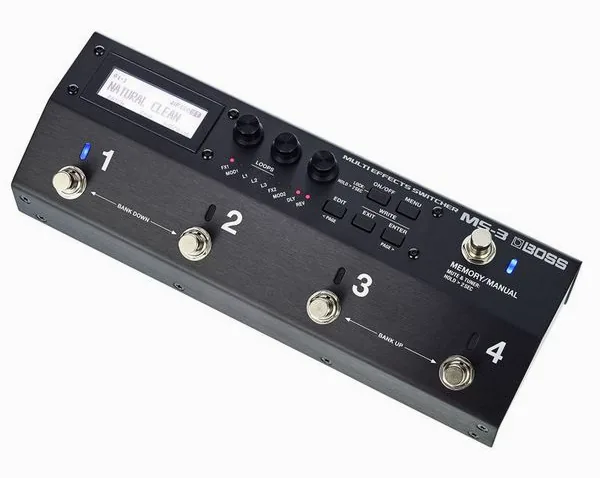
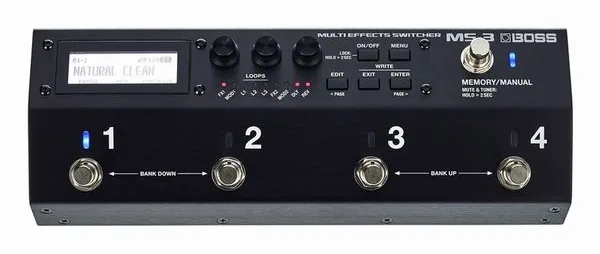
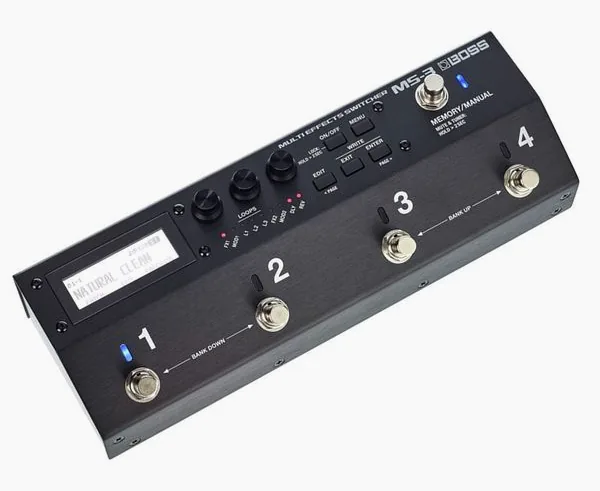
- Control: Four footswitches (for preset and manual modes), knobs for menu navigation, and the ability to add up to four external switches or expression pedals via dedicated stereo jacks. Functions are freely assignable, including amp switching and MIDI commands.
- Connectivity: Features MIDI out, USB type B for editor/librarian usage (no Bluetooth or app support), CTL (control) outputs, and stereo main outputs. Headphone out is absent, with all outputs via 6.3 mm jacks.
- Power and Build: Powered by an included 9V power supply (no battery option), with a power draw of 280 mA. Construction is all-metal, with robust jacks and reliable switches, consistent with Boss's reputation.
Programming and Workflow
The MS-3 presents two principal usage modes: preset memory for recalled combinations and a manual mode for live "stompbox" access. Programming can be performed directly using three continuous rotary knobs and a small, bright LED display, simple for basic patch creation, but less efficient for deep parameter editing or quick adjustments in a rehearsal or stage environment. The desktop editor, accessible via USB, streamlines patch management and detailed parameter assignment, becoming essential as effect routing or MIDI mapping grows more sophisticated.
The lack of a mobile app or Bluetooth feels restrictive next to newer units, and real-time editing in a live context can be cumbersome due to the small screen and menu structure. Knobs are endless encoders rather than stepped, leading to occasional overshooting of parameter targets, and some users find the physical spacing of the footswitches too tight for secure operation onstage.
Sound Quality and Routing
Boss's digital processing in the MS-3 provides clean, noise-managed sound with imperceptible latency and reliable A/D conversion. The unit is strongly buffered at input and output, preventing typical signal loss when running long pedal chains or interacting with vintage pedals. Effects quality is largely in line with Boss's standalone pedals: delays, reverbs, modulations, compression, and EQs are strong and gig-worthy. Overdrives and distortions are entirely usable for most, though analog purists may still favor independent pedals for their core tones.
Some users notice a modest darkening of tone, a high frequency roll-off around 5 kHz, especially evident on acoustic or semi-acoustic guitars. This is the trade-off from dual digital conversion (A/D and D/A) inherent to the signal path. Users particularly attuned to clarity and "sparkle" in their clean sounds may want to experiment with the MS-3's global equalizer to compensate.
Loop Routing is mostly fixed: all three loops must be grouped, and you cannot freely disperse them among internal effects in the chain. Effects can always be repositioned before or after the group of loops, granting most common modern routing arrangements, including four-cable method (for preamp/post effects), although this consumes one loop, reducing available slots for external pedals.
Control and Integration in Practice
- Foot Control: Up to four built-in footswitches, plus up to four external for expanded bank changes or toggling individual effects. Functions per patch are highly programmable; e.g., converting one tap into a solo boost, MIDI change, or activation of a loop effect.
- MIDI and Amp Switching: The MS-3 can issue MIDI program and control change messages, enabling scene changes on amps, multi-effects or even sequencers. Channel switching for most amps is possible either through TRS control jacks (for relay/outboard switching) or via MIDI for compatible models.
- PC Integration: The USB editor (Windows/macOS) is stable and highly functional, making large-scale preset management straightforward. Direct USB audio or recording functions are not present.
Performance on Pedalboards and Live
In real-world scenarios, the MS-3 has a reputation for reliability and flexible integration. Players frequently reduce pedalboard real estate and simplify cable routing by combining essential Boss effects with choice analog pedals in the loops. Live, the switcher allows instant recall of complex settings, no more tap dancing across multiple pedals between songs. MIDI and amp control work dependably, and the unit's solid hardware survives even heavy gigging.
Some complaints remain regarding ease of navigation on the small screen, particularly under low light, and the lack of spillover tails on delay and reverb when switching patches. For players who rely on rapid scene/chart changes or want per-effect instant access, the four onboard switches may feel limiting unless expanded with external controllers. There is also no MIDI input for running the MS-3 as a slave to another controller, something to consider for those needing full MIDI integration.
Conclusions
The Boss MS-3 stands out as a highly versatile hub for building modern hybrid pedalboards. It marries the practicality of programmable digital effects with flexible analog integration, excelling where space, weight, and simplicity are crucial. Sound quality is high for the category, and core functions (especially delays, reverbs, modulation, and MIDI/Amp switching) compete effectively with more expensive and bulkier rivals.
Limitations in loop routing, lack of advanced connectivity (Bluetooth/app), occasional tone coloration, and minor hardware ergonomic issues are outweighed for most by the MS-3's tight form factor, rugged reliability, and editing power. Perfect for working players who need broad sonic control, swiftly recallable setups, or a downsized stage rig without sacrificing essential pedal flavor.
Shipping and duties
The retailer ships from its warehouse in Germany. Prices are shown in US dollars and do not include import duties. Orders under roughly $800 usually clear US customs without duty; above that, a duty of a few percent may be collected on delivery. 30-day money-back and a 3-year warranty apply.
Scores by area
Where it shines, where it stumbles
What convinced me
- Extremely compact and sturdy floorboard design, ideal for modern pedalboards
- Includes more than 100 high-quality Boss effects with deep parameter control
- Allows integration of up to three external pedals in loops, along with MIDI and amp channel switching
- Highly flexible routing options and programmable footswitches for maximum versatility
- PC/Mac editor simplifies patch management and deep editing
What bugged me
- Series-only loop arrangement limits full routing flexibility
- Interface and menu navigation can be cumbersome, especially without the computer editor
- No amp modeling or drum machine, and no Bluetooth or mobile app support
- Small screen with basic UI, needs time to learn deep functions
- Noticeable gap when switching presets; no delay/reverb spillover
Is it the right one for you?
Good pick if
Ideal for guitarists and bassists who require quick access to a large selection of effects while keeping their board compact, especially those integrating analog pedals with digital control. Highly recommended for gigging musicians, cover bands, and players who value versatile signal routing, amp channel switching, and MIDI capabilities.Look elsewhere if
Not recommended for purist analog enthusiasts or those needing total flexibility in loop arrangement. Players who rely heavily on seamless preset transitions, amp modeling, or prefer an intuitive, modern touchscreen or mobile interface may find it limiting.Suggested level: Intermediate
Specifications
- Design
- Floorboard
- Amp modeling
- No
- Drumcomputer
- No
- Incl. tuner
- Yes
- Expression pedal
- No
- Usb-port
- Yes
- Headphone output
- No
- Midi interface
- Yes
- Line out
- No
- Battery operation
- No
- Psu included
- Yes
- Type
- Looper
- Led display
- Yes
- Psu connector
- Yes
What other players say
Customer feedback consistently highlights the Boss MS-3 as a well-built, compact solution for combining high-quality digital effects and pedal switching. Users praise its flexible PC/Mac editor, wide array of usable effects, robust integration of external pedals, and ease of programming complex setups. The main criticisms include rigid loop arrangement, a learning curve for the interface, and preset switching gaps. Overall satisfaction is high, especially for users seeking to streamline or modernize their pedalboards without full digital systems.
The flexibility and (once set up) simple operation of the MS-3, especially given the compact size, outweighs everything else for me.
Sound: Lots of Boss effects available in this unit which mostly sound great and with high fidelity also in terms of its digital converters.
It's nicely built, and the effects inside are very good - although the rotary sounds are nowhere near as nice as the Boss RT-20.
Up close
Watch and listen
Before you decide
Questions players ask
Can I individually place each external loop anywhere in the effects chain?
No, the three effects loops are arranged together in the signal path and cannot be separated or placed between internal effects; all loops must be grouped.
Does the MS-3 support spillover for delay and reverb when switching presets?
No, there is an audible gap when changing presets, and effects like delays and reverbs do not spill over between patches.
How user-friendly is the MS-3 for on-the-fly setup and live use?
While general use is straightforward, deep editing and setup are easier using the PC/Mac editor; the onboard interface can be time-consuming to navigate in live scenarios.
Can I use the MS-3 to change amp channels or control other devices via MIDI?
Yes, the MS-3 can switch amplifier channels and send MIDI commands to external devices, making it suitable as a full pedalboard controller.
Are the built-in effects suitable for both guitar and bass?
Yes, internal effects are categorized for guitar and bass, with specific versions for low frequencies, making the unit suitable for both instruments.
The last word from the bench
The Boss MS-3 Multi Effects Switcher stands out as a compact and highly versatile centerpiece for modern pedalboard setups, offering both an impressive array of internal effects and integration with your favorite pedals. While the software editor streamlines much of the deep configuration, the on-device interface can feel dated and limited, with preset switching gaps and series-only loop routing as notable drawbacks. Despite these, the overall build, sound quality, and connectivity deliver a premium experience, making it excellent for musicians who demand efficient control and maximum versatility. For players prioritizing compactness and hybrid pedalboards over ultimate analog purity or the very deepest routing, it's a top recommendation.
Hanging next to it
Boss MS-3 Multi Effects Switcher
Today's price and delivery time are shown at the retailer.
 Guitar Gear Reviews