Source Audio One Series Nemesis Delay ADT
A sonically exceptional, feature-rich stereo delay undermined by worrying software reliability issues.
★★★★★ 4.5/5 · 6 buyer reviews · 8 min read · updated 2026-10-07 · Tested by Cal Whitaker
Introduction: Delay Powerhouse with Analog Clarity
The Source Audio One Series Nemesis Delay ADT brings an imposing combination of digital versatility and analog clarity to the table, targeting musicians who demand extensive delay options with a premium sound path. Released in January 2024, this unit stands out from its predecessor thanks to a dedicated analog dry signal routing. It comes in at a price of $341 and is designed for both straightforward and highly experimental delay application. This evaluation puts the ADT version through its paces in studio and live contexts, paying special attention to sound, performance, interface, and reliability.
Hardware Build and Connectivity
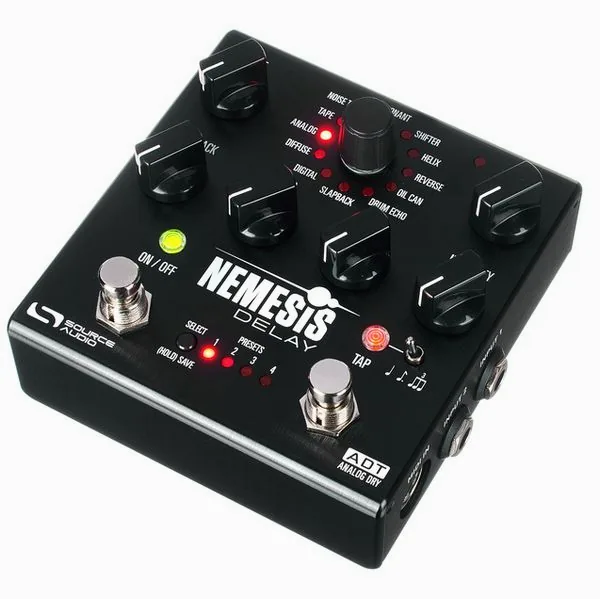
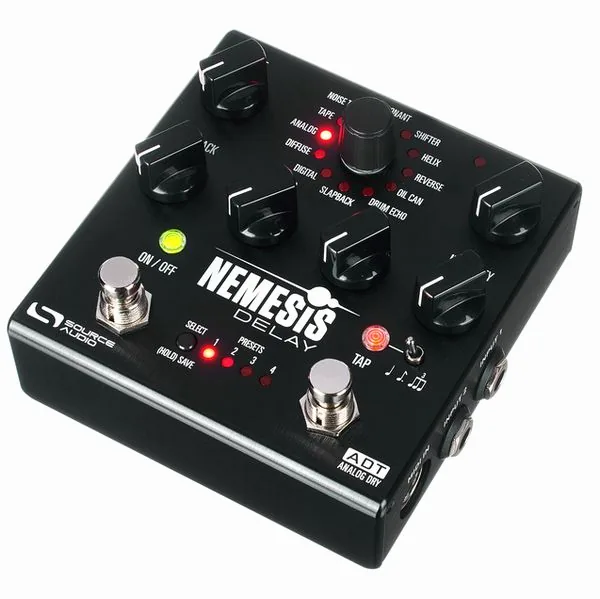
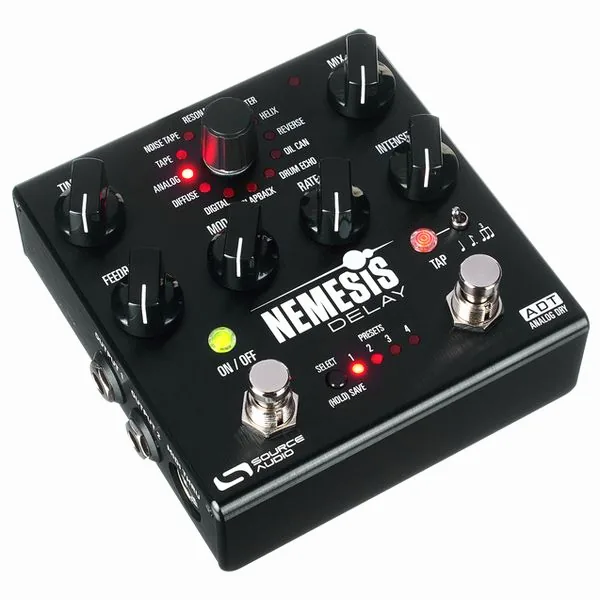
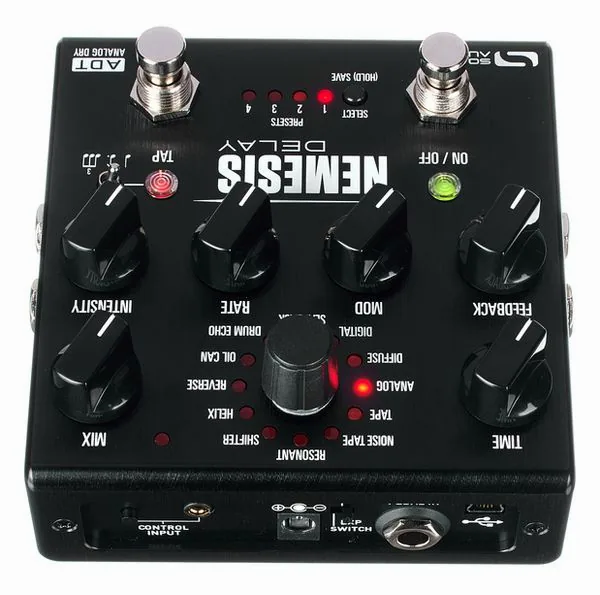
The pedal impresses with a brushed, anodized aluminum chassis that feels reliably robust in hand and underfoot. At 450 grams, it is substantial yet compact (dimensions: 114 x 114 x 51 mm). The stereo input and output use 6.3 mm jacks, secured by hardware mounting, which translates to solid long-term durability and reassuring cable retention. In addition to standard audio connections, the Nemesis Delay ADT is equipped with MIDI In and Thru, a mini USB port (Type B), a 6.3 mm TRS jack for expression pedal or footswitch, a 3.5 mm control port, and supported external control via compatible Source Audio devices.
One recurring user comment is that the placement of audio and MIDI inputs/outputs on opposing sides hinders efficient cable management, particularly on crowded pedalboards or in a rack setting. The use of a mini USB port in 2024 stands out as a dated choice, especially for users accustomed to USB Type-C integration across newer audio gear. Notably, the included extras, USB Type A to B cable and 3.5 mm to 6.3 mm TRS cable, offer flexibility in initial setup, but no power supply is included. The device draws power from a 9V DC (center negative) supply at 200 mA minimum, so a quality pedalboard power source is a must.
Controls and Operation
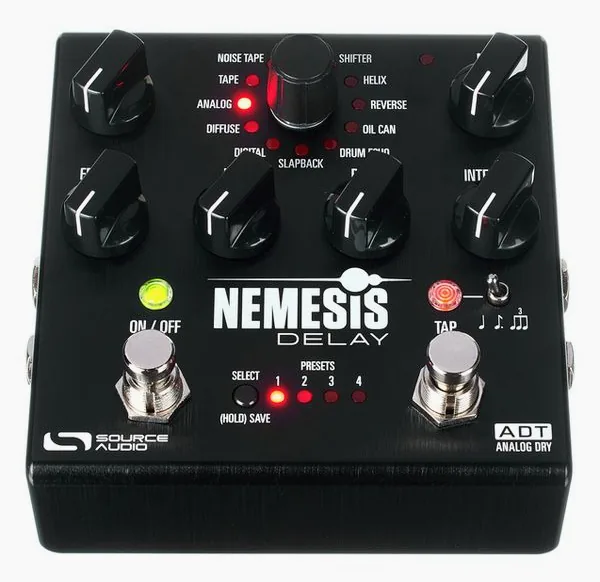
- Physical knobs: Time, Feedback, Modulation, Rate, Intensity, Mix, Engine select
- Subdivision switch for quarter, dotted eighth, or triplet tap tempo
- Two footswitches: main bypass and tap tempo
- Preset Bank-Select button: toggling among four hardware-accessible presets
- "Hold" function for infinite repeats
The UI is immediately familiar to experienced delay users. Essential real-time performance functions are right on top, and core navigation, switching engines, editing basic parameters, receives logical hardware placement. One limitation: only four user presets are directly accessible using on-device controls. Deep editing requires MIDI or the Neuro app.
Features & Engine Power
The Nemesis Delay ADT is digital at its core, except for the newly introduced analog dry signal feature. The impact is distinctly audible: the unaffected sound enjoys zero latency or digital coloration, ensuring instant switching between wet and dry with no loss in signal integrity, a major advantage over pure digital units in critical live or studio takes.
Delay time tops out at a practical 1.2 seconds. The pedal houses 12 integrated delay engines (from classic tape and analog to modern digital and diffusion textures), plus access to 14 more engines via the Neuro app (iOS, Android, Mac, PC). Signal processing runs 56-bits internally with a 24-bit delay line, yielding a clear, dynamic, and noise-free output. Tape, oil can, analog, and crushed echo flavors are all packed in, each fully tweakable across multiple parameters. The analog dry-through mode safeguards your core tone even during complex effect processing.
Integration is a core strength: full MIDI control offers access to 128 presets and parameter automation, making the Nemesis a strong candidate for synchronized setups or DAW-linked instrumentation. USB connectivity allows for deep patch management and firmware updates. Sadly, only four presets can be banked at the stompbox level; everything beyond requires MIDI or software intervention.
Neuro App and Software Integration
The pedal's true depth comes alive when interfaced with the free Neuro desktop or mobile software. Users can tweak every engine in detail, assign custom behaviors to hardware switches, and access a shared library of community presets. The learning curve is moderate, the desktop app is functional but not as fluid or intuitive as the pedal's onboard controls. With MIDI or USB interfacing, preset management grows exponentially: up to 128 patches, complex routings, and external clock sync all come into play.
The main drawback is the continued use of a mini USB interface, along with reported instability when using the mobile app via the supplied TRS audio cable, especially with certain Android or iOS devices. On desktop, connection is reliable. Direct, visual feedback of preset status is absent, a simple display could markedly improve live usability and prevent confusion when scrolling beyond four on-board presets.
Performance and Sound Quality
- Wide, articulate stereo image with natural dry signal integrity
- Tape and analog delay simulations produce warm, musical trails with convincing modulation
- Diffusion and oil can algorithms excel in ambient or experimental roles
- Depth, three-dimensionality, and sonic adaptability to any genre or instrument
Sound is the chief strength of the Nemesis ADT. From subtle slapbacks to complex cloud-like reverbs, the pedal produces polished results without fuss. Even under aggressive parameter changes, noise and digital artifacts are minimal, and the tape algorithms bear close comparison to premium competition (such as Strymon's El Capistan).
Reliability and Stability Concerns
No piece of gear is without fault, and here significant user feedback brings serious issues to light. In heavy editing scenarios, especially when pushing parameters in "Diffusion" or "Crushed Echo" engines, the pedal's DSP can overload and crash. In these situations, the effect output disappears entirely; only the analog dry signal remains. The only fix is deactivating/rebooting the effect, hardly practical mid-performance.
While these issues are reportedly rare under typical use, they do undermine confidence, especially for live applications. Some users report flawless operation; others found the instability reproducible within hours. For risk-averse professionals or anyone with mission-critical live needs, this could be a dealbreaker until Source Audio issues firmware updates or stability fixes.
Conclusion
The Source Audio One Series Nemesis Delay ADT presents an enticing blend: stellar sound, deep customization, and solid hardware. Its analog dry signal path and robust feature set make it ideal for those who value tonal purity and extensive editing. However, software stability remains a significant caveat. For sound experimenters and studio users, its tone and flexibility are exceptional, if you're willing to work around a dated USB port and the occasional crash risk. For anyone demanding failsafe reliability in live sessions, alternatives may be better suited.
Strengths:- Outstanding stereo sound and creative delay engine selection
- Analog dry-through ensures natural, latency-free signal
- Broad editing and MIDI integration
- Physical build quality above average
- Software instability with certain presets/parameter extremes
- 4-preset limit on the pedal; confusing interface with external control
- Mini USB port feels outdated
- No onboard display for full preset management
- Connection placement complicates cable routing
Shipping and duties
The retailer ships from its warehouse in Germany. Prices are shown in US dollars and do not include import duties. Orders under roughly $800 usually clear US customs without duty; above that, a duty of a few percent may be collected on delivery. 30-day money-back and a 3-year warranty apply.
Scores by area
Where it shines, where it stumbles
What convinced me
- Outstanding sound quality and depth with organic feel
- Versatile stereo delay featuring an analog dry signal path
- Extensive editing options via Neuro software, including 26 delay types
- MIDI integration and expression pedal support
- Sturdy build with secure, screwed input/output jacks
What bugged me
- Reproducible software crashes with certain parameter combinations
- Outdated Mini USB port
- Only four presets accessible directly from the device
- Illogical placement of audio and MIDI ports makes cable management harder
- No visual display showing loaded presets
Is it the right one for you?
Good pick if
Ideal for tone-seeking musicians, experimental players, studio producers, and anyone needing lush, tweakable delay textures with immediate satisfying results. Suitable for both creative sound design and traditional delay uses, especially users who work primarily in controlled settings or are comfortable editing with software.Look elsewhere if
Not intended for performers demanding iron-clad reliability for critical live or recording use, nor for those who need onboard visual preset management or modern USB-C/Bluetooth. Also may frustrate users seeking completely menu-free stompbox workflows.Suggested level: Intermediate
Specifications
- Analog
- No
- Delay time
- 1,2 s
- Tap feature
- Yes
- Battery operation
- No
- Psu included
- No
What other players say
Users consistently highlight the Nemesis ADT's lush, versatile sound and intuitive controls, with particular praise for its tape and analog emulations and creative depth. Many are impressed with its straightforward operation out of the box and the extended functions available via the Neuro software and MIDI. However, several reviews underscore frequent software crashes under certain parameter conditions, causing effect dropouts and reliability anxiety, especially for studio or live contexts. Hardware quality and stereo/analog-dry architecture are appreciated, but practical drawbacks like the mini USB port and port placement are repeatedly criticized.
Wide, dense delays with outstanding tape and analog emulations, the 'Oil Can' engine sounds excellent with a gritty 303, and the diffusion engine creates massive, spherical spaces.
Despite the impressive sound, the software quality of the pedal is disappointing. After only a few hours, I could reproducibly crash the effect engine by turning up feedback and modulation.
If you want a versatile, fantastic-sounding, simple-to-use delay and can do without a display, you should definitely go for the Nemesis ADT.
Up close
Watch and listen
Before you decide
Questions players ask
Does the Nemesis ADT allow for real-time parameter control with expression pedals?
Yes, it features an expression pedal input for morphing between settings or controlling single parameters, fully assignable via onboard controls or the Neuro app.
How many presets can be stored and recalled?
You can store and instantly recall eight onboard presets, or up to 128 via MIDI, with further extensive editing and saving via the Neuro app.
How reliable is the pedal in live performance situations?
Multiple user reports document software instability under specific settings, causing effect dropouts. While basic use is stable, demanding setups risk crashes, this may present issues live.
Is it possible to update the firmware or fix software issues?
Firmware updates and parameter tweaks are possible via the USB port and Neuro app, though as of now, software-related crashes remain a concern for demanding users.
What is included in the box?
The package includes the pedal, a USB Type A to Type B cable, a 3.5 mm to 6.3 mm TRS cable, stickers, a manual, and a compact power supply (though use of your own 9V DC adapter is also needed).
The last word from the bench
Source Audio One Series Nemesis Delay ADT delivers top-tier delay tones, a vast palette of effects, and deep editability, especially with analog-dry stereo implementation. However, persistent software crashes and a lack of onboard preset visibility seriously compromise its dependability for live or studio use. The hardware and control layout are solid but are hampered by outdated connectivity and challenging cable management. If rock-solid performance is urgent, alternatives may be safer, otherwise, this is a powerhouse with risk worth weighing.
Hanging next to it
Source Audio One Series Nemesis Delay ADT
Today's price and delivery time are shown at the retailer.
 Guitar Gear Reviews