KMA Audio Machines Cirrus Delay and Reverb
The Cirrus Delay and Reverb delivers highly creative soundscapes and deep modulation, with extensive control and solid value. Not for those needing dead-simple usability or stereo operation.
★★★★★ 4.7/5 · 28 buyer reviews · 7 min read · updated 2026-10-07 · Tested by Cal Whitaker
KMA Audio Machines Cirrus Delay and Reverb: A Full Test
KMA Audio Machines' Cirrus Delay and Reverb packs an unusual mix of advanced features into a compact enclosure. Positioned at a mid-range price of $194, it targets tone crafters who demand more than basic ambiance. After extensive hands-on exploration, including layered pedalboard setups and single-instrument runs, here's how the Cirrus stacks up for serious players and experimenters alike.
Design, Build, and User Interface
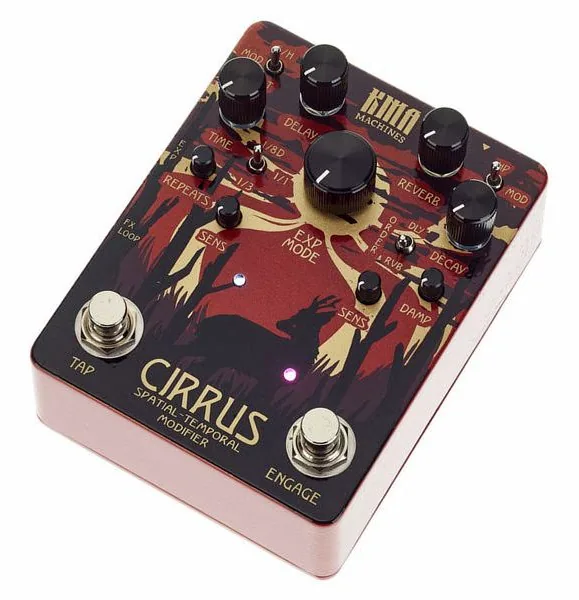
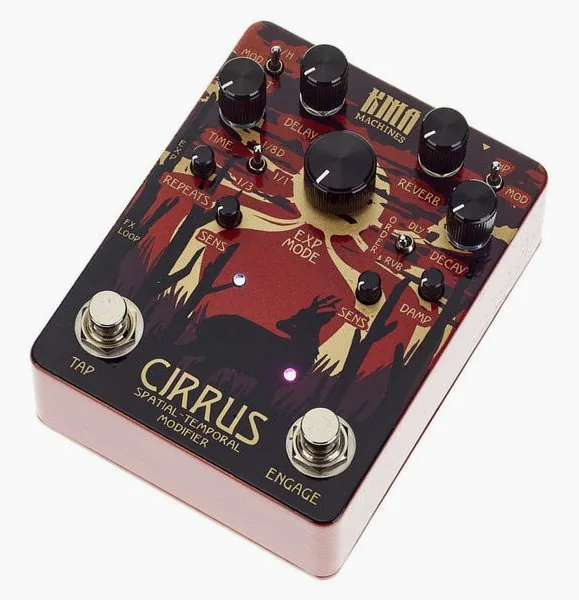
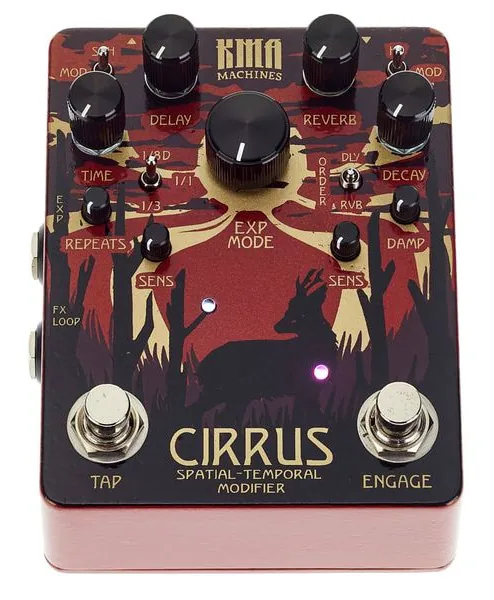
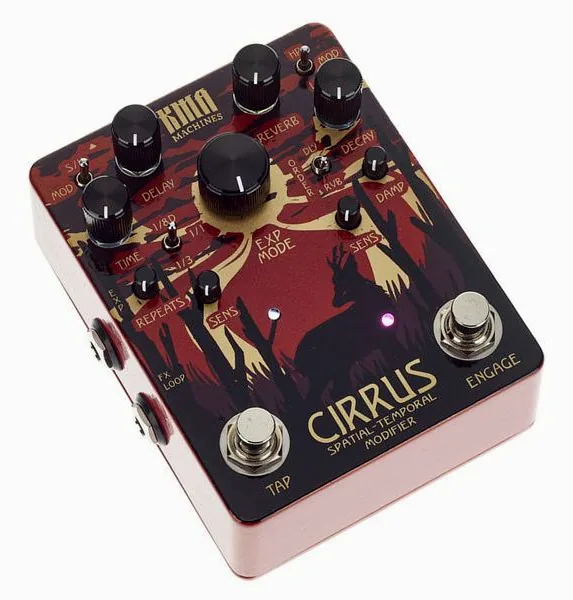
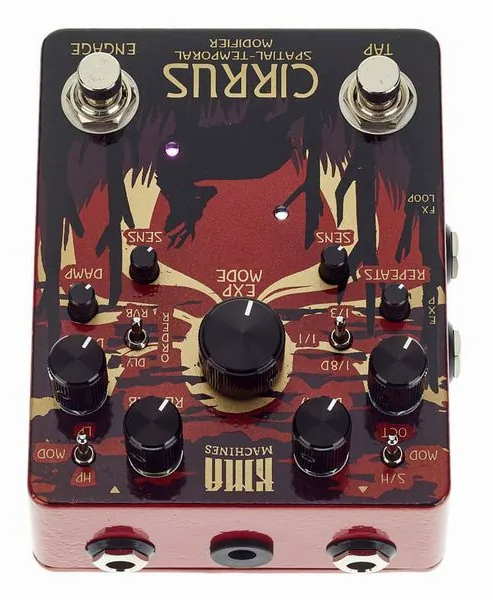
The Cirrus comes in a sturdy, solid-feeling enclosure measuring 90 x 120 x 62 mm and weighing 420 grams. Manufactured in Germany, it carries the sense of reliability found in boutique-grade pedals, with a detailed graphical design and clear control labeling that appeal to both studio and stage environments. All jacks are standard 6.3 mm (mono in/out, expression, and dual effects loop), with power supplied by a 9-volt DC adapter (not included). There is no option for battery operation, understandable given the circuit's digital nature and 220 mA current draw.
Controls are extensive but logical, with separate Delay and Reverb sides, each offering primary effect knobs plus a global Mix dial. Physical toggle switches select between three reverb types and three types of delay, while additional switches control effect order, allowing the reverb to precede or follow the delay. There's also footswitchable bypass and tap tempo, each doubling as an access point for swell/repeat maxing functions if held. For dynamic players, attack- and sensitivity-controlled modulation, assigned with the Sens and Attack controls, make Cirrus highly interactive with your playing style.
Delay Section: Versatility Above Standard
The delay module is strictly digital, reaching up to 1500 ms of delay time. One standout is the mode selector offering different character flavors, including classic echoes, modulated repeats, and a unique octave-shifted delay. The inclusion of tap tempo with subdivisions (quarter, dotted eighth, triplet) opens rhythmic flexibility, though multiple users report the tap function takes time to master: inputting the desired tempo is less straightforward than on simpler designs. Delay repeats can be maxed out by holding the related footswitch for oscillation effects, a creative live option.
Reverb Module: From Subtle Tails to Celestial Washes
Reverb offers three modes as well, each with its own ambient scope: conventional room, a continuous ambient wash, and one with extended decay. The Decay and Damp controls allow for shaping the tail and brightness, supporting everything from subtle space to overwhelming texture. Particularly notable is how the reverb interacts with the Sensitivity and Attack settings; striking the strings harder or softer actively changes the depth or modulation, creating reverb effects that are anything but static.
Advanced Features: Modulation, FX Loop, and Expression Pedal
- Effect Loop: Separate send/return paths let users insert other pedals between delay and reverb, radically changing the sonic outcome. This enables, for example, placing overdrives or modulation between the two ambient stages, a rare feature at this price point.
- Expression Input: A stereo jack allows parameter sweeps with an external expression pedal. Depending on the mode and assignment, this can morph anything from mix and sensitivity levels to delay/reverb intensity mid-performance.
- Switchable Effect Order: A physical switch changes the processing chain between delay-into-reverb or the reverse, resulting in two fundamentally different textures at the stomp of a switch.
- Internal Options: Inside the chassis, two switches swap between trails and true bypass, while internal trim pots provide additional tweaking.
Sound: From Classic to Experimental
Sonically, the Cirrus leans into atmospheric territory. Standard reverb and delay sounds are available with all modulation and sensitivity settings minimized, but the pedal is truly designed to thrive at the edges. The dynamic response (modulation and effect depth reacting to picking strength) is especially engaging for expressive players. When combining delay and reverb with higher sensitivity or in the more extreme modes, the pedal produces wall-of-sound, ambient textures well-suited to post-rock, shoegaze, or cinematic sound design.
In practical use, the pedal does not offer stereo output, so setups remain mono, which may deter certain ambient players chasing expansive panning effects. Another notable quirk: delay and reverb cannot be individually switched off via footswitch, users must roll the mix controls to zero, demanding forethought in layered or live settings.
Real-World Impressions: Feedback from the Field
Owners consistently praise the Cirrus for its creative scope and build quality. Its sound quality holds up even when run into other effect chains, and it accepts both guitar and unconventional instruments (like electric violin) gracefully. There is some division on usability: some find the interface brilliantly flexible and inspiring, while others report frustrations with the footswitch mechanism or tap tempo intuitiveness. Several users cite this as a better-value alternative to pricier ambient pedals, though a few wish for features like individual effect switching, preset storage, or stereo operation. Minor criticisms include occasional switch or knob issues and a learning curve for maximizing all available features.
Conclusion: Who Should Buy the Cirrus?
The KMA Audio Machines Cirrus Delay and Reverb stands out for players who want more than basic effects. Its carefully-considered interface, creative modulation parameters, and chain flexibility are particularly attractive to those building ambient, post-rock, or experimental soundscapes. While it lacks stereo outputs and has a steeper learning curve for some functions, its overall sound palette, robust construction, and innovative features make it a strong contender in the mid-priced dual effect segment.
For the price, few pedals manage to pack in as many creative tools or as much hands-on control. Those looking for traditional set-and-forget ambiance may want to explore simpler alternatives, but for dedicated sound architects, Cirrus offers a unique and inspiring workflow rarely matched at this price point.
Shipping and duties
The retailer ships from its warehouse in Germany. Prices are shown in US dollars and do not include import duties. Orders under roughly $800 usually clear US customs without duty; above that, a duty of a few percent may be collected on delivery. 30-day money-back and a 3-year warranty apply.
Scores by area
Where it shines, where it stumbles
What convinced me
- Extremely versatile with three distinct delay and reverb modes each, allowing for deep ambient and experimental sounds
- Controls are sensitive, responsive, and allow for in-depth sound shaping
- Supports dynamic playing: attack-sensitive responses create interactive soundscapes
- Sturdy build quality and appealing design, made in Germany
- Tap tempo and momentary functions for both delay and reverb, with footswitches for adjusting maximum decay/repeat
What bugged me
- No stereo output, which limits spatial options for some users
- Cannot independently switch off delay or reverb; requires mix knob adjustments for individual effect control
- Some users find the interface and footswitch operation unintuitive or cumbersome, especially the tap tempo and effect switching logic
- Small toggle switches can be accidentally moved
- Slight background noise possible, not totally pristine in every setting
Is it the right one for you?
Good pick if
Ideal for ambient, shoegaze, post-rock, and experimental musicians seeking to build lush, evolving soundscapes with intricate modulation. Also excellent for studio tinkerers and those who enjoy deep pedal tweaking and creative routing, especially with expression pedals and complex effect chains.Look elsewhere if
Not for live performers needing intuitive, easily accessible controls or those who rely on stereo operation and preset storage. Also unsuitable for anyone wanting instantly recallable sounds or plug-and-play simplicity.Suggested level: Intermediate
Specifications
- Analog
- No
- Delay time
- 1500 ms
- Tap feature
- Yes
- Battery operation
- No
- Psu included
- No
- Input/output configuration
- Mono in / mono out
What other players say
Customer feedback underscores the Cirrus as a feature-rich, robust, and highly versatile dual effect. Positive reviews focus on its inspiring sonic palette, sensitive controls, and suitability for experimental and atmospheric playing. Some frustrations center on the lack of stereo and the use interface, particularly tap tempo and effect switching logic. The build quality earns praise, though a handful of users report minor hardware and packaging issues. Overall, players see it as a unique, value-packed option for those who value creative modulation and sound design.
The versatility and the sensibility of the knobs is huge, I was never able to get the same sound twice.
Both the delay and the reverb remain very clear and distinct even with more complex distortions or effects.
If you're into Explosions in the Sky and Post-Rock, this is the thing!
Up close
Watch and listen
Before you decide
Questions players ask
Can I use the Cirrus Delay and Reverb as a standard delay or reverb, or is it only for ambient sounds?
Yes, with sensitivity controls set low, it functions as a straightforward delay and reverb, but its main strengths are creative and ambient uses.
Does it support switching between stereo in/out or saving presets?
No, Cirrus is strictly mono-in/mono-out and does not offer any preset storage or MIDI integration.
Is the tap tempo easy to use?
Opinions are mixed; some find the tap tempo unintuitive, with certain footswitch operations requiring a learning curve or more precision than average.
Can I switch the order of delay and reverb effects?
Yes, there is a dedicated toggle switch to place delay before or after reverb, which drastically changes the sonic result.
Will the Cirrus work well with an expression pedal and other external gear?
Absolutely; it accepts expression pedals for real-time control and has an effect loop for creative routing, making it flexible in complex setups.
The last word from the bench
KMA Audio Machines Cirrus is packed with features, offering highly interactive ambient textures and enough tweakability to suit experimental players, pedal enthusiasts, and those seeking unique combinations of delay and reverb. Build quality is generally impressive, and the value proposition is strong. Some operational quirks and a lack of stereo/MIDI may frustrate users with specific workflow needs or who want instant preset switching. For the adventurous and sound-driven, Cirrus stands out in its price range.
Hanging next to it
KMA Audio Machines Cirrus Delay and Reverb
Today's price and delivery time are shown at the retailer.
 Guitar Gear Reviews