Ibanez LD303 Layer Delayer
The LD303 Layer Delayer delivers deep sound design potential but is hindered by frustrating usability flaws and inconsistent build quality.
★★★☆☆ 3/5 · 2 buyer reviews · 7 min read · updated 2026-10-07 · Tested by Cal Whitaker
Ibanez LD303 Layer Delayer: Hands-on Test
The LD303 Layer Delayer from Ibanez enters the crowded multi-delay arena with a feature suite that targets both experimental guitarists and electronic musicians. Built as a strictly digital device, it blends modern delay workflow with a few analog-inspired tricks, plus MIDI integration uncommon at this price. The street price is 194, positioning it between basic stompboxes and higher-end workstation delays.
Core Functions and Signal Chain
The LD303's main selling points are its independent variable volume controls for sixteenth-note and triplet repeats, a rare inclusion that lets you dial in polyrhythmic textures without external gear. The stereo input and output, along with an FX loop that operates directly in the delayed signal path, open up plenty of routing possibilities. MIDI input and thru jacks allow the delay to be slaved or chained to external devices.
It simulates digital delay, tape echo, and classic analog-style delay, with sounds that can morph or crossfade between these flavors on the fly. There's no true analog circuit, but a simulated low-pass transistor ladder filter brings subtractive synthesis techniques to pedalboard setups. The filter is continuously variable and can shape repeats subtly or dramatically, though it does not self-oscillate even at extreme resonance settings.
- Tap tempo: Dedicated footswitch for real-time tempo setting
- Preset handling: 20 factory slots, up to 50 user presets
- Variable tail: Control how delay trails fade out
- 8 autopan modes: Stereo moving effects for wider mixes
Performance and Sound
On paper, the ability to morph between tape, analog, and digital algorithms is enticing, letting users sweep between pristine repeats and darker, filtered echoes. In practice, these sonic differences narrow rapidly when the ladder filter is engaged. The distinction between analog "grit" and digital "clean" is subtle, once the filter is in play, nuances all but disappear. Tape echo mode lacks the saturation and edge typically associated with overdriven tape repeaters, while the analog setting doesn't introduce the expected aliasing or noise at longer delays. A dedicated drive or saturation control, missing here, would lend more character to extreme settings.
The filter section promises more than it delivers. While the underlying topology is inspired by classic synthesizer circuits, resonance does not reach self-oscillation, and the sweet spot for musical sweeps is cramped into a narrow range of the knob's travel. The regulator curve feels uneven, making smooth filter sweeps hard to perform responsively. Still, with external processing, especially distortion or modulation pedals in the FX loop, the LD303 can achieve unique layered effects and experimental chains not possible on most delay pedals in this price class.
MIDI and Sync Limitations
The LD303's MIDI clock sync and tap tempo promise flexible integration into digital rigs, but several field reports indicate major usability setbacks. First, not all integer beats per minute (BPM) values can be selected when dialing in tempos manually, the encoder skips certain values between 100 to 160 BPM by design. This forces users to accept coarse tempo increments unless using an external MIDI clock. Even then, the delay can only follow the incoming clock's rate, not subdivisions or multiples, limiting rhythmic options. For half- or double-time echoes (for instance, dotted eighths), users must resort to creative MIDI workarounds, at the cost of smooth workflow.
Another practical problem is system reliability. Some users report recurring "freeze" states, where the pedal locks up, emits high-frequency noise, and requires a full power-cycle to recover. These outages often occur with complex MIDI routing or rapid preset changes, and no panic function exists to mute or escape these hangs on stage. Occasional MIDI sync loss causes unexpected timing drifts mid-performance, the resulting randomness may be inspirational in ambient/drone genres but is a liability in live or precise studio setups.
Hardware and User Experience
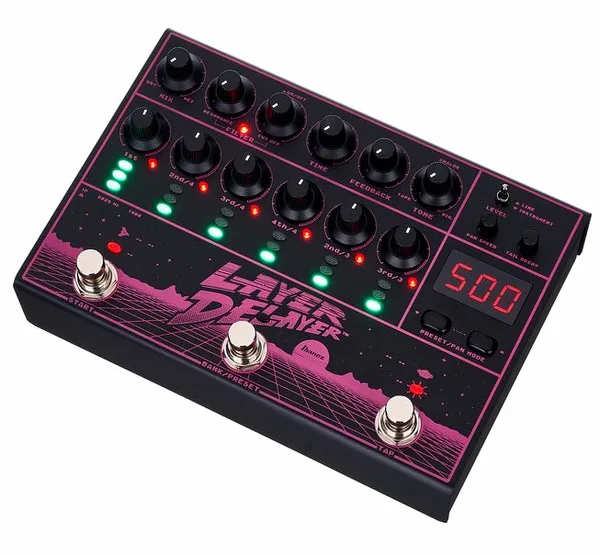
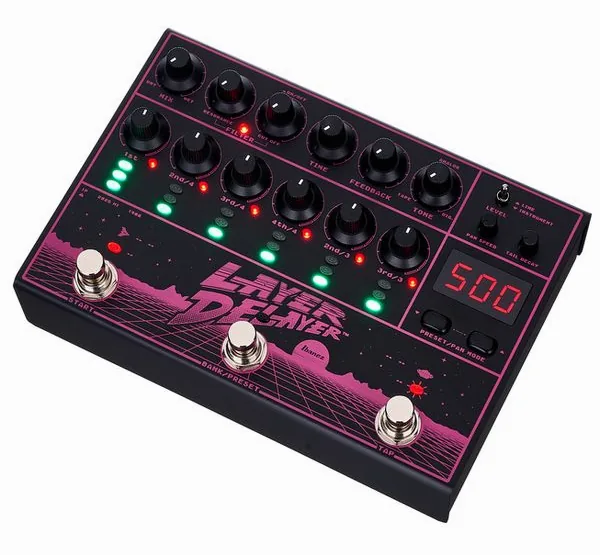
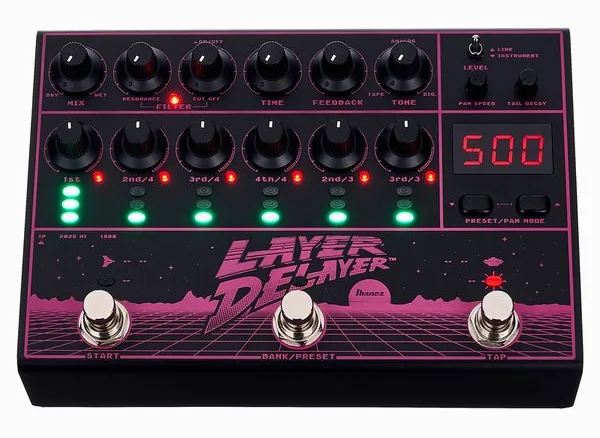
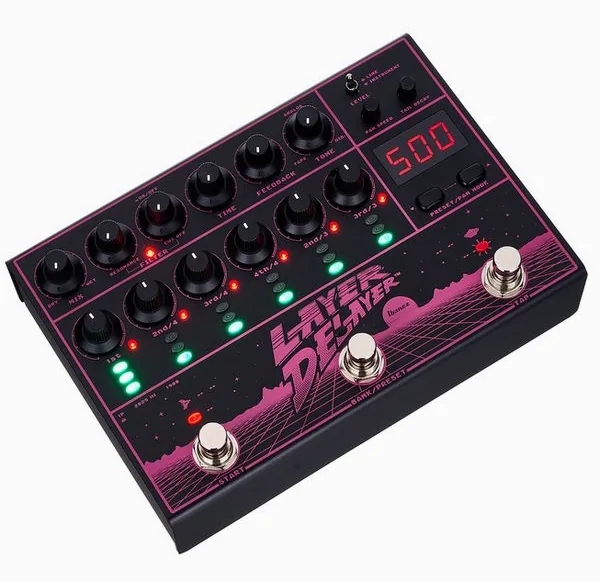
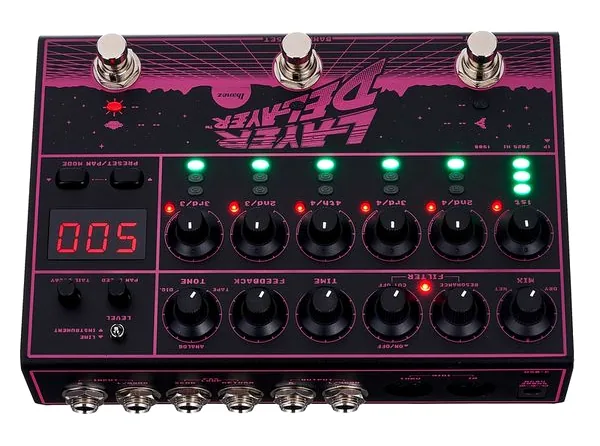
The chassis has a compact footprint (175 x 125 x 62 mm, 640 grams), but trades durability for density. Jack spacing is extremely tight; large or right-angled plugs are almost required to avoid cable pile-up. The push-pull potentiometers used for tempo mapping and menu navigation feel noticeably looser than the main controls, which can make live adjustments imprecise. Physically, these switching pots rock and wobble, conveying a cheap impression, unusual for other manufacturers at this price.
The printed graphics (purple on glossy black) are nearly unreadable under stage lighting and the LEDs are so bright they can be blinding in dark venues. Unless memorized, many control labels disappear, complicating live operation. The manual's signal routing diagram also mismatches the pedal's actual behavior, in reality, the FX loop is stereo and sits within the feedback line, not after feedback and limited to one channel as shown in the documentation. Mono users must route input through the correct (right) side to have the effect chain in full scope.
Noise is another weak spot: with some external effects (notably from Boss, MXR, and Eventide), CPU clock whine can bleed into the signal path when patching through the FX loop. In a studio environment, workarounds are possible, but gigging players will face random interference if chaining certain third-party pedals.
Conclusion
The Ibanez LD303 Layer Delayer is packed with routing and modulation features that will thrill experimentalists and sound designers, especially those working with modular synths, ambient soundscapes, or unconventional pedal setups. Its concept is ambitious, with stereo operation, variable panning, onboard filtering, and deep MIDI implementation. However, execution falters, build quality feels compromised, usability is mixed, and current firmware introduces critical limitations for tempo syncing and live reliability. The FX loop and filter are innovative in theory but less impressive in daily use, and signal noise or sync dropouts may frustrate demanding performers. For careful studio construction or creative textural layering, especially with the pedal's unique delay note controls, the LD303 stands out. For live workflows or seamless integration into latency-sensitive rigs, expect rough edges and a learning curve until potential future firmware updates resolve these issues.
Shipping and duties
The retailer ships from its warehouse in Germany. Prices are shown in US dollars and do not include import duties. Orders under roughly $800 usually clear US customs without duty; above that, a duty of a few percent may be collected on delivery. 30-day money-back and a 3-year warranty apply.
Scores by area
Where it shines, where it stumbles
What convinced me
- Extensive delay sound shaping, from digital to analog and tape echo emulations
- Independent volume control for 16th note and triplet delay notes
- True stereo input/output and dedicated effects loop within the delay path
- MIDI sync and auto-panning offer advanced creative possibilities
- Real ladder low-pass filter on delay signal for additional tonal sculpting
What bugged me
- Not all BPM values selectable; fine-tuning tempo is awkward and unintuitive
- Occasional freezes require full power cycle to recover
- Filter lacks authentic Moog characteristics and has a narrow sweet spot
- Very bright LEDs and hardly readable purple print hamper usability on stage
- Wobbly/cheap-feeling knobs, particularly those with push functionality
Is it the right one for you?
Good pick if
Best suited for sound designers, experimental musicians, and studio producers seeking a uniquely versatile delay unit with MIDI, stereo routing, and creative filtering. Particularly beneficial for those working in electronic, ambient, or avant-garde genres who can tolerate and workaround firmware quirks.Look elsewhere if
Not recommended for performers needing absolute reliability, precise tempo synchronization, or robust hardware for stage use. Also not ideal for those expecting classic analog/tape delay emulation, or users who need intuitive, well-labeled controls for quick live adjustments.Suggested level: Intermediate
Specifications
- Analog
- No
- Tap feature
- Yes
- Battery operation
- No
- Psu included
- No
What other players say
Most users praise the LD303's layering concept, its deep editing potential, and its creative appeal, especially for studio applications. However, many express disappointment with the poor resolution of tempo selection, unreliable performance (notably system freezes), lackluster filter behavior, cheap-feeling hardware, too-bright LEDs, and difficult-to-read labeling. Problems with noise in the effects loop and cramped jack placement are frequently cited. Updates to both firmware and physical design are a common demand.
The idea for the device is brilliant. But the execution is poor, both in terms of sound design and hardware.
The main problem with the effects loop is frequent noise and interference whenever other effects are inserted.
It's amazing for studio experiments, but in its current state I can't trust it live and really hope for a firmware update.
Up close
Watch and listen
Before you decide
Questions players ask
Does the LD303 allow precise BPM selection for delay times?
No, not all BPM values can be selected, particularly in the 100-160 bpm range. Some users find this lack of precision limiting for syncing delays to tempo.
Can filter resonance achieve self-oscillation like classic synthesizers?
The ladder filter cannot self-oscillate at high resonance. Its scaling is narrow and it does not fully emulate the iconic Moog filter response.
Is the LD303 reliable for live performance?
Multiple users have reported the device freezing during use, requiring a manual power cycle. This currently limits its suitability for live shows.
What power supply is required?
The device requires an external 9V DC power supply (center negative), which is not included in the box.
How usable are the controls and labeling on stage?
The combination of extremely bright LEDs and low-contrast purple print often make the labeling unreadable under stage lighting, and certain knobs feel particularly loose and cheap.
The last word from the bench
Conceptually, the LD303 stands out for its blend of delay modes, creative filter, and powerful routing options. However, limitations in tempo control, user interface weaknesses, and reliability issues make it unsuited for live use in its current state. It shines in experimental studio contexts but demands patience and workarounds. Critical firmware and hardware refinements are needed before it can be widely recommended.
Hanging next to it
Ibanez LD303 Layer Delayer
Today's price and delivery time are shown at the retailer.
 Guitar Gear Reviews