Hotone Ampero II Stomp
Hotone Ampero II Stomp delivers impressive versatility and sound quality in a rugged, highly portable format if you can accept its workflow and effect limitations.
★★★★★ 4.5/5 · 59 buyer reviews · 8 min read · updated 2026-10-07 · Tested by Cal Whitaker
Overview: Compact Powerhouse with Ambition
The Hotone Ampero II Stomp enters the multi-effects market as a compact, pedalboard-friendly digital modeling platform. For $359, you get an all-in-one solution featuring 87 amplifier models, 68 cabinet models, and a library of 460 effects, up to 12 of which can be used at once. Its design emphasizes flexibility, both in sonic options and physical routing, making it a contender in its price range. The core is a tri-core digital signal processor paired with high-spec converters from ESS Sabre, promising high-fidelity tone for both home and stage use.
Hardware and Build Quality
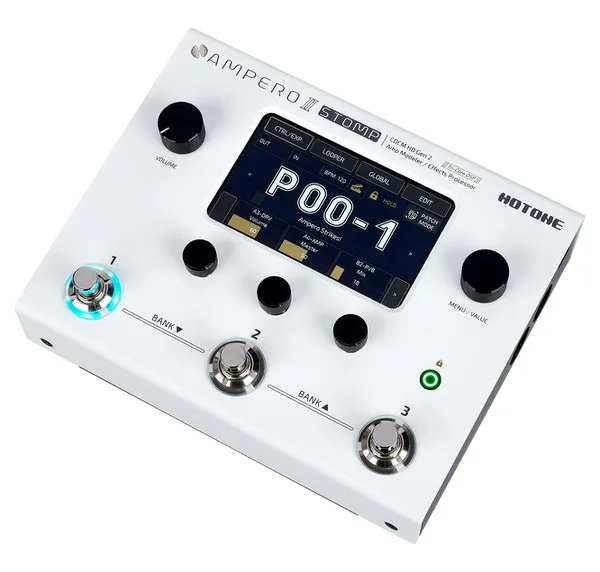
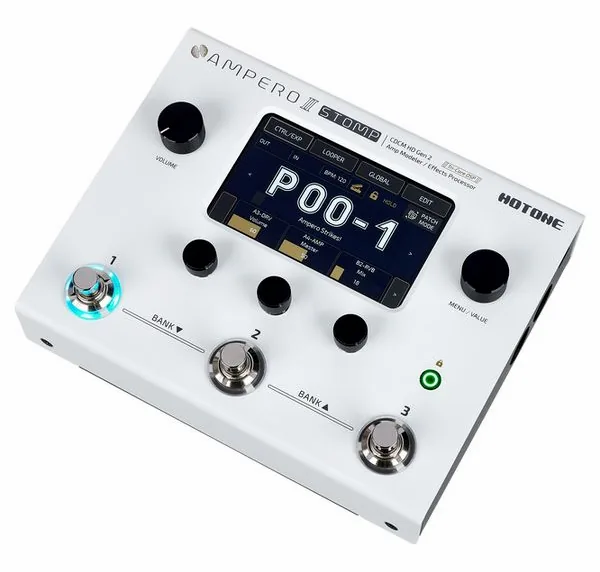
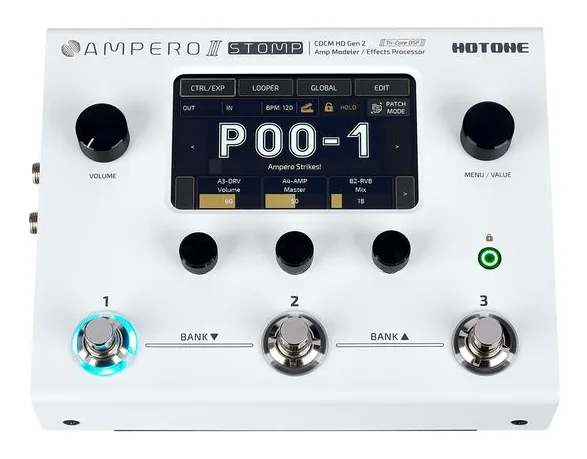
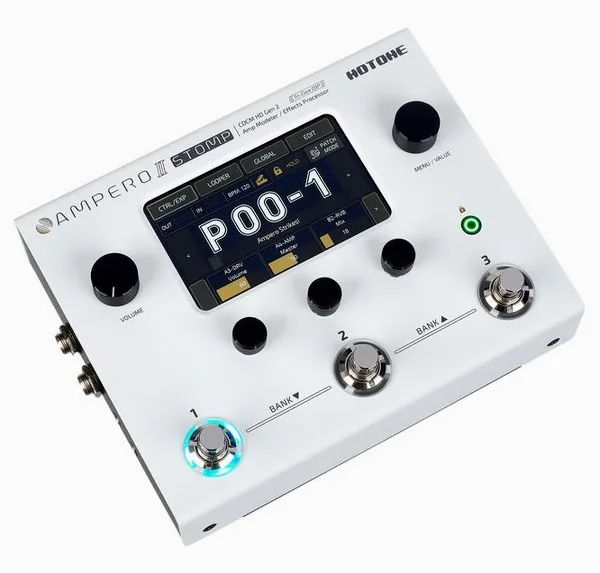
The enclosure is solid metal and feels robust, weighing just over 1 kilogram (1080 g) and measuring 185 x 145 x 58 mm. This makes it truly portable, easy to fit in a gig bag or studio desk setup. Three assignable footswitches control patch switching and effects toggling. The pedal's most striking feature is the 4.3-inch color TFT touch screen, which provides intuitive editing and signal chain management. Physical controls include three stiff, clicky select knobs and a menu/value dial. An LED ring around each switch displays status, but colors are factory-fixed.
- Inputs/Outputs: Stereo instrument/line inputs and balanced stereo outputs (TRS 6.3 mm), an auxiliary input, send/return loop, headphone output, MIDI in/out/thru, USB-C for audio and editing, and a dedicated jack for expression pedal or external switch.
- Power: 9, 18V DC adapter (included), 800 mA draw, no battery operation.
Signal Chain and Routing
Signal chain routing is a key feature and mostly easy to manage. Up to 12 effects (from 460 algorithms) can be chained together in various serial, parallel, or split configurations using the touch screen or computer-based editor. This opens up dual-chain setups for processing two instruments or achieving complex blends, guitar and bass, or synth and guitar, for example.
However, the unit's stereo capabilities come with caveats. The majority of effects, especially dynamics and overdrives, are mono. Using stereo sources requires careful routing: you must split the input to two mono channels early to preserve stereo, but you lose the ability to place stereo effects before the split. Attempting parallel stereo routes can quickly hit processor and slot limits, particularly if you want both chains fully featured.
Firmware and Software Control
The onboard touch screen is quick and fluid: you can drag blocks, assign footswitches, and adjust parameters directly. Editing is straightforward, especially for setting up pedalboard-style chains. The Hotone computer editor makes complex signal paths or IR loading easier, but both Windows and Mac users report occasional connection headaches, especially after firmware updates. Firmware should be updated sequentially, matching the editor's version with your firmware before jumping to the latest version, which is not always intuitive.
Modeling and Effects Quality
- Amp and Cabinet Models: The tone from amp modeling is the Ampero II Stomp's strongest suit. Clean and classic overdrive models (like those inspired by Fender or Friedman) feel responsive and authentic, with convincing breakup and touch sensitivity. Heavier and high-gain sounds show a digital top-end, revealing some synthetic harmonics and crunchy attack, especially at loud volumes or with headphones.
- Cabinets and IR Support: The built-in cabinet simulations are usable, though often dark, "boxy," and sometimes phasey. Importing your own impulse responses is straightforward and a commonly recommended tweak for getting modern, "airy" tones.
- Effects: Modulations, delays, and reverbs are a mixed bag. Time-based effects (like complex multi-tap delays) perform well, but simple delays and reverbs sometimes sound cheap, with short decays or digital artifacts. Pitch-based effects are criticized for high latency and digital noise, so the Ampero II Stomp is not a go-to for precise harmonizing or octave effects. On the plus side, compressors, gates, and drives are effective, and the system includes deep amp and power amp parameter controls (such as virtual tube models and negative feedback options) not commonly found elsewhere at this price.
You can store up to 300 presets, organize scenes (useful for live transitions), and use a 60-second stereo looper. MIDI support is broad, covering program and control changes, but mapping extra controllers or MIDI foot switches is best planned in advance due to jack sharing limitations.
User Experience in Practice
For guitarists and bassists, the touch workflow dramatically speeds up building and editing sounds. Experienced users appreciate the deep tweaking possible through the touchscreen or software, input and output levels, global equalizer, power amp sag, and IR blending all allow detailed tuning for nearly any output scenario. The pedal is well-suited for silent practice (headphone output is loud and clear), direct recording over USB, or as a compact gig rig if connected to a PA or FRFR amp.
However, beginners or those seeking instant gratification from presets may be overwhelmed. Factory patches range widely in volume and quality, and building clean sounds requires methodical gain staging and EQ work. For players who expect analog simplicity, a familiar three-knob amp feel, there is an initial learning curve. Also, some users have encountered reliability issues: software connection bugs, looping glitches, output noise in some setups, and occasional hardware quirks (such as loose jacks).
- + Compact, light, and rugged
- + Touch screen is fast and mostly reliable
- + Amp models are high quality for the price
- + Deep parameter editing and flexible routing
- , Reverbs, simple delays, and pitch effects trail best-in-class pedals
- , Mono-centric effect library limits stereo sources
- , Some batch-to-batch reliability concerns
- , Not beginner-friendly; time investment needed for best results
Conclusion: Who Should Buy the Ampero II Stomp?
The Hotone Ampero II Stomp impresses for its price, flexibility, and depth. For guitarists, bassists, and even synth players wanting a compact, studio- and stage-capable modeler, it covers most bases: great amp tones, broad connections, and tons of effects for experimentation. While not all effects are best-in-class, and stereo routing has software quirks, value and feature density are hard to match below $500. If you like to tweak and want a portable platform with full signal chain editing, it's a strong competitor in its class, just be prepared to spend time unlocking its potential.
Shipping and duties
The retailer ships from its warehouse in Germany. Prices are shown in US dollars and do not include import duties. Orders under roughly $800 usually clear US customs without duty; above that, a duty of a few percent may be collected on delivery. 30-day money-back and a 3-year warranty apply.
Scores by area
Where it shines, where it stumbles
What convinced me
- Extremely compact, robust metal chassis with pedalboard-friendly size
- Massive selection of effects, amp, and cabinet models with flexible routing
- Touchscreen makes editing quick and intuitive, editor software is comprehensive
- Amp simulations are genuinely high quality, sound and feel are well regarded
- USB audio, MIDI, headphone and aux inputs cover modern connectivity needs
What bugged me
- Many effects are mono only, stereo support for complex patches is limited
- Effect quality is inconsistent, especially reverb, delay, and pitch algorithms
- Firmware and editor software occasionally buggy or cumbersome, updates are not straightforward
- Knobs are stiff and imprecise for live tweaking; touchscreen sliders can be small
- Preset management is basic, patch volumes can vary unpredictably
Is it the right one for you?
Good pick if
Ideal for guitarists and bassists who want maximum tonal options and editing power in a compact, affordable floor unit. Great for home recording setups, versatile gigging musicians, and players looking to experiment with amp models and effects chains. Also suitable for those who value portability or need MIDI and USB integration without breaking the bank.Look elsewhere if
Not for absolute beginners, as the workflow and configuration can overwhelm those new to digital modelers. Demanding players seeking industry-leading reverb, delay, and polished stereo effects may be disappointed. Not ideal for those needing advanced DI or XLR outputs or seamless preset management live.Suggested level: Intermediate
Specifications
- Design
- Pedal
- Amp modeling
- Yes
- Drumcomputer
- No
- Incl. tuner
- Yes
- Expression pedal
- No
- Usb-port
- Yes
- Headphone output
- Yes
- Midi interface
- Yes
- Line out
- No
- Battery operation
- No
- Psu included
- Yes
What other players say
Customer reviews highlight the Ampero II Stomp's compactness, solid build, deep routing, and user-friendly interface, especially the touch display and editor software. Amp models receive strong praise, though some users notice digital harshness or inconsistency in effect quality, with particular criticism of reverb, delay, and pitch algorithms. Patches and stereo setups can be tricky to configure, and some find firmware updates convoluted, but overall the unit is seen as high-value and practical for most needs, especially if paired with quality IRs. Live use and sound customization are easily achievable for those willing to take time with setup.
Amp simulations and distortions are REALLY GOOD though.
Touchscreen makes editing super simple. The amps sound great. It makes playing fun again!
You get a lot for your money no other brand offers in this price range, but absolute killer sound is not included.
Up close
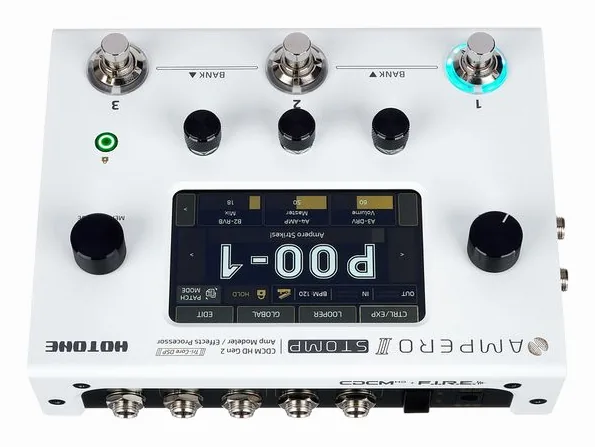
Watch and listen
Before you decide
Questions players ask
How is the sound quality of amp and cab models on the Ampero II Stomp?
Most users find the amp modeling to be impressively realistic and versatile for the price. Some effects and cabinet simulations sound digital or boxy, but third-party impulse responses can improve the tone significantly.
Is it easy to use for live performance and quick parameter changes?
The touchscreen makes editing fast, but live tweaking with the knobs is difficult due to their stiffness and stepped response. Assignable footswitches help, but adding more live control requires external switches or MIDI programming.
Does the Ampero II Stomp work well with keyboards, synths, or stereo sources?
It can process stereo sources, but most effects work in mono, advanced stereo processing requires careful patch building and workarounds. Keyboard and synth users may find the stereo routing limiting.
How reliable is the firmware and editor software?
Firmware updates can be tricky, and the editor occasionally fails to connect or glitches on both Windows and Mac. Most settings can be managed directly via the touchscreen in case of issues.
Can the Ampero II Stomp serve as a full rig for gigging and home recording?
For most guitarists and bassists, yes, it covers amp simulation, effects, USB recording, MIDI, headphone monitoring, and compact transport. Pro touring demands (like DI output, extended foot control, or ultra-high sound quality) still favor pricier modelers.
The last word from the bench
The Hotone Ampero II Stomp is a compact, well-built multi-effects powerhouse ideal for players who appreciate deep editing and flexible routing. Amp modeling is a real highlight, and the device offers strong value compared to higher-priced competitors. However, effect quality and stereo processing still lag behind top-tier alternatives, and patch management plus software quirks mean a learning curve. If you want maximum versatility under $400 and can live with some digital artifacts and setup work, it's one of the smartest buys available.
Hanging next to it
Hotone Ampero II Stomp
Today's price and delivery time are shown at the retailer.
 Guitar Gear Reviews