Boss GX-100
Boss GX-100 brings a vast effect palette and amp models in a highly robust, user-friendly floorboard. Its versatility and logical interface make it a strong choice, though some tonal and ergonomic quirks remain.
★★★★★ 4.6/5 · 73 buyer reviews · 8 min read · updated 2026-10-07 · Tested by Cal Whitaker
Boss GX-100 Floorboard: Technical Performance and Build
The Boss GX-100 stands out in the mid-priced tier of amp modelers and multi-effect processors, entering at $511. Launched in March 2022, this processor brings together 23 amplifier models, over 150 effects, a touchscreen interface, robust connectivity, and a customizable control experience in a single floorboard design.
Hardware and Physical Design
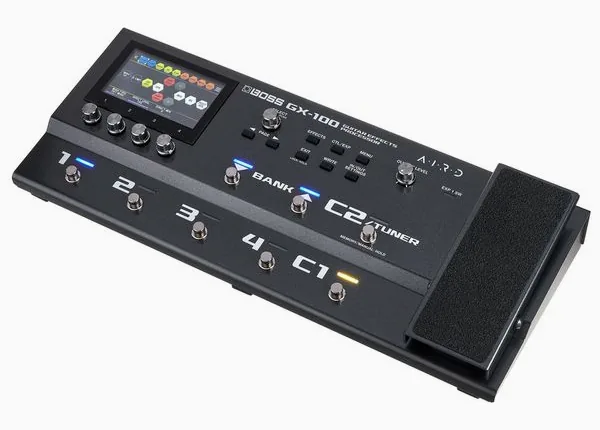
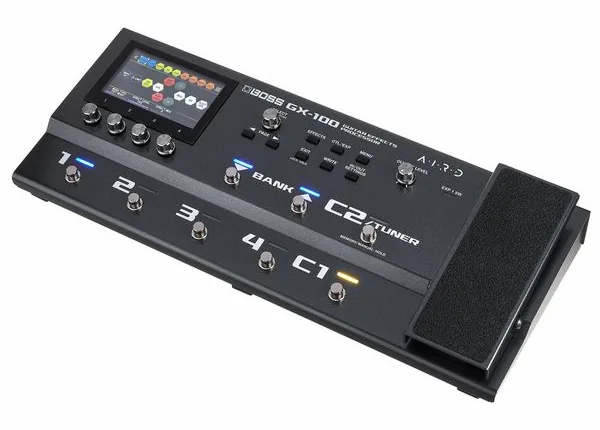
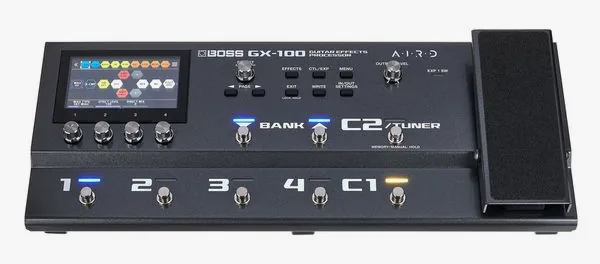
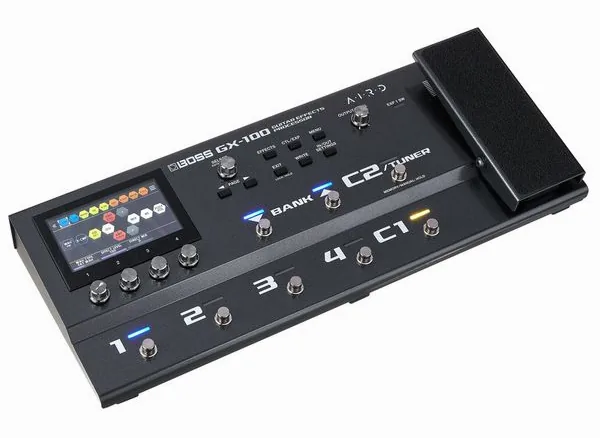
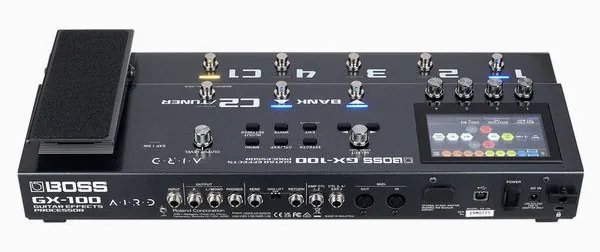
Weighing in at 3.5 kg and measuring 490 x 193 x 73 mm, the Boss GX-100 has a solid metal chassis that inspires confidence both for stage and studio use. The unit's slightly slimmer and longer footprint might be less immediately pedalboard-friendly, but its overall build quality is among its strong points. All switches and encoders are tactile and give a premium response: rotary encoders are detented and can be "pushed in" for parametric selections, while the eight footswitches (1-4, two control, and bank up/down) plus the integrated volume/expression pedal (with a toe switch) cover most live needs. Some users note the switches are relatively small and closely spaced, which can make hitting them with larger shoes or barefoot tricky, footswitch toppers may help.
For connections, the GX-100 is generous: mono input on a 1/4" jack, stereo outputs (L/R), stereo effects send and return, MIDI in and out, expression pedal and footswitch inputs, and a headphone jack, all on 1/4" jacks. USB allows for direct multichannel recording and integration with the included Boss Tone Studio editor (Windows/Mac), while a power supply (9V DC, 1200mA) is provided. Bluetooth support for audio and MIDI editing requires a separate adapter.
Interface and Usability
The centerpiece of the controls is a color touchscreen, which enables intuitive patch creation, drag and drop blocks, reorder effects, assign parameters, and adjust signal flow. While it brings modern convenience, the touch response can lag and target zones for dragging are small, especially with larger fingers. Thankfully, every parameter remains accessible via the physical encoders and navigation buttons, compensating for the occasional sluggish touch operation. Four rotaries below the screen can be freely assigned for hands-on control during live use or quick editing, supporting efficient workflow once set up.
The interface supports up to 15 assignable blocks per patch, and each footswitch and pedal can be freely mapped, either to enable individual effects ("manual mode"), toggle banks, control tap tempo, send MIDI commands, or even switch amp channels on external hardware via the amp control output. Shifting between standard and four-cable method setups is straightforward, simply by rearranging blocks in the chain. Switching latency is negligible, making it viable for fast-paced live environments. Onboard help and logical menu groups make the GX-100 relatively easy to learn, especially compared to more menu-heavy competitors.
Sound: Amp Modeling and Effects Quality
The 23 amplifier models use AIRD technology (Augmented Impulse Response Dynamics) to deliver "tube-like" response. In practice, clean and edge-of-breakup sounds are a highlight, with dynamic touch and realistic reaction to picking. Crunch tones are solid, though some players feel the high-gain models lack the depth, aggression, or "sizzle" found in competitors like Line 6's Helix or higher-end Boss GT-1000 units. Heavier tones require careful EQ and gain staging; some users report needing to stack EQs and tweak extensively, especially for hard rock and metal. For classic rock, blues, pop, and fusion, the amp models hold up well. On the effects side, Boss's signature pedals are faithfully represented, from lush delays and reverbs to compressors, chorus, pitch, and drive boxes (including interpretations of other classic pedals like fuzzes and distortions). The update to firmware 2.0 expanded the effects pool further, introducing tools like Slicer and Humanizer.
The signal chain's flexibility is unusually high for the price: dual parallel paths, custom routing of effects, send/return insertion at any point, and up to 200 memory locations allow the creation of elaborate rigs, replicating a multi-amp setup or complex pedalboard is entirely feasible. You can import your own cabinet impulse responses (WAV format), in addition to the built-in speaker models, giving further tonal variety for direct recording or full-range PA performance.
Integration, Control, and Recording Options
On stage or in the studio, integration is above average. MIDI implementation is thorough: any footswitch can send control changes, enabling the GX-100 to operate as both a MIDI master and slave, syncing tap tempo and patch changes with DAWs or external pedals. USB connectivity supports multichannel recording, individual amp and effects paths can be tracked separately. The onboard looper is basic, without MIDI sync or quantization, making it more of a practice tool than a live performance feature.
Boss Tone Studio for Mac and PC enables deep editing and patch management, with the added benefit of the Tone Exchange platform for downloading and sharing user patches. Bluetooth editing and audio streaming are possible via an additional dongle. Direct monitoring for practice is supported via the headphone output, though its volume is not independently adjustable.
Limitations and Considerations
- Switches are relatively small and can be hard to manage without footwear, especially for larger feet.
- The touchscreen, while very useful, is less responsive than modern tablets or smartphones.
- The integrated expression pedal, while smooth, is on the firm side, and some wish for it to be easier to press during "wah" assignments.
- No XLR output, a standard feature on some rivals, limits direct connection to certain mixers or interfaces without adapters.
- Factory presets are numerous but often require editing to be stage-ready; fortunately, building custom patches is straightforward once the interface is understood.
- Software installation and updates require downloading several packages; some users report connection headaches with drivers, though many also find the computer integration robust after setup.
Verdict: Practical Floorboard for Live and Studio
The Boss GX-100 offers a deep and highly configurable effects and amplifier ecosystem in a robust, tour-friendly chassis. Its clean and crunch amp models are among the best in its class, and the extensive effects library covers almost every sonic requirement. The editing experience is modernized by the touchscreen, though not without occasional frustrations. Integration with MIDI, USB recording, and external pedals/controller adds versatility for live sets, rehearsal, and home production alike. While those seeking plug-and-play high-gain rock out of the box may need patience for deep editing, most players who value flexibility and sound sculpting will find the GX-100 an excellent value and a powerful creative tool for guitar and bass.
Shipping and duties
The retailer ships from its warehouse in Germany. Prices are shown in US dollars and do not include import duties. Orders under roughly $800 usually clear US customs without duty; above that, a duty of a few percent may be collected on delivery. 30-day money-back and a 3-year warranty apply.
Scores by area
Where it shines, where it stumbles
What convinced me
- Extremely versatile with over 150 built-in effects and 23 amplifier models, supporting parallel signal paths and custom impulse response loading
- Intuitive user interface with a color touch screen and programmable switches; hands-on editing is quick and logical
- Robust, all-metal construction and compact footprint; suitable for both home and stage use
- Strong integration with computer editing (Boss Tone Studio), USB multi-channel recording, and MIDI control options
- Manual mode emulates traditional pedalboard workflow for direct access to individual effects; designed for both beginners and experienced users
What bugged me
- Touchscreen can be sluggish and sometimes unresponsive compared to competitors
- Heavy unit at 3.5 kg, making transport less convenient for spontaneous gigs
- Overdriven and high-gain amp models sound thin or lack character without EQ expertise; clean and crunch tones fare better
- Expression pedal is small and stiff for some users; cannot always double as a wah without additional gear
- Software installation and updates can be convoluted, requiring multiple downloads; Bluetooth and some advanced features need extra purchases
Is it the right one for you?
Good pick if
Ideal for multi-instrumentalists, cover band guitarists, recording hobbyists, and those wanting high versatility in a single floorboard. Strong fit for those moving from analog to digital pedalboards, or as an affordable, powerful alternative to flagship models. Users looking for quick setup of both standard and elaborate signal chains with computer integration will appreciate its workflow.Look elsewhere if
Not recommended for purists seeking highly authentic tube overdrive/distortion without deep editing, or for players who require instant, out-of-the-box high-gain tones. Those who prioritize light weight, precise touchscreen UX, or need extensive I/O including XLR may find better options elsewhere.Suggested level: Intermediate
Specifications
- Design
- Floorboard
- Tube(s)
- No
- Amp modeling
- Yes
- Effects
- Yes
- Headphone output
- Yes
- Direct out
- Yes
- Midi interface
- Yes
- Integrated expression pedal
- Yes
- Connections for pedals or switches
- No
- Aux-input
- Yes
- Integrated tuner
- Yes
- Usb-port
- Yes
- Drum-computer
- No
- Incl. tuner
- Yes
What other players say
Most users praise the GX-100's broad effect and amp model library, robust hardware, and user-friendly design, finding it suitable for both beginners and advanced players. Clean and crunch tones are consistently rated as strong; distorted sounds divide opinion, and some suggest advanced EQ tweaking is needed. The touchscreen and PC/Mac software are largely appreciated, but the learning curve and occasional software/set-up hassles are cited. Some regret the basic looper and lack of certain pro features, but the overall sentiment is positive. Transport and footswitch ergonomics are minor complaints; customer support is noted as mixed. The price-to-value ratio is regarded as strong, making it a favored 'all-in-one' solution for stage or studio.
Every switch is fully programmable and customizable, per patch. Can also send MIDI CCs per switch, so I've mapped some switches in Ableton Live for scene scrolling and launching.
The blocks (hexagons) are color coded by category. No latency to speak of when playing and switching patches.
After using it in couple of gigs, here are my thoughts: + Sturdy chassis, I mean it is strong, no plastics + I liked the sounds of the amps and pedals...
Up close
Watch and listen
Before you decide
Questions players ask
Does the GX-100 work equally well with guitar and bass?
Yes, the GX-100 supports both guitar and bass, offering usable amp models and effects for each. Some users report needing to tweak EQs for optimal results, but overall flexibility is a key strength.
How difficult is it to program custom sounds and presets?
Programming is regarded as straightforward once you learn the logic, especially with the touch display and PC/Mac editor. There is a learning curve, but many users find it easy after initial setup.
Can I use the GX-100 with my existing pedalboard or amp?
Yes. The send/return loop and flexible routing support classic four-cable method setups with amps or integration of external pedals.
Is the Bluetooth module necessary?
Bluetooth is not required for all features but adds wireless editing and audio streaming with mobile devices. The module is sold separately; editing and all critical configuration can also be done by USB or on-device.
What are the main limitations compared to flagship models?
The GX-100 lacks XLR outputs, has basic looper functions, fewer switches than some top-tier boards, and some users report less realistic high-gain amp modeling. Still, it covers most needs in its price range.
The last word from the bench
Boss GX-100 stands out for its flexibility, build quality, and intuitive approach to both live and studio work, catering to a wide range of guitarists and bassists. Sound quality is generally strong, with cleans and crunches particularly impressive; however, some users may find the higher-gain tones require effort to shape. Hardware and software integration is generally smooth, but expectations should be moderated regarding the out-of-box overdrive sounds and touchscreen performance. Despite these drawbacks, GX-100 provides comprehensive capability for most players at this price point.
Hanging next to it
Boss GX-100
Today's price and delivery time are shown at the retailer.
 Guitar Gear Reviews