Blackstar ID:X Floor Three
Smart tube emulation, streamlined workflow, and solid effects make the Blackstar ID:X Floor Three a standout floor modeler, though the expression pedal may disappoint some users.
★★★★★ 4.5/5 · 4 buyer reviews · 7 min read · updated 2026-10-07 · Tested by Cal Whitaker
Blackstar ID:X Floor Three: A Focused Amp Modeler and Effects Board
The Blackstar ID:X Floor Three sits between multi-effect processors and amp modelers, aiming for plug-and-play operation with serious tonal flexibility. Priced at $272, the Floor Three avoids feature bloat and delivers a streamlined set of amp models, onboard effects, and practical connectivity for home, stage, and studio. After several days with this unit, here's a hands-on account of its performance, workflow, and sound qualities.
Hardware Design and Controls
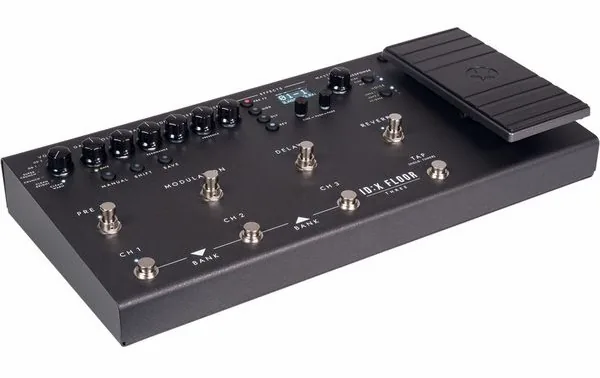
True to its name, the ID:X Floor Three is configured as a compact floor effect. At just under 6.8 x 39.7 x 19.5 centimeters and 2.88 kilograms, it sits comfortably on most pedalboards but is sturdy enough for standalone use. The black chassis feels well-finished. The expression pedal is firmly mounted, though some users report it operates functionally as a two-position switch in practice, especially when using it as a wah, despite successful calibration in the supplied Blackstar Architect software, full sweep control remains elusive for some, possibly due to a software glitch with the included firmware series.
Front-panel controls include gain, master volume, and a full three-band equalization (bass, middle, treble), with global output presence managed by Blackstar's ISF (Infinite Shape Feature) dial. There is a dynamic display providing patch information and adjustment feedback. Switches enable hands-on toggling of various effect blocks (pre-effect, modulation, delay, reverb), as well as access to manual, shift, save, bank, response (power tube voicing), tap tempo, and Cabrig (cabinet simulation) functions.
Connections and Integration
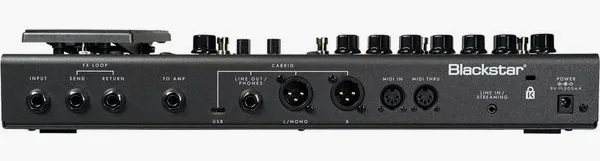
The ID:X Floor Three covers a typical guitarist's setup requirements in both direct and amplifier-connected situations. Inputs include a standard instrument jack and auxiliary input for playback or backing tracks. Outputs feature a dedicated amplifier output, effects loop send/return, balanced XLR output, uncompensated line output, and a stereo headphone/line output. There is MIDI in/thru for deeper integration, as well as USB-C for editing patches, firmware updates, and digital audio streaming. Notably, there are no external pedal or switch connections beyond the built-in expression pedal.
A key advantage for home use is the headphone output and USB connectivity, making silent practice and direct recording seamless. For live scenarios, direct-to-mixer output with onboard speaker emulation, plus separate amp output, allow for flexible routing.
Modeling and Sound Quality
Instead of loading users with dozens of amp simulations, the ID:X Floor Three focuses on a handful of high-quality voices: warm clean, bright clean, standard crunch, 'super' crunch, and two overdrive modes. The inclusion of three specific power tube emulations, 6L6, EL34, and EL84, adds nuance to the output response, genuinely affecting dynamic feel and attack. This 'separate power stage emulation' approach stands out, producing a more amp-like presence, especially when played through a guitar cabinet (ex: Marshall Vintage 1960) as users note in blind A/B tests. It's clear that Blackstar's modeling doesn't just sound good in isolation, it reacts naturally in a band context and at gig volumes, which cannot be said for many competing modelers that retain a "flat" or studio monitor character when pushed through an actual guitar amplifier.
The ID-X Floor Three's Cabrig technology (Blackstar's speaker simulation) represents a step forward for direct and headphone use, it is more natural than standard impulse response cabinet models with microphone simulation, delivering a feel closer to a real amp in the room. This becomes especially evident over headphones, where the sense of air and three-dimensionality outpaces older digital modelers.
Effects Processing
The board offers over 35 effects, directly editable on the unit, including all essentials: compressors, modulation (chorus, flange, phase), delays, and reverbs. The sonic quality is described as reliable and musical across the board. Delay and reverb in particular are praised for their immediacy and transparency, letting you dial in usable tones fast. However, the compressor strength is moderate; for bass usage, players find the compression just adequate, especially when using a pick, but it can lag behind the demands of heavier fingerstyle playing or slap.
Performance Notes and General Workflow
This is a product designed for players who want to spend time playing, not programming. Navigation is efficient: finding good tones or saving patches is intuitive, and you're not forced to scroll through endless lists of amp models or convoluted interface pages. The range of included sounds is sufficient for most practical live and studio contexts, there aren't 60+ amp models, but all included voices are usable, with careful attention to "feel" and translating pick dynamics and phrasing. This efficiency is a major plus.
For practicing or home recording, the Floor Three's headphone output and auxiliary input make it simple to jam along with tracks. USB streaming and MIDI implementation enable integration into a DAW setup or broader stage rig. Despite the overall strong showing, one consistent complaint involves global output volume: some users find the master volume ceiling too low when running into external power amplifiers (such as a Harley Benton GPA-100 into a 4x12 cab), even at max volume and impedance matching. Adding a microphone preamp with pad may be required for sufficient output headroom in these situations.
Conclusion
The Blackstar ID:X Floor Three is aimed at guitarists who want authentic amp feel, essential effect capability, and simple workflow in a rugged floorboard format. The absence of an integrated tuner is a minor surprise at this price, and the inconsistent behavior of the expression pedal needs a firmware update. Still, for guitarists seeking solid direct- or cab-ready sound with focused features and a natural playing response, this unit is an easy recommendation, especially at its asking price. Blackstar has avoided excessive complexity and aimed for quality over quantity, and that pays off for players seeking relevance and reliability in the heat of rehearsal, recording, or the stage.
Shipping and duties
The retailer ships from its warehouse in Germany. Prices are shown in US dollars and do not include import duties. Orders under roughly $800 usually clear US customs without duty; above that, a duty of a few percent may be collected on delivery. 30-day money-back and a 3-year warranty apply.
Scores by area
Where it shines, where it stumbles
What convinced me
- Excellent amp modeling with convincing tube emulation (EL84, EL34, 6L6)
- Over 35 onboard effects, all directly editable without menu diving
- Integrated, responsive expression pedal
- Robust connection options: XLR out, USB-C, MIDI, FX Loop, direct out
- Compact, sturdy design; ready for both stage and home use
What bugged me
- Master volume may be too low for some power amp/cabinet setups
- Expression pedal calibration issues reported by multiple users
- Compressor effect lacks punch for some bassists, especially pick players
- No built-in tuner
- No connections for external switches or pedals
Is it the right one for you?
Good pick if
Ideal for guitarists seeking direct, tube-like amp modeling in a robust and portable package, gigging players who want a reliable stage unit with fast setup, and home or studio users needing versatile connectivity. Also suitable for musicians who dislike menu-diving and value hands-on control over sounds.Look elsewhere if
Not for players who need extensive custom pedal/switch integration, musicians focused on extreme master volume through passive power amps, or bassists demanding advanced compression. Also may frustrate those needing a rock-solid expression pedal experience or integrated tuner.Suggested level: Intermediate
Specifications
- Design
- Floor Effect
- Tube(s)
- No
- Amp modeling
- Yes
- Effects
- Yes
- Headphone output
- Yes
- Direct out
- Yes
- Midi interface
- Yes
- Integrated expression pedal
- Yes
- Connections for pedals or switches
- No
- Aux-input
- Yes
- Integrated tuner
- No
- Usb-port
- Yes
- Drum-computer
- No
- Expression pedal
- Yes
What other players say
Customer reviews describe the Blackstar ID:X Floor Three as a well-built floor modeler with highly realistic amp sounds, with many noting it captures authentic tube character. The effects are broadly approved as clear and usable, and players value the limited, purposeful selection of amp models. Some users, however, are disappointed by a buggy expression pedal and a relatively weak master volume when used directly with certain power amps and cabinets. Value for money is repeatedly praised, especially given the sound quality, but advanced users may want better compressor performance or an internal tuner.
The overall sound is very good, even compared to the competition; I would have a hard time recognizing the original pedal or amp in a blind test.
For me, this is the first modeler that, played loudly over a guitar cab, truly sounds like an amp.
The only drawback is the low master volume. With all volumes maxed out, through a Harley Benton GPA-100 into a 4x12, it just wasn't enough for rehearsal.
Up close
Watch and listen
Before you decide
Questions players ask
Is the Blackstar ID:X Floor Three suitable for both live gigs and home recording?
Yes, it offers extensive connectivity (XLR, USB-C, FX Loop, headphone output) and robust sounds suited for both live performances and studio use.
Can the expression pedal be recalibrated or fixed if it only registers on/off instead of a sweep?
Some users report partial success recalibrating via the Architect software, but the issue seems to persist for a few, likely a firmware or hardware bug.
How convincing is the amp modeling, especially compared to competitor units?
The tube emulation is consistently praised as natural and full, with several users unable to distinguish it from much more expensive analog or tube setups in blind tests.
Is it suitable for use with bass, keyboards, or just electric guitar?
While primarily designed for guitar, it works for bass and keys, but the compressor may not satisfy all bass players, especially those using a pick.
Does the device include a built-in tuner?
No, it lacks an onboard tuner, so external tuning solutions are necessary.
The last word from the bench
The Blackstar ID:X Floor Three focuses on quality over quantity, delivering excellent amp modeling and effects with an intuitive interface. Its limited but well-chosen selection of amp sounds and direct, player-friendly design help it avoid menu-driven frustrations. Connection options are broad, supporting both live and recording setups. Issues with the expression pedal's calibration and master volume on certain setups may trouble demanding users, but overall value remains impressive for the price.
Hanging next to it
Blackstar ID:X Floor Three
Today's price and delivery time are shown at the retailer.
 Guitar Gear Reviews