Walrus Audio Qi Etherealizer TK
The Qi Etherealizer is a richly featured experimental pedal ideal for ambient and sound designers, but the delay is the clear weak point.
★★★★☆ 4.4/5 · 6 buyer reviews · 8 min read · updated 2026-10-07 · Tested by Cal Whitaker
Overview: The Walrus Audio Qi Etherealizer TK Experience
The Walrus Audio Qi Etherealizer TK, designed with Yvette Young, is a signature multi-effect pedal that combines chorus, digital delay, granular and reverb processing in a rugged stereo pedal format. With a street price of $487, it aims to offer an ambient toolkit for guitars, synths, and experimental setups, all shaped by Young's distinctive sound aesthetic and artwork. Launched in February 2025, this pedal targets musicians who value textural possibilities, seamless effect routing, and extended preset flexibility.
Main Features
- Effects: Chorus (tri-chorus/stereo), Digital delay with up to 2 seconds time, Granular processing (five modes), Reverb (single knob control)
- Signal Chain: Switchable series or parallel routing
- Presets: Three onboard plus up to 127 via MIDI
- Connectivity: Stereo input and output (two 6.3 mm jacks each), TRS MIDI (3.5 mm), USB-C for firmware
- Chipset: MDSP digital engine for high headroom and low noise
- Power: 9V DC (300 mA)
Build, Layout, and User Experience
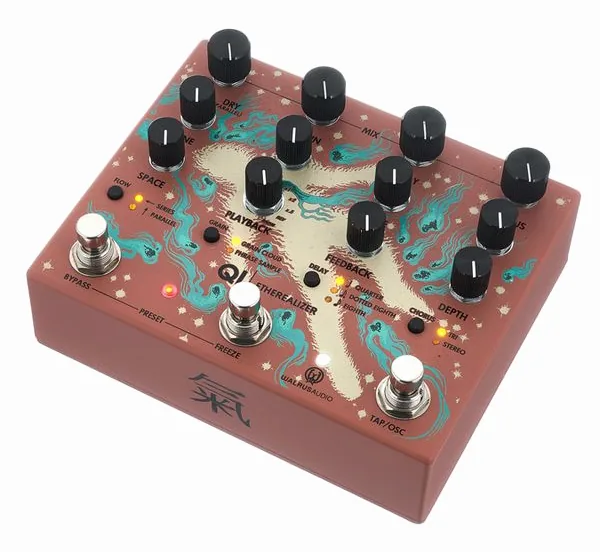
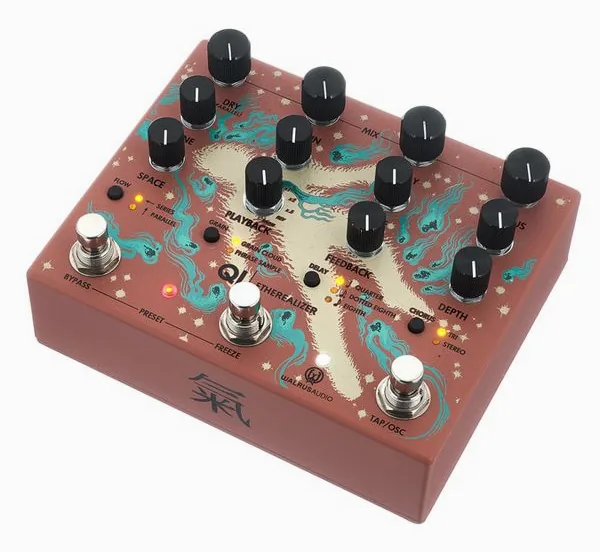
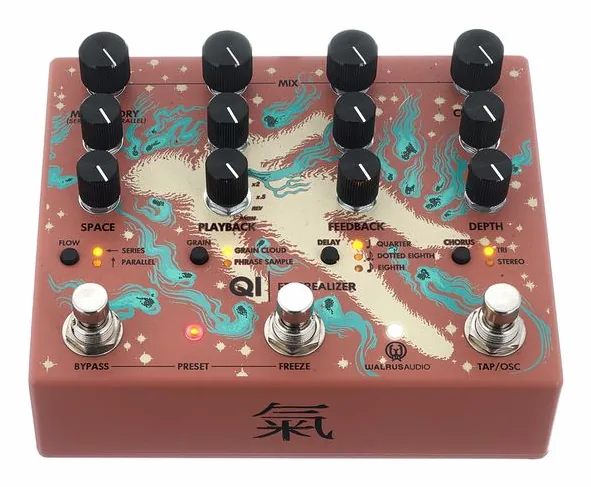
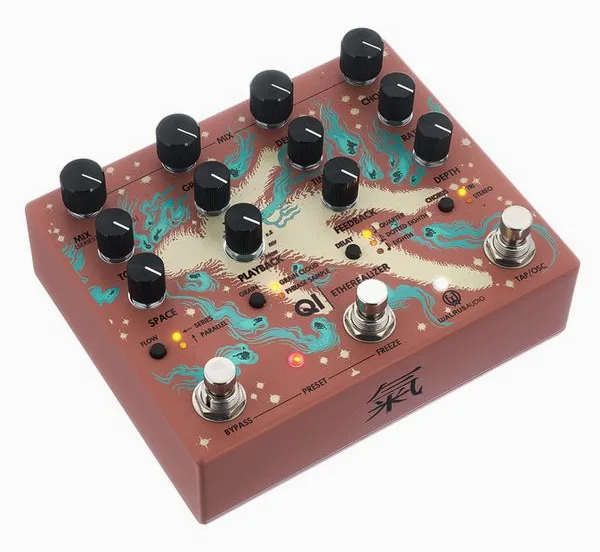
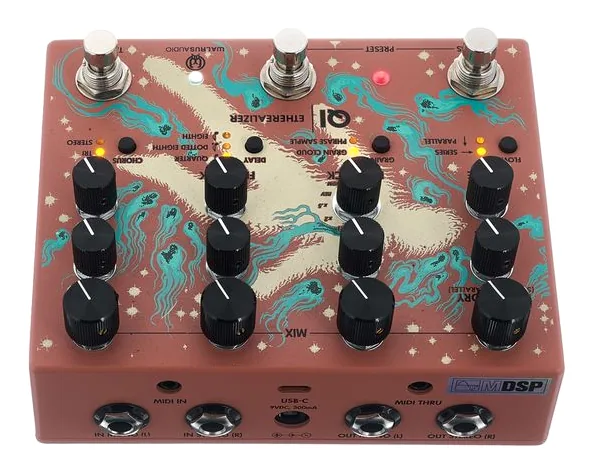
The Qi Etherealizer TK immediately stands out for its terracotta shell and custom Yvette Young graphics. The pedal is robust, with solid switches and a clear knob layout despite the multiple effect sections. Essential controls like Space (reverb size), Tone, Dry/Wet mixing, and a series/parallel toggle are easy to reach and responsive. In series mode, the effects run in a stack; in parallel, each section processes the dry input separately, yielding a more transparent result, especially helpful for synth and ambient work.
A recurring user concern is crackling when adjusting certain potentiometers. While construction quality is generally high, rotating some of the knobs produces noise, which can be distracting or problematic during real-time recording or performance adjustments.
Chorus: Strength of the Pedal
The chorus section is subtle but lush. With tri-chorus and wide stereo modes onboard, modulation ranges from a barely-there shimmer to deep, multi-voiced movement. Many musicians highlight the tri-chorus as a particular strength, offering a dimensional quality reminiscent of vintage rack units but more compact. The sound is musical and blends well both with guitar and synths, producing evocative textures without overpowering the input signal.
Delay: Functionality vs. Depth
The delay in the Qi Etherealizer covers up to two seconds, suitable for ambient swells and rhythmic repeats. It is digital, clean, and straightforward, without extra features like tape simulation or analog coloration. This simplicity can be seen as both an asset and a limitation. For users already equipped with higher-end delay units, this section is serviceable but does not stand out on its own. It integrates well when used as an additional layer, particularly in parallel mode where excessive smearing is avoided.
When stacking multiple effects, especially with the grain engine engaged, the delay's voice can become buried, and the overall signal risks becoming muddy. For those who need their delay as a dominant effect or wish for more character, the Qi Etherealizer serves better as a secondary or complementary option rather than the main delay device.
Granular Engine: Versatile but Demanding
The granular processor is the most experimental aspect of the pedal. It offers five distinct algorithms: Standard, Double-Speed (plus one octave), Half-Speed (minus one octave), Reverse, and Random. Within those, "Grain Cloud" mode scatters micro-samples based on parameter tweaks, producing unpredictable ambient clouds, while "Phrase Sample" slices grains at rhythmic peaks controlled by tempo. For ambient sound design, freezing textures, and glitchy interludes, this section rewards deep exploration. However, the grain engine's interface is complex and not instantly intuitive; it takes time to master the balance between unpredictability and control.
User feedback on the grain engine is mixed, it excels for creating atmospheric pads and spectral transitions, particularly with guitar or tape loops. However, some feel it can sound uninspiring if used superficially, and its interaction with the delay section is less effective for those seeking precise rhythmic repeats.
Reverb Section: Single Knob, Expansive Sound
The reverb is controlled by a single "Space" knob, yet delivers a wide range from subtle ambiance to immersive, lush tails. Several users highlight this as the pedal's sonic highlight, especially for atmospheric, cinematic, or shoegaze-fused sounds. Despite its limited control, the reverb remains effective and musical, imparting depth without washing out detail.
Workflow, Presets, and MIDI Integration
Navigating the Qi Etherealizer involves balancing complexity and immediacy. The pedal allows for three user presets and a live mode, making quick changes practical for live or studio use. Deep integration is available via MIDI, managing up to 127 presets and mapping parameters remotely, which is vital for elaborate or recallable setups. For those who demand more than surface-level experimentation, this is a real advantage, though mastering MIDI control requires an investment in time and setup.
Sound Signature and Best Use Cases
This pedal shines as an all-in-one solution for sonic explorers who lean towards ambient, post-rock, or experimental genres. Its ability to run effects in parallel preserves clarity when stacking chorus, reverb, and granular processing. With synths, transitions between effect modes are smooth and do not disrupt the audio flow. The sound is unmistakably colored by Yvette Young's playful and luminous tonal palette, appealing to those seeking to emulate or expand on her style.
On the downside, demanding users may outgrow the delay section or want additional connectivity such as effects loops. The pedal does not aim to replace boutique single-effect pedals for every workflow. It is most rewarding when leveraged as a creative hub for layering, textural expansion, or as an "inspiration machine" in writing, live, or production setups.
Conclusion
The Walrus Audio Qi Etherealizer TK is a specialty tool for musicians drawn to lush chorus, experimental grain, and vibrant, single-knob ambient reverb. Its build and sound are generally robust, with small usability quirks around crackling potentiometers. The delay may not excite those wanting deep tweakability or analog character, but it serves its purpose within the broader effect suite. With strong MIDI integration, a signature sound, and a well-designed parallel routing option, this pedal makes a convincing case as an atmospheric centerpiece, especially if you embrace its strengths and accept its focused approach to delay.
Shipping and duties
The retailer ships from its warehouse in Germany. Prices are shown in US dollars and do not include import duties. Orders under roughly $800 usually clear US customs without duty; above that, a duty of a few percent may be collected on delivery. 30-day money-back and a 3-year warranty apply.
Scores by area
Where it shines, where it stumbles
What convinced me
- Outstanding stereo sound and smooth transitions between effects
- Versatile with chorus, granular, delay, and reverb sections, each with distinct character
- Robust construction and visually appealing Yvette Young graphics
- Very effective series/parallel routing for deeper sound design
- High preset capacity with onboard and MIDI management
What bugged me
- Delay section is underwhelming and lacks depth compared to dedicated delays
- Some potentiometers may crackle during adjustments
- Grain effect can be challenging to master, especially with complex setups
- No effects loop or send/return, limiting integration with other pedals
- Learning curve for unlocking full potential
Is it the right one for you?
Good pick if
Ideal for experimental musicians, ambient sound designers, and artists looking for a compact multi-effect with strong granular, reverb, and chorus capabilities. Works well in both studio and live synth or guitar setups, especially for atmospheric or cinematic genres.Look elsewhere if
Not suited for players seeking a top-tier delay as a centerpiece. Also less suitable for those who require easy plug-and-play operation without a learning curve, or who need effects loop integration for complex pedalboard routing.Suggested level: Intermediate
Specifications
- Chorus
- Yes
- Flanger
- No
- Phaser
- No
- Delay time
- 2000 ms
- Input/output configuration
- stereo in / stereo out
What other players say
Customers consistently praise the Qi Etherealizer's lush stereo sound, nuanced chorus, and atmospheric reverb, with the parallel routing and signature sonic touch from Yvette Young standing out. However, users are less impressed with the delay section, finding it utilitarian and lacking the richness of specialized delay units. While the granular effect is applauded for creative depth, it demands effort to master. Despite minor build glitches such as crackling knobs, most agree the pedal adds unique value in sound design and experimental contexts, earning high satisfaction among those seeking versatility and ambiance.
The Chorus is very nice.
The reverb has a nice tone, the filter is decent, The grain is only ok in my opinion.
Chorus is subtle but beautiful; preference for the tri-chorus. Delay is simplistic but has all the effective features to be musical.
Up close
Watch and listen
Before you decide
Questions players ask
Is the Qi Etherealizer suitable as a main delay pedal?
While the delay is functional and musical, it lacks the depth and character of many standalone delay pedals. It's better as a supporting delay rather than as a main centerpiece.
Does this pedal integrate well with synthesizers and tape loops?
Yes, the stereo architecture and smooth effect transitions make it particularly attractive for synths and tape loops, with shining results in ambient or cinematic soundscapes.
How steep is the learning curve for the granular section?
The grain features are powerful but can be difficult to fully grasp at first. Expect to spend time experimenting to unlock the pedal's deepest creative potential.
Are the presets easy to access and manage during performance?
Three onboard presets plus a live mode provide quick access, and up to 127 can be managed via MIDI, making on-the-fly changes practical for both stage and studio.
Is the build quality reliable for regular gigging?
Generally robust and well built, though some users have reported crackling potentiometers, especially critical if you're adjusting settings in real time while recording or performing.
The last word from the bench
Walrus Audio's Qi Etherealizer TK delivers a luxurious combination of granular, chorus, and reverb effects, particularly shining in ambient and atmospheric contexts. Though the chorus and reverb are excellent and the grain section opens creative possibilities, the delay is simplistic and underperforms compared to standalone units. The pedal's build and signature sound are commendable, just don't expect it to replace dedicated delay or reverb pedals at the highest end. A strong choice for experimentalists willing to invest time to master its multidimensional capabilities.
Hanging next to it

Walrus Audio Qi Etherealizer TK
Today's price and delivery time are shown at the retailer.
 Guitar Gear Reviews