Tone King Royalist MKII Tri-Tube Preamp
The Tone King Royalist MKII Tri-Tube Preamp delivers vintage British amp tones with modern flexibility, but its inherently bright sound and EQ limits won't suit everyone.
★★★★☆ 4/5 · 8 buyer reviews · 8 min read · updated 2026-10-06 · Tested by Cal Whitaker
Overview: At a Glance
The Tone King Royalist MKII Tri-Tube Preamp is a high-end tube preamp pedal engineered for players seeking mid-century British amplifier textures with up-to-date connectivity and digital flexibility. Priced at $619, it is hand-made in the USA and employs three 12AX7 vacuum tubes within a compact stompbox format, bringing analog warmth and amp-style reactivity right to your pedalboard or studio setup.
Physical Build and Layout
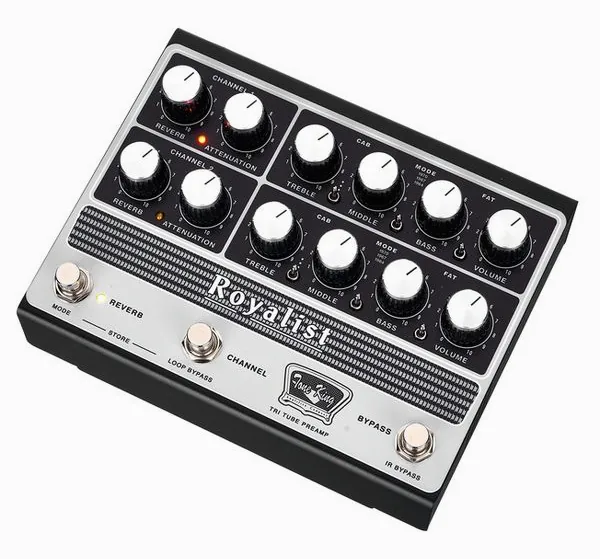
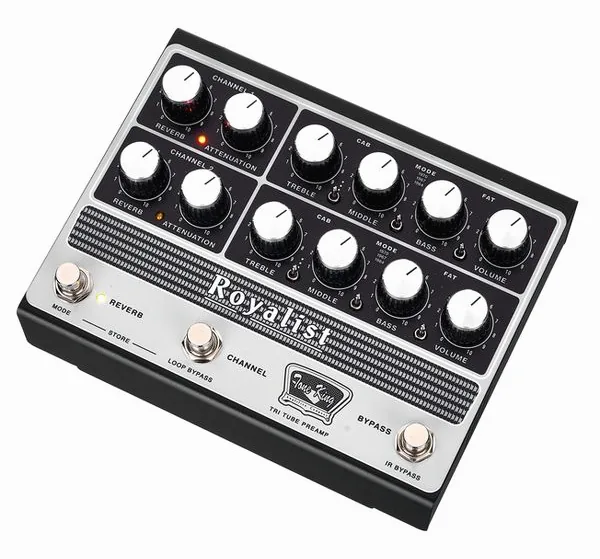
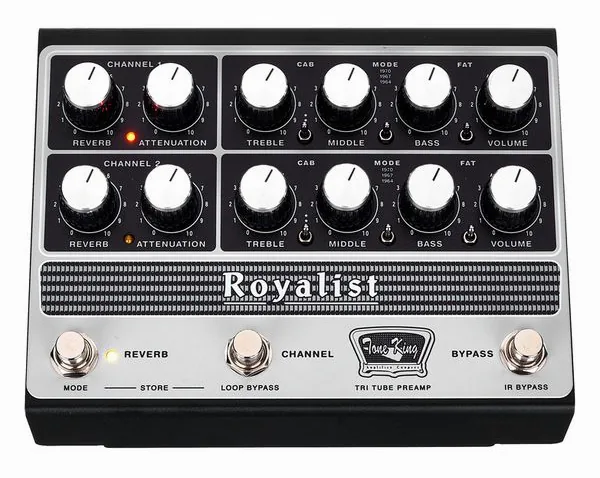
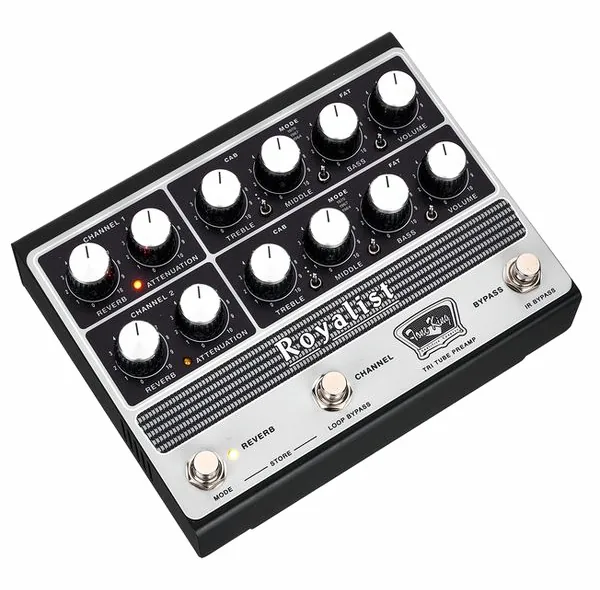
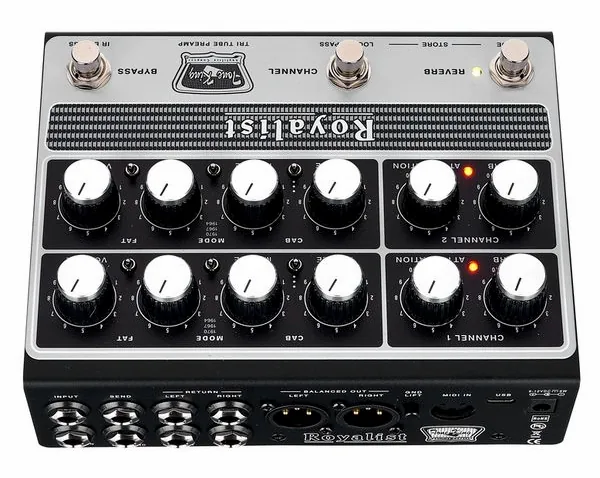
The Royalist MKII measures a portable 183 by 145 by 70 mm and weighs just under 1 kg. Its robust metal chassis supports discrete controls for each channel: Volume, Bass, Middle, Treble, Attenuation, and Reverb. Each channel has three-mode switches for cabinet simulation, preamp voicing (with 1964, 1967, or 1970 British amp flavors), and Fat mode for added thickness. Noteworthy is the lack of footswitch input or expression pedal support; switching between channels or presets is best handled via external MIDI controllers, emphasizing studio or rack-style integration rather than fly-by-foot flexibility.
Sound, Feel, and Voicing
The primary draw is authentic tube response and dynamics, with two completely independent channels. Channel one focuses on 1960s British tones (think treble-heavy, direct, and crunch-ready), while channel two leans into the thicker, more saturated 1970s palette. Both channels deliver classic amp sag and dynamic pushback thanks to the true vacuum tube circuit and zero-watt power amp simulation.
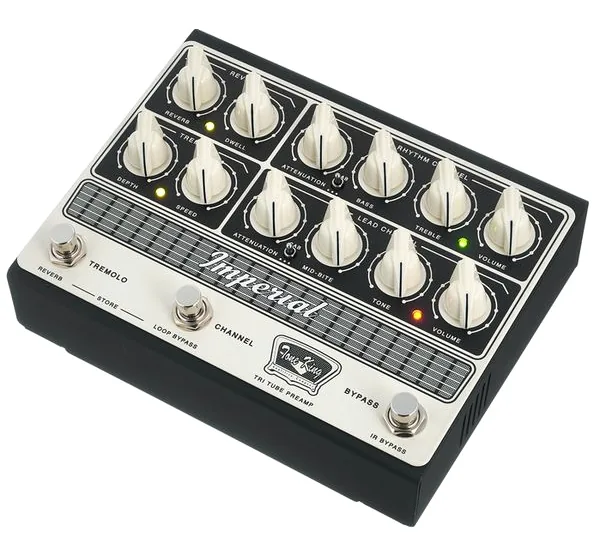
User feedback is mixed on voicing. Many praise the Royalist MKII for faithful and lively harmonic behavior, especially when playing with touch and dynamics; the preamp responds well to picking nuances, bloom, and even yields controlled feedback in the style of classic rock heroes. Side-by-side with the Imperial Preamp, however, several users noticed the Royalist stands out for its pronounced midrange and sometimes overly aggressive treble content, even with the digital high-cut options engaged via the included Tone King Editor software.
In terms of distortion, the Royalist delivers thick, singing overdrive on both channels, and when pushed, can reach classic rock saturation without getting muddy. The Fat switch is particularly effective in adding weight and roundness when paired with single-coil pickups or thinner-sounding instruments.
Digital Features and Routing
The Royalist MKII sets itself apart with extensive digital routing. The pedal runs amp modeling and cabinet simulation through built-in DSP and features exclusive OwnHammer impulse responses for direct-to-mixer or DAW recording. The studio-grade XLR outputs (stereo) are clean, and headphones receive a realistic amp-in-room simulation with the stereo cab IRs. There is no drum computer or integrated tuner, but essential connectivity is present: stereo effects loop (6.3 mm ins and outs), USB-C for integration with the editor/librarian, MIDI in (5-pin), and direct out options.
Attenuation and reverb are onboard, with the latter controllable per channel. The reverb is described as basic, but effective, giving a usable space without overwhelming the dry sound. A handy upgrade over the Imperial model is that reverb state is now remembered after power-down. The pedal is supplied with a 12V DC mains adapter and draws 800 mA, so isolated power is necessary.
Preset Management and Software
You can save up to 128 presets but note an important limitation: gain staging, deep amp settings, and some switch positions are recalled, but actual positions of EQ knobs are not saved with the preset. This means fine-tuning live may require careful attention when recalling sounds. The Tone King Editor enables further tone shaping, including advanced cabinet selection, high/low cuts, and routing tweaks.
In Context: Playability and Practical Feedback
- Input sensitivity and chain position: The input impedance is strictly tuned for instruments. Placing the Royalist in the effects loop of digital modelers like Fractal Audio, rather than at the chain's front, will result in less gain and a different touch response. Even with buffer pedals inserted, some found a significant drop in distortion at drive settings.
- The sound, direct and live: Connected directly to a PA with high-power speakers, the Royalist holds up well in a stereo mix, especially with careful IR selection. In studio monitors, harshness may arise, especially on upper-mids and treble; matching pickup voicing and cab sim is critical here.
- Routing flexibility: The pedal supports four-cable method setups for integration with other systems and responds well to MIDI, but lacks auxiliary input and expression pedal functions, limiting application for those needing on-the-fly volume or parameter control.
- Effects loop: Temporal effects (delay, modulation) run best in the series loop, while drives and compressors should precede the input stage for optimal tone stack response.
- Build: Mechanical construction is robust, though some users mentioned stiff 6.35 mm jack connectors, which may ease with use. The overall feel is that of a professional studio tool rather than a rough-and-ready gigging pedal.
Summary: Who Is This For?
The Tone King Royalist MKII Tri-Tube Preamp is a niche, premium tool for players who prize British-style cleans and overdrive and want both tube warmth and digital convenience. Its British voicings do not aim to mimic the most popular classic amps verbatim, instead carving their own path with assertive mids and a lively bright top end that can be polarizing, brilliant in a busy live mix, sometimes fatiguing in solo situations. The comprehensive routing, recallable presets, and excellent cab simulations offer serious studio or silent-stage value, but some may find the lack of on-board footswitch flexibility limiting. If your tastes lean toward cutting British tones and you enjoy tweaking with both knobs and editors, the Royalist is a confident, characterful choice in the modern analog-digital landscape.
Shipping and duties
The retailer ships from its warehouse in Germany. Prices are shown in US dollars and do not include import duties. Orders under roughly $800 usually clear US customs without duty; above that, a duty of a few percent may be collected on delivery. 30-day money-back and a 3-year warranty apply.
Scores by area
Where it shines, where it stumbles
What convinced me
- Distinctive British-inspired voicings with authentic dynamic response
- High-quality tube preamp delivers convincing amp feel and richness
- Extensive connectivity: stereo out, USB-C, MIDI, headphones, direct balanced XLR, effects loop
- Robust, well-engineered build and premium materials
- 128 user presets and intuitive software editor for deep tone shaping and IR management
What bugged me
- Default voicing is extremely bright and mid-forward, may cause ear fatigue for some
- Limited footswitch and pedal integration; external controller required for full preset access
- Reverb is basic and some may miss onboard tremolo
- EQ controls have a limited effect on taming harsh upper frequencies for certain setups
- Presets do not save EQ knob positions, which can be disappointing for fast recall
Is it the right one for you?
Good pick if
Ideal for guitarists seeking expressive, harmonically rich British-style amp tones with modern routing, direct recording, and silent practice flexibility. Perfect for players wanting tube dynamics and studio-quality cab/mic simulation in a compact format. Suits those comfortable using advanced software editors and MIDI.Look elsewhere if
Not for those preferring rounder, mellower, or dark amp voicings out of the box. Less suited to anyone needing plug-and-play vintage American sounds, extensive footswitch integration, or deeper effect choices like tremolo. Those sensitive to harshness or treble-heavy tones may want alternatives.Suggested level: Intermediate
Specifications
- Design
- Stompbox
- Tube(s)
- Yes
- Amp modeling
- Yes
- Effects
- Yes
- Headphone output
- Yes
- Direct out
- Yes
- Midi interface
- Yes
- Integrated expression pedal
- No
- Connections for pedals or switches
- No
- Aux-input
- No
- Integrated tuner
- No
- Usb-port
- Yes
- Drum-computer
- No
- Effect types
- Preamp
What other players say
Most users praise the preamp's authentic amp feel, robust build, and flexible connectivity, particularly highlighting its lively British voicings and dynamic response at any volume. Several express concern about the inherently bright and mid-heavy tonality, noting that taming harshness requires effort via IRs or EQ. The software editor is considered essential for tailoring the sound, though it cannot fully resolve tonal sharpness for everyone. While routing options impress, some lament the limited footswitch support and basic onboard reverb. The build quality is nearly universally applauded, although some find the jack sockets stiff out of the box. Comparison with the Imperial model appears frequently, with the Royalist favored by those specifically seeking vintage British drive.
You can feel the difference in harmonics and controlled feedback, it's fun and has a sense of warmth.
It sounds very Marshall: a Brit made for rock with ripping upper mids, though some might want a bit more gain.
My only real criticism is that it sounds too bright, sometimes even harsh. Even at maximum high-cut, it can still cause ear fatigue.
Up close
Watch and listen
Questions players ask
Does the Royalist MKII work well as an all-in-one solution for home and stage use?
Yes, its comprehensive I/O, silent cab simulation, headphone output, and flexible routing make it viable both for recording, silent practice, and live gigs. However, the core voicing may need additional EQ or IR tweaks to taste.
Can I use my existing pedalboard with the Royalist easily?
It works best when drive/boost effects are placed before the input and modulation/time-based effects are in the loop, just like a classic amp rig. Integration is straightforward, but compatibility with advanced switching setups (e.g. Four-cable method) may need experimentation.
Is the onboard reverb comparable to classic amp reverbs?
The reverb is effective and channel-assignable, delivering a classic spring-like feel, but is basic compared to dedicated high-end reverb units and lacks tremolo effects.
How easily can you edit and recall presets during a live performance?
Up to 128 user presets are available and can be quickly accessed via MIDI, but a separate controller is needed. EQ knob positions aren't saved, so you must match the hardware controls manually for full consistency.
Will the Royalist suit fans of warmer or more restrained vintage amp sounds?
This preamp is fundamentally voiced for pronounced, bright, and present British character, reminiscent of classic Marshall designs; those seeking mellower or less aggressive tones may need additional EQ or IR shaping, or may prefer other models like the Imperial.
The last word from the bench
The Royalist MKII Preamp excels at reproducing the touch, harmonics, and dynamic feel of classic British amps, enriched by tubes and high-quality onboard cab simulations. While its build and connectivity are top-notch and its tonal range wide on paper, the unit's bright, mid-present core voicing can be divisive. The software and hardware EQ options help but cannot fully tame the pronounced treble for all situations. Best suited for players searching specifically for this kind of aggressive, cutting sound and ready to refine via additional gear or IR choices.
Hanging next to it

Before you decide
Tone King Royalist MKII Tri-Tube Preamp
Today's price and delivery time are shown at the retailer. Affiliate link, your price does not change.
 Guitar Gear Reviews