Strymon TimeLine MX Multi Delay
With powerful dual delay engines, refined algorithms, and top-tier construction, the Strymon TimeLine MX raises the bar for delay pedals.
★★★★★ 5/5 · 1 buyer reviews · 7 min read · updated 2026-10-06 · Tested by Cal Whitaker
Strymon TimeLine MX Multi Delay Review: Dual Engine Redefined
Build Quality, Controls and Interface
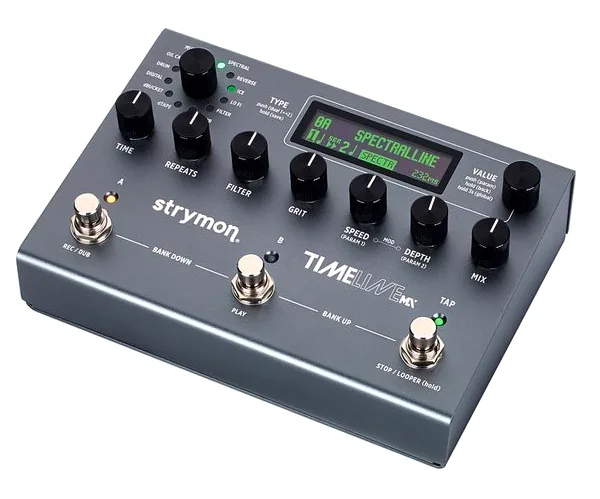
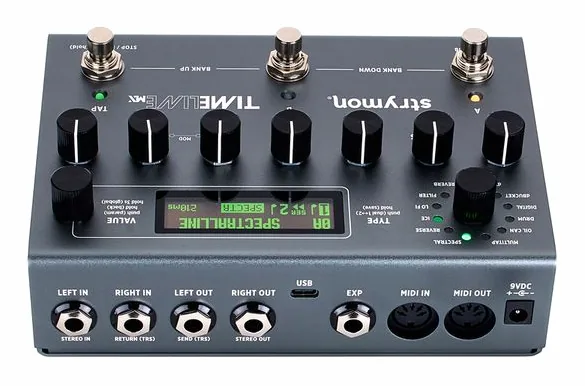
Strymon is known for rugged American-crafted pedals. The TimeLine MX maintains this reputation, with a heavy-duty brushed metal chassis measuring 178 x 127 x 47 millimeters. All jacks and switches feel secure, with no flex or looseness even after repeated foot activation. At 777 currency units, you would expect premium construction, and this unit delivers.
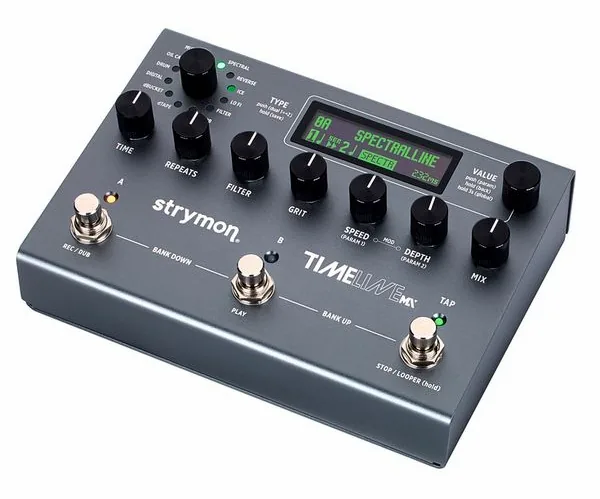
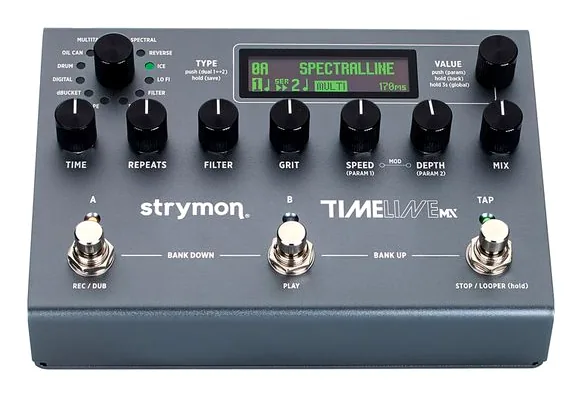
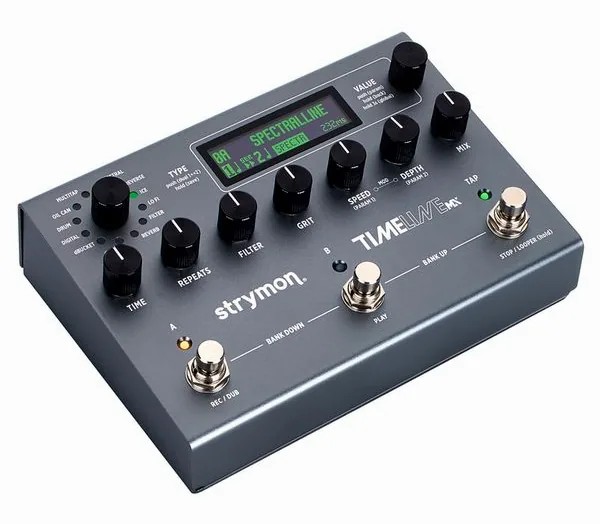
On the top panel, the layout prioritizes usability. Three footswitches cover Effect A On (which doubles for recording and dubbing), Effect B On (for playback), and Tap (which also stops the looper). Above, a full OLED display replaces the older screen, finally offering clear, real-time feedback, preset names, and parameter editing without menu diving. Status LEDs track engine activity and tap tempo at a glance.
Ins and Outs, Power, and Connectivity
Stereo connectivity comes standard, with 6.3 mm stereo jacks for both input and output pairs. External control runs deep: there's an expression input (stereo jack), full MIDI in/out (classic DIN), and USB-C for both updates and MIDI control. You can connect the pedal to a computer or controller for deep integration, ideal for complex live setups or studio automation.
Notably, the power supply isn't included. You'll need a 9V DC adapter with at least 500 mA capacity and a center-negative barrel (5.5 x 2.1 mm). There's no option for battery power. The current draw reflects the demands of a tri-core ARM processor at 800 MHz, which is central to the pedal's enhanced algorithmic capabilities.
Engine Suite: Analog Inspiration, Digital Precision
The TimeLine MX differentiates itself with two fully independent delay engines. You can configure them in parallel or series, vastly expanding creative potential. Each engine features Strymon's newest algorithms: Oil Can for smeared echoes, Spectral for frequency-split delays, Drum for mechanical echo emulation, and MultiTap for complex rhythmic patterns.
Classic algorithms from previous TimeLine generations remain (such as Digital, Tape, and Analog emulations), but they've been refined, offering lower noise, wider dynamic range, and subtle improvements in realism. The new MultiTap Engine is a standout. It provides up to eight separate delay lines per tap, with each tap assignable for pan, level, and independent filtering. With a single sequence from a mono synth, you can build textured, ping-pong patterns, or dense clusters akin to custom reverb, all sculpted at extremely fine granularity.
The result is that MX can sound sparkly-clean, convincingly vintage, or saturated with unique character. Several users report that in combination with hardware synths, even digital-leaning ones, the pedal deepens the sonic palette, pushing tracks into cinematic or experimental territory.
Reverb and Looper: Beyond Delay
Unlike its predecessor, the TimeLine MX integrates a fresh reverb algorithm, giving users delay and reverb without extra pedals. The reverb can be combined with any delay engine for atmospheric sweeps or subtle ambient tails, providing a one-box solution for most modulation needs.
The pedal includes a five-minute high-fidelity stereo looper (not available in the original TimeLine), supporting reverse playback and half-speed options. Looping is straightforward: the left footswitch records or dubs, the middle plays, and the right tap footswitch stops or clears the loop. MIDI control allows for external syncing or remote pedalboard operation. Its stereo architecture and pristine sound make the looper useful for everything from basic practice to complex multi-layered performances.
Sound Shaping and Presets
There are dedicated knobs for core parameters: Mode, Value, Time, Repeats, Filter, Grit, Speed (parameter one), Depth (parameter two), and Mix. These offer immediate access to both traditional delay controls and more experimental settings such as digital artifacting (via Grit), and deep frequency tailoring (via Filter).
All settings, including all combinations of engines and routing, can be saved as named presets. The screen finally makes managing a deep library of sounds practical, users can recall tailored patches within seconds for studio or live needs.
Workflow and Practical Impressions
- Dual Engine Workflow: Tweak delays in series for cascading ambience, or in parallel for competing rhythmic patterns. True/buffered bypass can be switched for either analog-accurate signal paths or seamless digital trails.
- MIDI and Automation: Full MIDI support covers sync, preset recall, parameter automation, and more, both through traditional DIN and USB-C. Keyboardists and synth players will appreciate deep DAW and controller mapping, making the TimeLine MX at home on modern boards and vintage setups alike.
- Use with Synths: In a studio context, the pedal shines when paired with hardware synths for both subtle thickening and intense sound design. MultiTap rhythms, especially, give monosynth lines stereo width and evolving character, while long complex reverbs transform basic patches into immersive soundscapes.
Drawbacks
The TimeLine MX has no battery operation and omits a power supply despite its price. You must use mains power, factoring in the adapter purchase. Also, its depth of features can be intimidating; while the OLED panel and dedicated controls help, users committed to fast, simple stompbox-style operation might find it overkill.
Conclusion
The Strymon TimeLine MX Multi Delay reimagines what a delay pedal can be. It is versatile, deeply programmable, and sonically rich enough to serve as both a classic delay unit and an experimental sound-design tool. With its dual-engine routing, advanced MultiTap capability, integrated reverb, and true stereo looper, Strymon sets a new standard for all-in-one delay and reverb processing. Provided you supply your own power adapter, it is one of the most flexible and inspiring pedals for synth, guitar, and studio users demanding more than just repeats. For those seeking creative depth and pro-grade build, it's a justifiable highlight of the current effects market.
Shipping and duties
The retailer ships from its warehouse in Germany. Prices are shown in US dollars and do not include import duties. Orders under roughly $800 usually clear US customs without duty; above that, a duty of a few percent may be collected on delivery. 30-day money-back and a 3-year warranty apply.
Scores by area
Where it shines, where it stumbles
What convinced me
- Extensive dual delay engines enable flexible routing and deep sound design
- High-quality new delay algorithms, including Oil Can, Spectral, Drum, and Multitap
- Advanced control over each delay tap (pan, level, filtering, etc.) for intricate effects
- OLED display improves usability with clear and precise feedback
- Exceptional build quality, consistent with Strymon's reputation
What bugged me
- Power supply is not included and must be purchased separately
- High price may deter budget-conscious players
Is it the right one for you?
Good pick if
Ideal for experimental musicians, studio producers, and live performers in need of advanced delay and reverb capabilities. Perfect for those seeking detailed control and high sonic quality on both synthesizers and guitars.Look elsewhere if
Not well suited to first-time pedal buyers or players on a strict budget given its premium price. Probably excessive for those only needing simple, bread-and-butter delay effects.Suggested level: Professional
Specifications
- Analog
- No
- Tap feature
- Yes
- Battery operation
- No
- Psu included
- No
- Recording time in minutes
- 5 m
- Usb connector
- Yes
- Midi
- Yes
- Stereo
- Yes
What other players say
Customers praise the TimeLine MX for its rich, analog-like delay sounds, improved algorithms, and detailed control over each effect parameter. Users highlight the dual engine configuration as a breakthrough for creative routing and sound layering, particularly when paired with synthesizers. The quality of construction and clear OLED display are appreciated, though the absence of a bundled power supply is noted as a minor drawback. Overall, the pedal is regarded as a top-tier, versatile solution for musicians seeking depth and character in their delay effects.
Many new algorithms, dual engine, and finally a meaningful display.
The build quality on the TimeLine MX is, like you'd expect from Strymon, absolutely top notch!
What excites me most about the Strymon MX: the new engines like Oil, Drum, Granular, and above all the Multitap Delay.
Up close
Watch and listen
Questions players ask
Does the TimeLine MX require a dedicated power supply?
Yes, it needs a 9 V DC power supply with a 500 mA draw, and one is not included in the box.
Can you use both delay engines at once?
Yes, you can run two delay engines simultaneously, either in parallel or series, for expansive sound layering.
Is the pedal suitable for synthesizers as well as guitars?
Absolutely, the TimeLine MX works well with hardware synthesizers and other electronic instruments, as well as traditional guitar setups.
Does it offer MIDI and USB connectivity?
Yes, it features full MIDI control, including over USB-C, allowing for deep integration with modern studio rigs and controllers.
Can you save presets and name them?
Yes, presets can be saved and named for easy recall, thanks to the user-friendly OLED display.
The last word from the bench
The Strymon TimeLine MX delivers an impressive array of delay and reverb options through its dual engines and new algorithms. The enhanced interface and detailed control cater to demanding studio and live applications alike. Although not the most affordable unit and lacking a bundled power supply, its sonic flexibility and build quality justify the investment. This is a standout release for musicians seeking a comprehensive delay solution.
Hanging next to it
Before you decide
Strymon TimeLine MX Multi Delay
Today's price and delivery time are shown at the retailer. Affiliate link, your price does not change.
 Guitar Gear Reviews