SPL Reducer
The SPL Reducer delivers solid, transparent attenuation for most live and practice needs but lacks modern features and has some tonal compromises at extreme levels.
★★★★☆ 4.4/5 · 64 buyer reviews · 8 min read · updated 2026-10-06 · Tested by Cal Whitaker
SPL Reducer Overview: Simple, Heavy-Duty Attenuation
The SPL Reducer is a passive guitar amp attenuator that sits between your tube amp and speaker cabinet, allowing you to push your amp's output tubes to saturation while keeping overall volume safely in check. It is designed for guitarists who need to manage loud amplifier volumes without impacting tone excessively or making complex additions to their signal chain.
This German-made device supports three selectable speaker load impedances, 4, 8, and 16 ohms, making it compatible with practically any common amplifier/cabinet configuration. Power handling is robust: up to 90 watts RMS at 4 ohms, 200 watts RMS at 8 ohms, and 160 watts RMS at 16 ohms, with even higher peak ratings.
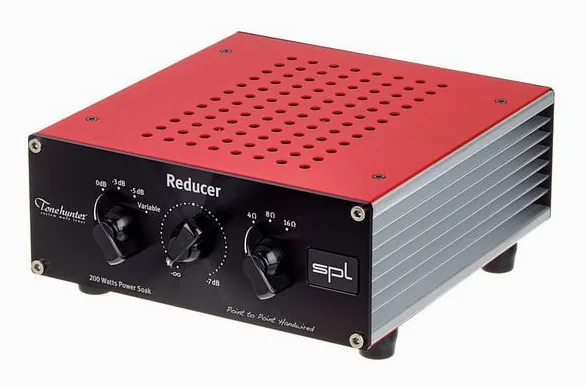
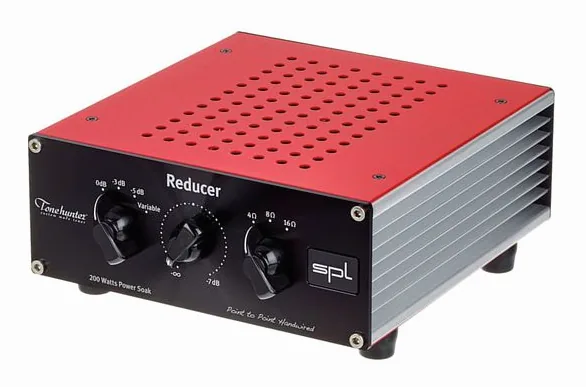
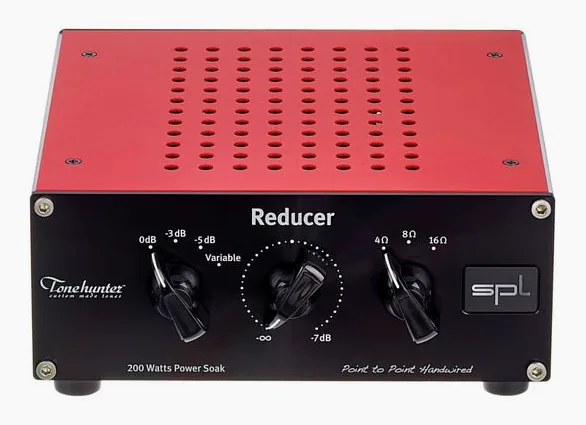
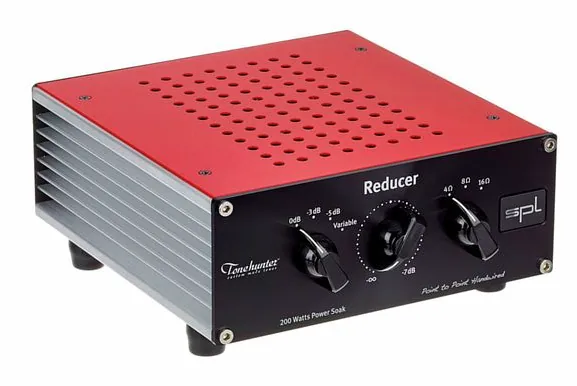
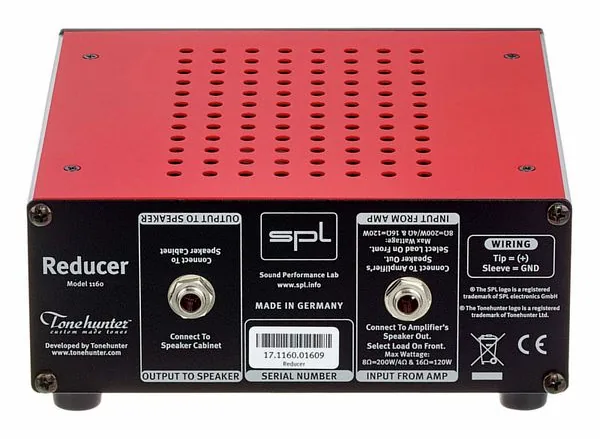
Physical construction is solid, with a steel chassis that includes aluminum side heat sinks, a glossy black front, matte red top cover, and clear labeling both upright and reversed for convenient connection checks. It measures 85 x 208 x 179 mm including feet and knobs, and weighs in at a reassuring 1.8 kilograms. All connections are standard 1/4" mono jacks.
No-Frills Feature Set
The SPL Reducer is all about focus. External controls are limited to an impedance selector and two volume controls: one rotary knob for variable attenuation and another stepped switch for preset reductions (-3, -5, and -7 dB, nominally at 8 ohms). There are no onboard features for noise suppression, direct injection, speaker simulation, recording outputs, or dummy load operation. As such, the Reducer cannot be used for silent recording, your amp must always be connected to a real speaker while in use.
- Pure attenuation: No sound-shaping circuitry, effects, or digital extras.
- Impedance flexibility: Switch between 4, 8, or 16 ohms as required for your rig.
- Connection simplicity: One input from your amp's speaker out, one output to your cabinet.
Performance in Use: What Does It Really Do to Your Tone?
Field experience shows the SPL Reducer meets its core promise: significant reduction of amp volume with most of your amplifier's character preserved. For many players, the Reducer opens up "cranked tube amp" tones at levels safe for homes, rehearsal rooms, and onstage situations where volume limits are enforced.
Sound Quality and Attenuation Effect
User feedback paints a mixed but largely positive picture, especially up to moderate reduction levels. Several owners found the SPL Reducer's passive resistive design to be more transparent than active attenuators, particularly when using amps like Marshall JMPs, Mesa Boogies, or Fender combos up to 100 watts. At -3 dB, most describe only a slight tonal change, slight loss of high-end detail or "air," minor compression of dynamics, but no dramatic color. Some owners report no perceivable impact on tone at all until attenuation becomes extreme. Others note high attenuation settings (approaching -7 dB or fully variable minimum) can muffle the top and bottom ends, constrict dynamics, and noticeably change the amp's feel, especially with modern, high-gain, or very dynamic amps.
One honest caveat: the step size for the -3 dB setting is significant. Because this is measured as a power cut, the resulting perceived volume drop is larger than you might expect (about half as loud), which can be too much for players using lower-wattage amps or hoping for more granular control. The infinite variable knob does allow fine-tuning, but going very close to zero can introduce "fluttering" in volume, subtle, but noted by more than one user at ultra-quiet settings.
Transparency and Sweet Spot Access
Players using classic tube amps (vintage Marshalls, Fender Deluxe, Orange, Mesa Boogie) consistently found they could hit their amp's natural overdrive and harmonic character without making their ears ring or annoying neighbors. Users praised the Reducer's ability to deliver "bedroom-level" volume while retaining much of the amp's punch, crunch, and low-end authority, especially with the main volume pushed and master lowered. For simple band rehearsal or club gigging, the majority report excellent results, no more being told to turn down, no more sacrificing your amp's "sweet spot."
Still, more exacting ears sometimes observed changes in touch sensitivity, and a few noted a noticeable "veil" over their sound at more extreme settings. Some preferred it to more complex load box attenuators, while others found reactive (rather than resistive) attenuators slightly more nuanced at studio levels.
Build Quality and Safety
The build impresses nearly everyone. The chassis is sturdy and the connectors solid. With its aluminum fins, the Reducer stays reasonably thermally managed under most conditions but can get hot with large amps at heavy attenuation, owners recommend letting it cool before touching and never changing impedance on the fly to avoid damage. Many appreciated the layout: front-facing selectors, clear labeling, and practical size for pedalboards or amp tops. Some users taped over the impedance knob for safety in dark gigs, as unintentional switching while powered can be damaging.
Negatives and Limitations
- No direct out or extra features: No line-level output for recording or dual speaker outs, strictly attenuation duty.
- No silent load: Cannot run your amp without a speaker attached.
- Tonal losses exist at high reduction: Expect a trade-off for extreme quiet.
- Initial odor: Some units emit a "new electronics" smell when first used. This typically fades after a break-in period.
- Price: At around $292, it is not the cheapest on the market, but is priced fairly for the quality and German manufacturing.
Real-World Suitability
In practical scenarios, the SPL Reducer is ideal for musicians who don't need line-level recording features or dummy load flexibility, but demand robust power handling, reliable attenuation, and compatibility with several different amps. It excels as a simple utility: plugging in is foolproof, the impedance switch and knobs are intuitive, and performance is consistent across different brands and wattages. For volume control in rehearsal, gig, or home use, the SPL Reducer does exactly what it is supposed to do, nothing more or less.
Conclusion: Reliable, If A Bit Basic
The SPL Reducer delivers on its promise: transparent, reliable attenuation with solid German build quality and multi-impedance support. While it is not the last word in tonal perfection at ultra-low levels and omits advanced features found on pricier units, for straightforward power handling and reliable everyday use, it is a safe, effective choice. If your needs are strictly volume management and you value durability, it justifies its price. For silent recording or ultimate studio transparency, you may want to look elsewhere, but for most guitarists, this device delivers the goods without fuss.
Shipping and duties
The retailer ships from its warehouse in Germany. Prices are shown in US dollars and do not include import duties. Orders under roughly $800 usually clear US customs without duty; above that, a duty of a few percent may be collected on delivery. 30-day money-back and a 3-year warranty apply.
Scores by area
Where it shines, where it stumbles
What convinced me
- Extremely robust, high-quality construction
- Transparent tone with minimal loss at moderate attenuation levels
- Compatible with most amps (4, 8, and 16 Ohm selectable impedance)
- Simple, intuitive operation with clear labeling
- No power supply required; passive circuitry
What bugged me
- Noticeable loss of tone and dynamics at high attenuation
- No line output, recording, or cabinet simulation features
- Impedance selector placement can be risky in dark environments
- Unit heats up significantly with extensive use
- Attenuation steps may be too drastic for low-wattage amps
Is it the right one for you?
Good pick if
Ideal for gigging and home guitarists with multiple tube amplifiers needing to reduce loudness without sacrificing core amp tone. Suits those prioritizing reliability, simplicity, and easy impedance matching in a solidly built product. Good choice for users uninterested in modern digital or recording features.Look elsewhere if
Not meant for players requiring silent recording, cabinet simulation, or detailed feature sets like line outs. Studio professionals needing totally transparent attenuation at extreme volumes, or those seeking precise incremental volume reduction for bedroom use, may find its limitations restrictive.Suggested level: Intermediate
Specifications
- Impedance
- 4, 8, 16
- Noise supression
- No
- Di interface
- No
- Speaker simulation
- No
- Dummy load (usable without cabinet)
- No
What other players say
Customer feedback frequently highlights the Reducer's exceptional build quality, straightforward controls, and reliable attenuation across many amplifier types. Most users find moderate attenuation levels sufficiently transparent for practical band, studio, and home use, with only minimal tonal change. However, some report significant tonal degradation, loss of highs, reduced dynamics, under heavy attenuation or when used with certain amps. Many appreciate the product's simplicity over feature-rich competitors, though its lack of a line out or silent recording capability is often noted. There are rare reports of component failure or issues with the variable knob, but satisfaction is generally high for those prioritizing robust construction and essential functionality.
With SPL REDUCER I finally have true hot tube sound of this excellent amp even in my house. I think its really minimal change of sound even at bedroom level.
It is very simple and easy to use and the minimal features may also preserve the guitar's tone, just like a simple guitar amp when compared to a more complex amp.
Up close
Watch and listen
Questions players ask
Does the SPL Reducer maintain amp tone at very low volumes?
At moderate attenuation levels, the amp's tone is mostly preserved, but at high attenuation settings, a loss of highs and dynamics is noticeable for many users.
Can I use the SPL Reducer for silent recording?
No, this device is not a dummy load and requires a connected speaker cabinet at all times. It cannot be used for silent recording.
Is the SPL Reducer compatible with both tube and solid-state amps?
Yes, the unit is compatible with a wide range of amps thanks to selectable impedance (4, 8, 16 Ohms) and high power handling, but always verify your amp's requirements before connecting.
Does the SPL Reducer include a line-out or DI feature?
No, it does not provide a line-out, direct injection, or recording output; it is solely a passive attenuator for reducing speaker volume.
How hot does the SPL Reducer get during extended sessions?
The unit can become very hot under heavy use, especially at high power. It's recommended to allow cooling time before handling after playing.
The last word from the bench
The SPL Reducer stands out for its rugged build, ease of use, and ability to tame even high-powered tube amps while keeping core tone mostly intact at moderate settings. However, as attenuation increases, noticeable loss of highs and dynamics can occur, especially with modern amps or for recording. Its limited feature set, no direct out, no cabinet simulation, no dummy load, means it's best suited for traditional attenuation rather than as a studio tool. If you need rock-solid reliability and simplicity and can live without extra features, it's a worthwhile investment.
Hanging next to it
Before you decide
SPL Reducer
Today's price and delivery time are shown at the retailer. Affiliate link, your price does not change.
 Guitar Gear Reviews