Source Audio SA 263 Collider Delay+ Reverb
A studio-grade stereo delay and reverb platform filled with features, stunning sound quality, and versatile routing, but with workflow quirks to consider for live use.
★★★★★ 4.8/5 · 43 buyer reviews · 7 min read · updated 2026-10-07 · Tested by Cal Whitaker
Overview: The Studio in a Box Approach
The Source Audio SA 263 Collider Delay+ Reverb targets demanding guitarists, synth players, and studio users who want high-end ambient effects with deep control. At its heart are two independent digital signal processors, both 56-bit, which allow the Collider to run two different effect engines at once: any combination of five delay types and seven reverb algorithms, in series or in parallel. The unit handles full stereo input and output on quarter-inch jacks, and also supports extensive MIDI control via standard five-pin ports and USB, making it extremely adaptable from simple pedalboards to advanced studio routing.
Dual Effects Engines: Delay and Reverb, Doubled Up
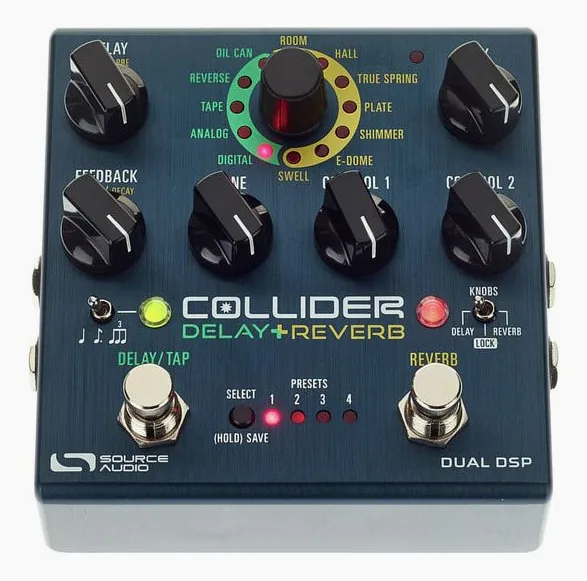
The Collider's structure is built around two independent signal engines. Users can load either or both engines with delay or reverb effects: run delay into reverb, reverb into delay, or even doubles of the same type. On the delay side, you'll find digital, tape, analog, reverse, and oil can flavors, each with distinct personalities modeled after classic circuits and retro effects. The reverb algorithms cover standards such as small room, hall, spring, and plate, plus modern textures like shimmer, "E-Dome," and swell.
- Parallel/Series Routing: It's possible to run effects in parallel, a technique usually reserved for studio racks. This unlocks lush, clean layering, avoiding the muddying when delay and reverb stack in series.
- Programmable Flexibility: Up to eight presets onboard and 120 more via MIDI give plenty of room for frequently used combinations. However, it's worth noting preset storage combines both engines, recalling one always brings its paired partner.
Controls, Layout, and Hardware Build
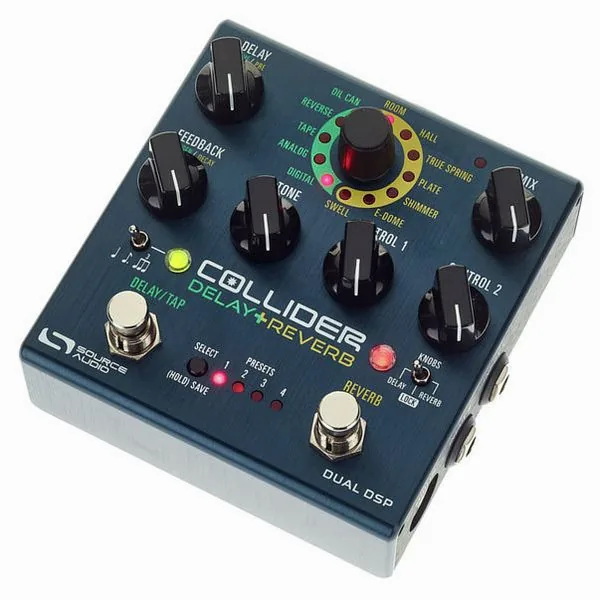
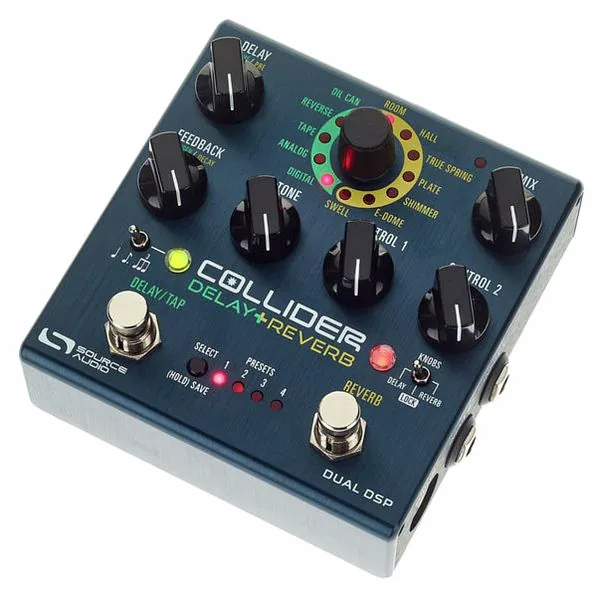
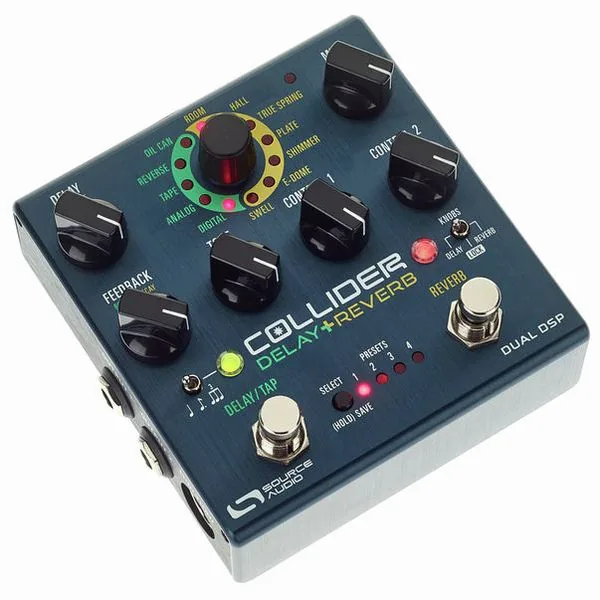
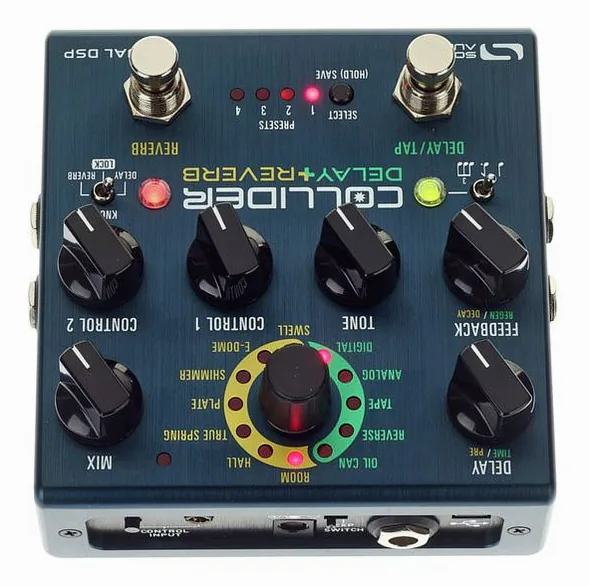
The Collider's interface is compact but not cramped: each of its six knobs (delay, feedback, tone, control 1, control 2, mix) is shared between engines, selected via a physical toggle. A large twelve-way rotary lets you pick among the 12 available engines at a glance, while a tap tempo switch, bypass/preset buttons, and bright status LEDs ensure live feedback.
- Compact Stompbox Form: At only 114 x 114 mm, 51 mm tall, and weighing in at 450 g with a robust, brushed aluminum case, the pedal sits neatly on crowded boards without sacrificing foot control.
- Universal Bypass Options: Analog buffered or relay-switched true bypass can be selected, and, crucially, a true analog dry-through path ensures your unaffected signal never hits converters.
- No Battery Power: The unit requires a 9V DC supply (not included) and draws a hefty 280mA, so dedicated power is mandatory. Connections are industry-standard for ins/outs and power.
Algorithm Quality: Sound and Feel
User reports confirm what the specs suggest: Collider leverages high-end algorithms derived from Source Audio's flagship Ventris (reverb) and Nemesis (delay), but streamlines the selection for focus and workflow. The delays land with presence, a modulated tape voice with analog warmth, tape echo with believable degradation, and a pristine digital echo for crystal-clear repeats. Subtlety or excess is available on tap.
On the reverb side, users highlight naturalism, clarity, and depth, comparing favorably even to Eventide and Strymon units. The shimmer and E-Dome effects, in particular, support both ambient washes and dramatic, modern sounds. Spring reverbs, especially the true spring, are described as touch-responsive and dynamic, rare for digital units.
Usability and Advanced Features
- MIDI and Editor Integration: Full MIDI implementation allows integration with DAWs, sequencers, or a MIDI controller, key for preset changes, parameter sweeps, or tempo sync. The mini USB port and Source Audio's Neuro editor open deep control, allowing every hidden parameter to be dialed in, from effect order to modulation rates and beyond.
- Hardware Shortcuts and Live Tweaks: Even without a computer or MIDI, the pedal remains highly playable: essential controls are always accessible, and hardware shortcuts cover real-world live needs once learned. Expression-pedal input supports sweeping multiple parameters hands-free.
- Routing Limitations: Notably, switching between engines (say, from tape delay to digital delay) does not offer seamless "trails," so audio will drop if changing engine types live. Trails are only supported when engaging/disengaging (not swapping) engines.
- Preset Management: One design trade-off: presets recall both engines together, rather than independently, which can frustrate improvisers wanting to mix-and-match live. Sophisticated setups benefit from MIDI banks, but non-MIDI users may find this limiting.
Field Experience and Use Case Insights
Reports from guitarists, synth players, and even vocalists and mixers point to studio-class flexibility. Many highlight its dead-quiet noise floor, pristine stereo image, and reliable analog dry path. For pedalboard minimalists, Collider replaces at least two pedals, and its space-saving matters. Some found complexity higher in the beginning, but most adapted quickly, especially with the streamlined desktop/mobile editor.
On stage, instant access to up to eight onboard presets combined with robust footswitches enables real-time changes (with caveats mentioned for preset pairing and trails). Full MIDI control solves most deeper needs, but some users note steeper learning curves when integrating with advanced switching systems.
Conclusion: Who Is It For?
The Source Audio SA 263 Collider Delay+ Reverb delivers an unusually high concentration of studio-grade delays and reverbs, with authentic personality and almost unlimited routing for $369. For artists in need of seamless, dual-engine ambient textures, deep sound sculpting, and compact footprint, it stands out as a best-in-class option. Power-users should be prepared to invest time in setup and explore the Neuro editor to reveal its full range, and be aware of the trails/preset limitations. As a dual-engine, stereo ambient workhorse, it is a clear winner for studio and advanced boards, with only minor quirks for live improvisers.
Shipping and duties
The retailer ships from its warehouse in Germany. Prices are shown in US dollars and do not include import duties. Orders under roughly $800 usually clear US customs without duty; above that, a duty of a few percent may be collected on delivery. 30-day money-back and a 3-year warranty apply.
Scores by area
Where it shines, where it stumbles
What convinced me
- Exceptional sound quality with multiple delay and reverb algorithms
- Full stereo input/output and flexible routing options including parallel, series, and dual-effect configurations
- Robust build quality in a compact brushed aluminum enclosure
- Highly programmable with onboard presets (up to 8) and extensive MIDI control
- Deep editing possible via the Neuro software, with advanced preset management
What bugged me
- Settings for reverb and delay share the same knobs; requires toggling and can be confusing live
- Changing effect engines causes short audio dropouts, making seamless preset switching difficult on stage
- Some advanced parameters and MIDI setup only accessible via software (PC/Mac/iOS)
- No power supply or USB cable included
- Input/output jacks are side-mounted, increasing pedalboard space with cables connected
Is it the right one for you?
Good pick if
Ideal for studio-based musicians, sound designers, and pedalboard users seeking top-quality stereo delay and reverb in a highly programmable format. Superb for those who want flexible routing, deep MIDI integration, and world-class sound from a compact pedal. Great for users who enjoy fine-tuning their effects chain, whether for guitar, synthesizer, or studio insert applications.Look elsewhere if
Not suited for players who need seamless, instant preset switching in live performance without any audio dropouts or those who prefer all parameters immediately accessible via hardware. Also less ideal for musicians who do not want to rely on external editors or software for deep configuration, or who find compact interfaces with shared controls confusing in fast-paced settings.Suggested level: Professional
Specifications
- Analog
- Yes
- Tap feature
- Yes
- Battery operation
- No
- Psu included
- No
- Input/output configuration
- stereo in / stereo out
What other players say
Customer feedback overwhelmingly praises the Collider's sound quality, flexibility, and depth, many users compare its effects to high-end studio units and appreciate its compact form factor and robust build. The dual-engine design and extensive preset/MIDI capabilities are highlighted as major strengths, especially for studio work, sound design, and hybrid pedalboard/DAW setups. Some challenges are mentioned regarding live use due to audio dropouts when changing presets or algorithms, and several users cite the need to rely on the Neuro editor for advanced configuration or MIDI operation. The shared control interface receives mixed feedback: many see it as a fair compromise for space and price, while live performers describe it as a workflow limitation. Overall, users recommend it highly for both quality and versatility, with only a few expressing reservations based on feature access and live operational quirks.
At the cost of one good pedal you get two, and 'perfectly playable.'
High end algorithms (many, unlike several other combo pedals) that make sense and each have a specific personality.
But the best feature, which alone makes this pedal worth the upgrade, is the ability to run delay and reverb in parallel.
Up close
Watch and listen
Before you decide
Questions players ask
Does the Collider let you run delay and reverb effects in parallel, and can you change their order?
Yes, the Collider lets you route effects in parallel, delay-into-reverb, reverb-into-delay, or even use dual delays or reverbs. This flexibility is accessible onboard and further enhanced via the editor.
How many presets can be stored and how are they accessed?
You can save up to 8 presets onboard and access up to 120 additional presets via MIDI, making it highly extendable for complex setups.
Is live preset switching seamless, or do you notice sound dropouts?
Switching algorithms or presets can cause short audio dropouts or tails to cut off, which can interrupt live performances. Firmware updates have improved this, but issues may persist depending on use.
Do I need the Neuro app for deep editing, or can everything be programmed from the pedal?
Essential parameters are accessible on the pedal, but advanced features (detailed parameter editing, MIDI channel assignment, complex routing, and full preset management) require the Neuro software for PC, Mac, or select mobile devices.
Is it compatible with both guitars and other instruments like synthesizers or vocals?
Absolutely. Its stereo IO, flexible wet/dry control, and analog dry path make it a great fit for guitars, synths, keys, and vocals. Users have successfully integrated it in both instrument and mixer insert configurations.
The last word from the bench
Source Audio's Collider Delay+ Reverb combines genuinely top-tier delay and reverb effects in a pedalboard-friendly, stereo package. Its dual-engine layout, deep presetting, and MIDI compatibility make it a favorite for home studios and sound designers. Some operational quirks, most notably audio dropouts when switching presets or engines, hinder seamless live use. Overall, it excels as an all-in-one ambient toolkit for musicians and producers seeking quality and flexibility.
Hanging next to it
Source Audio SA 263 Collider Delay+ Reverb
Today's price and delivery time are shown at the retailer.
 Guitar Gear Reviews