 Guitar Gear Reviews
Boss SY-1000 Guitar Synthesizer
The Boss SY-1000 sets a new benchmark for guitar synthesis and modeling with unrivaled sound design flexibility, but requires patience to master.
★★★★★ 4.7/5 · 15 buyer reviews · 7 min read · updated 2026-09-22 · Tested by Cal Whitaker
Shipping and duties
The retailer ships from its warehouse in Germany. Prices are shown in US dollars and do not include import duties. Orders under roughly $800 usually clear US customs without duty; above that, a duty of a few percent may be collected on delivery. 30-day money-back and a 3-year warranty apply.
Scores by area
Where it shines, where it stumbles
What convinced me
- Unmatched sonic versatility, covering synth, conventional guitar, bass, and layered sounds
- Extremely high-quality construction and robust chassis
- Extensive connectivity for studio and stage use, including USB audio, MIDI, and multiple outputs
- Customizable instrument and effect chains for deeply personalized patches
- Rich, gig-friendly amp and effect selection from the flagship lineup
What bugged me
- Steep learning curve with a non-intuitive workflow, demands significant programming effort
- No onboard looper or integrated expression pedal
- Default presets often underwhelm and require editing for best results
- Tracking for MIDI and legacy pickup systems not always reliable, limiting DAW MIDI control
- No ability to load custom impulse responses (IRs) or Bluetooth connectivity
Is it the right one for you?
Good pick if
Ideal for adventurous guitarists, multi-instrumentalists, and sound designers keen to explore advanced synthesis and guitar modeling. Excellent for live performers, session musicians, and those seeking to consolidate their rig or create custom sounds for creative projects. Musicians comfortable with deep editing and looking for a reliable, stage-capable processor will find this a powerful tool.Look elsewhere if
Not for beginners, plug-and-play seekers, or players needing instant results with minimal tweaking. Musicians looking for rock-solid MIDI tracking for DAW integration or those unwilling to invest effort into sound design may be frustrated. If you only seek traditional guitar effects without synthesis, there are simpler and more cost-effective options.Suggested level: Professional
Specifications
- Current consumption
- 800 mA
- Dimensions (w x d x h)
- 345 x 245 x 67 mm
- Weight
- 2500 g
- Controls
- 1 to 6
- Push buttons
- Inst, Effects, CTL, Exit, Write, System, Page Up and Down
- Led
- Backlit Graphic LCD (512 x 160 dots)
- Footswitches
- Bank Up and Down, CTL 1 and 2, 1 to 4
- Power supply connection
- Barrel connector 5.5 x 2.1 mm, negative polarity inside
What other players say
Customer opinions emphasize the SY-1000's powerful synthesis and modeling abilities, robust build, and expansive creative potential, particularly for experienced players willing to dive deep into editing. Praise centers on its unique instrument layering and realistic emulations, while criticism targets the steep learning curve, lack of plug-and-play simplicity, absence of a looper, and sometimes disappointing factory presets. The tracking and MIDI features receive mixed feedback, excelling for sound design but falling short for precise MIDI control in DAW environments. Most consider it a worthwhile investment for the ambitious, sound-focused guitarist.
There's a steep learning curve as all the sounds need to be programmed.
The guitar sounds in this box are more than enough for someone like me.
Preset sounds are mostly rubbish, and the delving necessary to get more out of it, I just don't have time for.
Up close
Watch and listen
Questions players ask
Does the SY-1000 work with standard guitar pickups, or is a 13-pin system required?
It supports both standard instrument inputs and 13-pin Roland GK-style pickups, though full synth and alternate tuning features require a 13-pin connection.
Is there a built-in looper or can you use the SY-1000 standalone for looping?
No onboard looper is provided; external hardware or software is needed if you require looper functions within your setup.
Can the SY-1000 send MIDI data to control virtual instruments in a DAW?
It can send MIDI data, but user feedback notes unreliable tracking for MIDI note input, making it less suitable for precise DAW MIDI control compared to newer generation systems.
How user-friendly is the interface for patch creation and editing?
Expect a learning curve; while the interface is logically organized, deep editing and understanding the signal flow are required for unlocking the unit's full potential.
Are the factory presets ready to use for live gigs, or do they require tweaking?
Many users find factory presets uninspiring out of the box; substantial editing is often necessary to achieve professional results for live or studio use.
Introduction
The Boss SY-1000 Guitar Synthesizer stands as Boss's most advanced unit for guitar and bass synthesis and modeling. Priced at $975, it targets players who demand deep programmability, massive sonic flexibility, and robust integration both live and in the studio.
Hardware and Build Quality
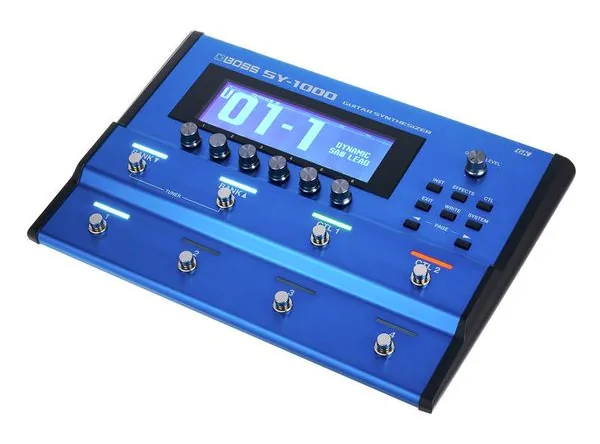
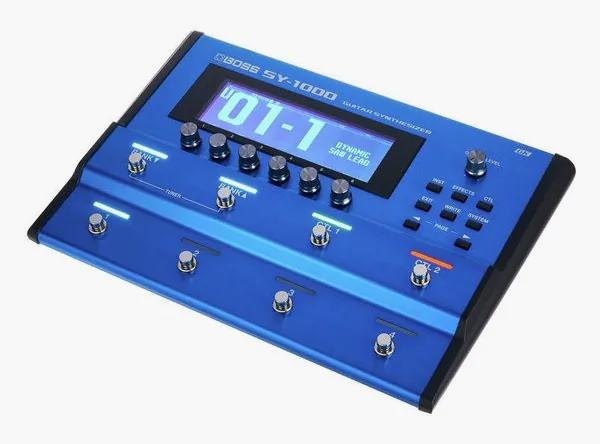
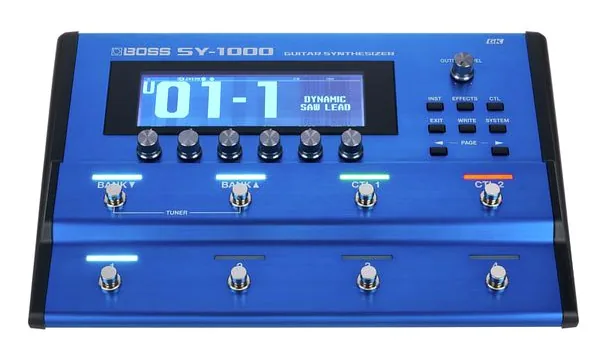
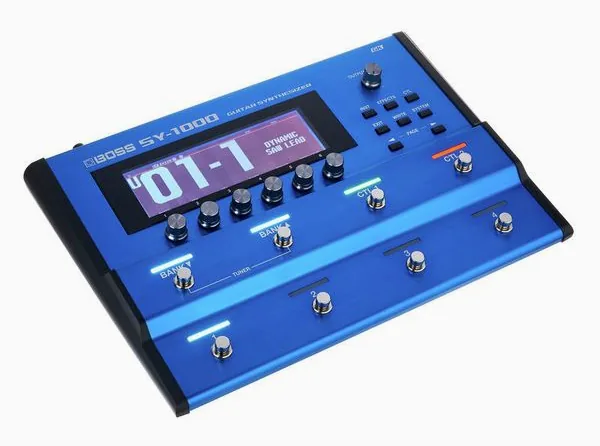
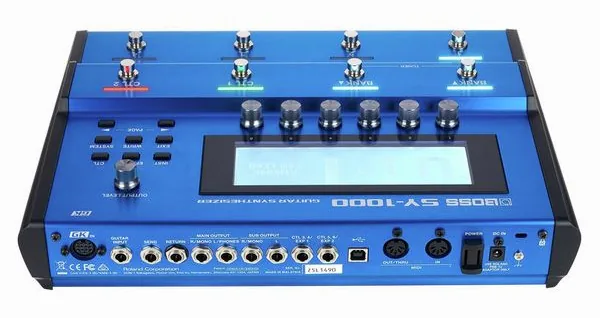
The SY-1000's chassis is firmly built, weighing in at 2.5 kg and measuring 345 x 245 x 67 mm. The footswitches and buttons are solid underfoot and hand, prioritizing reliability. Controls include six main rotary selectors, a bank of function push buttons (for instrument switching, effects, control assignment, patch writing, navigation), and four main footswitches alongside dedicated bank and control switches. The backlit graphic LCD is readable in various lighting, though some users comment that a larger screen would improve multi-layer programming.
Connectivity
- Integrated 13-pin input for divided pickups such as Roland/Boss's GK-3, opening up advanced pitch and tuning features.
- Standard 6.3 mm instrument input allows traditional guitars to access much of the signal processing, amp modeling, and effects chain.
- Comprehensive output section: Main (stereo), Sub (stereo), headphone jack, stereo jacks for external controllers or expression pedals, plus full USB audio/MIDI, and MIDI In/Out/Thru.
- A 9V DC power adapter is included, and current draw is specified at 800 mA via a 5.5 x 2.1 mm barrel connector.
Synthesis and Signal Processing
The heart of the SY-1000 is a DSP engine designed for next-generation synthesis at 48 kHz, 32-bit processing. It supports three parallel synth or instrument voices, each independently configurable. Historic models (including "OSC Synth," "GR-300," electric and acoustic guitar, bass, and Poly FX) sit alongside the new Dynamic Synth, which tracks the guitar's natural envelope with surprising accuracy. Step sequencers (two, 16-part each) provide automation over pitch, filtering, and amplitude, allowing evolving, layered sounds far beyond one-dimensional patches.
Pitch, level, and stereo placement of each string can be controlled separately when using the divided pickup. With this, open tunings, non-standard splits, and customized string assignments are instantly available and respond in real time, a big advance for anyone needing complex arrangements or orchestration on a single instrument. However, this string-level processing is not available in regular instrument mode.
Sound Quality and Playability
User feedback indicates that the amp and effects processing is inherited directly from Boss's GT-1000 flagship, with high-quality overdrives, fuzzes, modulations, delays, and reverbs. Clean electric, steel and nylon acoustic, and especially twelve-string emulations are singled out for realism and clarity, even described as "almost hyperreal" when using divided pickups. Synth-focused users praise the density and musicality of the Dynamic Synth and GR-300 models, noting that complex pads, arpeggios, and sequenced motifs are easy to generate (if not to program initially).
Latency is low, typically remaining imperceptible during intricate playing, with a few users detecting slight delay when using aggressive, staccato techniques. Tracking accuracy with the GK-3 pickup is generally solid for most synth sounds, but users looking for flawless MIDI conversion into DAWs report inconsistent pitch detection and note glitches, especially compared to Boss's newer GM-800 paired with an updated pickup. Note, too, that classic sampled instruments (piano, flute, saxophone) are absent from the SY-1000, a downgrade for some coming from earlier Roland models like the GR-55.
Programming and User Interface
The SY-1000 is not "plug and play." The internal logic follows the Boss multi-engine tradition: you build sounds from instrument and synth blocks, assign effects, and program variation sets for use across presets. Editing is handled via the panel and a backlit LCD, with the Boss Tone Studio desktop application as the companion for deeper patch editing and management (including easy access to a large user patch library via Boss Tone Central).
User reports converge on a steep initial learning curve, especially for musicians new to synthesizer concepts like low-frequency oscillators or multilane sequencing. The interface is organized and logical, rewarding users willing to invest time, but factory presets are often seen as uninspiring or not stage-ready. Most power users recommend bypassing the preset library in favor of crafting tailored sounds, once done, the rewards are enormous, and patch switching is immediate and reliable.
Practical Use: Live, Studio, and Creative Applications
- Live players value the all-in-one flexibility. With access to synths, guitars, amps, and effects in one floor unit, setup is drastically simplified and performance options multiplied.
- Studio users appreciate the quality of USB audio and the unit's role as a sound interface, though serious MIDI controllers looking for full-string-to-MIDI conversion may be disappointed.
- In creative workflows, the SY-1000 can act as a sound design playground, layering, sequencing, and transforming instruments well beyond ordinary pedalboards or rack setups.
The robust housing and stage-ready outputs are matched by a strong community and patch-sharing ecosystem. However, lack of impulse response loading and Bluetooth connectivity (present in some competitors) may be missed depending on workflow.
Verdict
The Boss SY-1000 is a professional-grade synth and effects processor, excelling in flexibility, build quality, and sound creation potential for guitar and bass. Its real magic is unlocked by users willing to learn its architecture and design their own sounds. If instant gratification is your goal, the complex editor and deep menu may prove frustrating. But for sonic explorers, the SY-1000 is among the most dynamic, expressive, and powerful platforms of its kind, an investment in both sound quality and boundary-pushing versatility.
Pros:- Unmatched synthesis, modeling, and effects flexibility for guitars and basses
- Extremely robust build quality
- Inspiring sound engine with advanced parameter control per string
- Deep editor with good desktop integration
- Low latency and reliable tracking for most real-time use
- Steep learning curve for newcomers
- MIDI note tracking for DAW use is not yet competitive with newer models
- No classic sample-based sounds or impulse response support
- No onboard looper or built-in pedal
- Sparse stock presets for immediate stage use
The last word from the bench
The Boss SY-1000 is a powerhouse for creative guitarists eager to explore synthesis and advanced modeling, offering immense sound-shaping power and top-notch build quality. Its demands for in-depth programming and familiarity with synthesis may deter beginners or those expecting instant gratification. Its strengths reveal themselves when building custom patches and leveraging its unique layering capabilities, both on stage and in the studio. While not flawless, it stands out as a premium choice for ambitious musicians seeking to push sonic boundaries.
Hanging next to it

Before you decide
Boss SY-1000 Guitar Synthesizer
Today's price and delivery time are shown at the retailer. Affiliate link, your price does not change.