Polyend Press
The Polyend Press delivers versatile, studio-quality analog stereo compression in a rugged, compact format.
★★★★★ 4.5/5 · 2 buyer reviews · 6 min read · updated 2026-10-06 · Tested by Cal Whitaker
Overview: The Polyend Press Stereo Analog Compressor
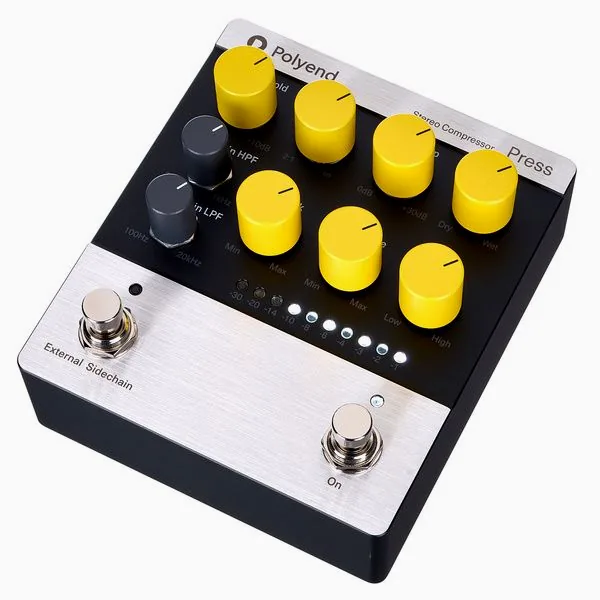
The Polyend Press is an analog stereo compressor designed for guitarists and synthesizer users seeking precise dynamics control in a small package. Launched in February 2026, it enters the market at a mid-tier price point of 385. With an all-aluminum case, a wide range of adjustment options, and configurations tailored for both instruments and line-level sources, the Press targets both studio and live applications where audio transparency and versatility are required.
Design and Build Quality
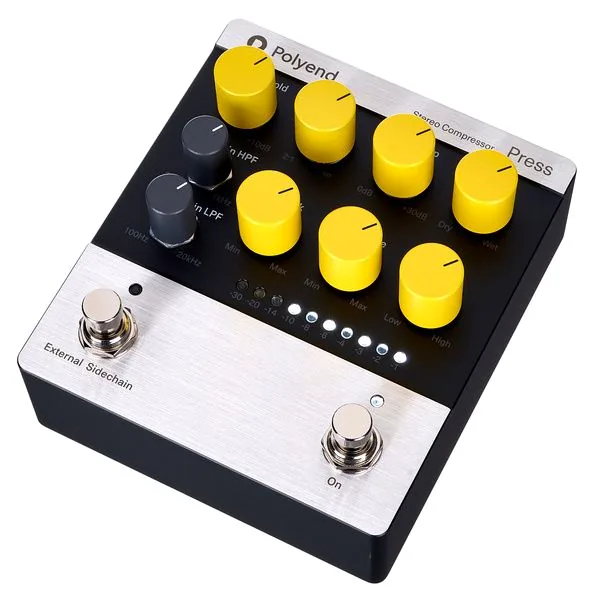
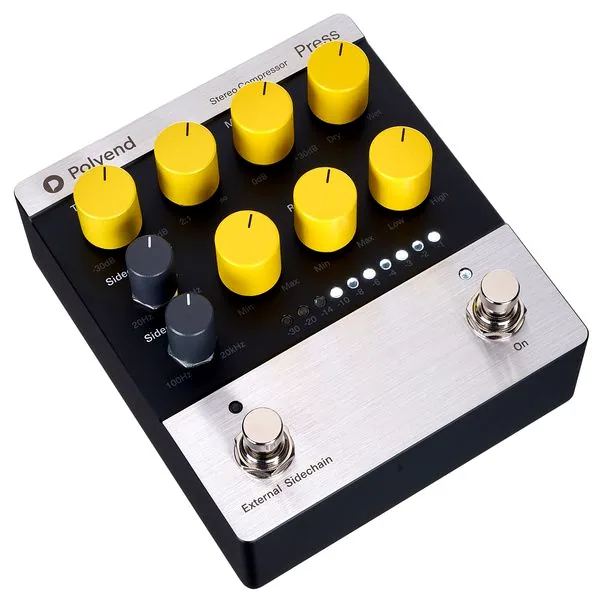
The Press measures 120 by 100 by 57 millimeters and weighs 0.6 kilograms, making it highly portable for mobile setups or cramped pedalboards. The unit's all-aluminum construction ensures durability and heat dissipation in demanding environments. All input and output connections are provided by two pairs of quarter-inch balanced jacks, compatible with both line-level and instrument signals. An external 9-volt DC power supply is required and not included, drawing a modest 400 milliamperes.
Compressor Circuit and Control Layout
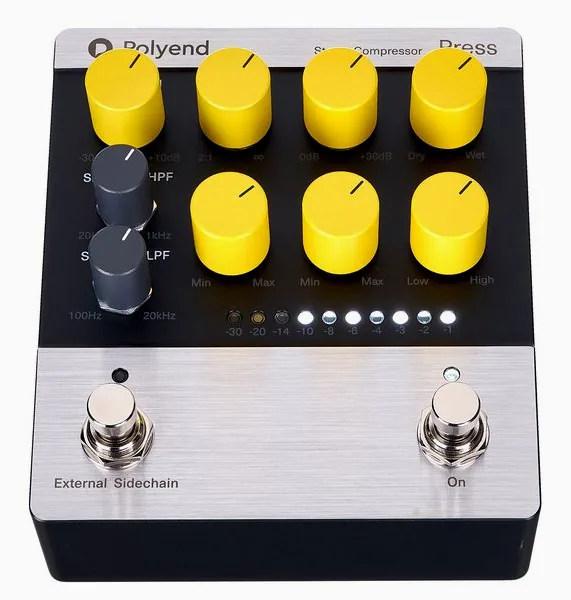
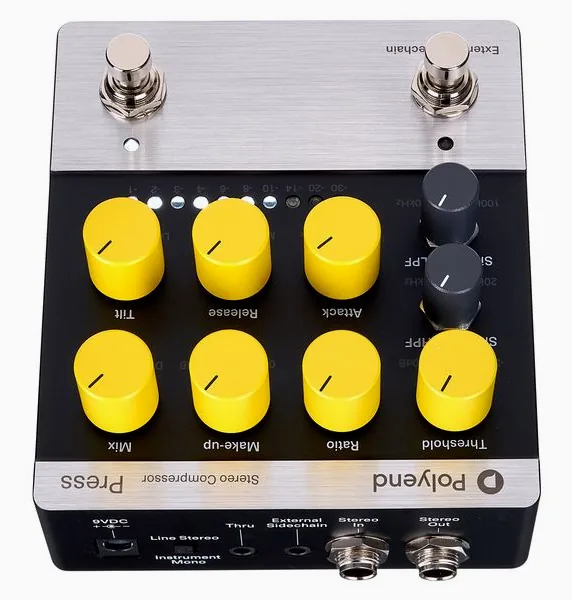
At its core, the Press employs a fully analog compressor circuit, handling stereo signals with dedicated controls for ratio, threshold, attack, and release. Adjustment ranges are broad enough to cover subtle leveling or aggressive limiting:
- Threshold: -30 decibels up to +10 decibels, accommodating both hot and quiet signals
- Ratio: 2:1 to true limiting (infinite ratio), supporting light compression or hard limiting
- Attack: Fastest setting at 0.1 milliseconds; slowest at 30 milliseconds
- Release: 100 to 1000 milliseconds for detailed envelope shaping
- Makeup Gain: Provides up to 30 decibels of amplification to compensate for gain lost during compression
A front-panel mix knob allows for wet/dry blending, enabling easy parallel compression, a technique where compressed and uncompressed signals are combined for more natural transients with controlled dynamics. This expands creative use beyond basic leveling.
Connectivity and Versatility
The Press features dual balanced inputs and outputs, each on 6.3 millimeter (quarter-inch) stereo jacks, suitable for integrating into keyboard rigs, recording chains, or pedalboards. Impedance selection is smartly implemented: a line input impedance of 20 kilo-ohms and a dedicated instrument input impedance of 1 mega-ohm ensure compatibility without unwanted tonal coloration for both electric guitars and synth outputs. Output impedance at 100 ohms matches well with most mixers and audio interfaces.
Stereo sidechain options are a notable inclusion. The Press handles internal or external sidechain detection, opening classic bus compression or creative pumping effects using an outside audio source. Sidechain filtering adds more depth: on-board high- and low-pass filters let users sculpt which parts of the incoming signal influence the gain reduction, avoiding unwanted pumping from kick drums or overly bright sources.
Frequency Response and Headroom
Polyend specifies a frequency response from 20 hertz to 20 kilohertz, with a deviation of no more than 3 decibels across the spectrum. This ensures transparency and minimal loss of fidelity, crucial for both high-end synthesizers and full-range guitar signals. The makeup gain section's generous range (up to 30 decibels) gives the flexibility to drive following devices or reclaim perceived volume after heavy compression.
Application and Use Cases
The Press accommodates a variety of setups. Its dual impedance input circuit means guitars can be plugged straight in without a separate buffer or pedal, while synths and effects return lines are equally supported. The analog circuit path caters to users who value warmth and character over the sterile response of digital processing. Live performers, pedalboard users, and compact desktop studios will appreciate the minimized footprint paired with fully stereo operation and comprehensive control layout.
The external sidechain and onboard mix control mark it as more than a basic stereo compressor. Engineers can push creative boundaries, achieving everything from side-chained synth sweeps to modern, parallel-compressed drums within a streamlined analog workflow. The tilt equalizer on the wet signal further tailors tonal emphasis, acting as a broad spectral shaper for the compressed path only, useful for correcting overly dark or bright sources after compression.
Power and Additional Considerations
With a 9-volt DC requirement and no supply included in the box, users must source a compatible adapter capable of 400 milliamperes. Standard pedalboard power supplies will often fit the need but care should be taken to supply clean, regulated power due to the sensitivity of analog audio circuits. Maintenance is straightforward, with the aluminum housing resistant to stage wear and easily cleaned.
Conclusion: An Analog Compressor with Flexible Routing
The Polyend Press stands out for its combination of stereo analog compression, broad control flexibility, and advanced routing features within a compact, robust chassis. Its appeal stretches from guitarists and synthesizer enthusiasts to studio engineers looking for a versatile, hands-on dynamics processor. The absence of digital circuitry guarantees a classic compression sound with modern usability. The inclusion of parallel blending, sidechain filtering, and a tilt equalizer makes the Press a well-rounded tool for creative and corrective compression tasks in both live and studio contexts.
Shipping and duties
The retailer ships from its warehouse in Germany. Prices are shown in US dollars and do not include import duties. Orders under roughly $800 usually clear US customs without duty; above that, a duty of a few percent may be collected on delivery. 30-day money-back and a 3-year warranty apply.
Scores by area
Where it shines, where it stumbles
What convinced me
- Wide range of compression options with adjustable threshold, ratio, attack, and release
- True stereo operation with both internal and external sidechain control
- All-aluminum housing offers durability and solid build quality
- Flexible sidechain filtering with high and low pass options
- Parallel compression and Tilt-EQ expand tonal shaping
What bugged me
- External power supply not included
- Relatively high price for a compact compressor
- No preset storage or digital recall
Is it the right one for you?
Good pick if
Ideal for studio engineers, guitarists, synthesizer users, and electronic musicians looking for flexible analog stereo compression in a portable form. Great for those who value features like parallel compression and advanced sidechain filtering.Look elsewhere if
Not suitable for beginners seeking a simple compressor pedal or those on a tight budget. Unsuitable for users who need digital features like preset storage or recall.Suggested level: Professional
Specifications
- Input impedance
- Line 20 kOhm / Instrument 1 MOhm
- Output impedance
- 100 Ohm
- Frequency range
- 20-20,000 Hz (-3 dB)
- Threshold
- -30 dB bis +10 dB
- Ratio
- 2:1 up to limit
- Attack
- 0.1 - 30 ms
- Release
- 100-1000 ms
- Makeup gain
- 0-30 dB
- Input
- 2 x 6.3 mm TRS jack
- Output
- 2 x 6.3 mm TRS jack
- Power supply
- 9 V DC, 400 mA (power supply not included)
- Dimensions
- 120 x 100 x 57 mm
- Weight
- 0.6 kg
Up close
Watch and listen
Questions players ask
Is the Polyend Press suitable for both guitar and synthesizer setups?
Yes, it provides switchable input impedance for both line and instrument signals, making it ideal for guitars and synthesizers.
Does the Polyend Press have true stereo compression?
Yes, it features true stereo inputs and outputs, plus stereo sidechain options.
What power supply is needed for the Polyend Press?
It requires a 9V DC power supply rated at 400 mA, which is not included.
Can you use external sidechain sources?
Yes, the unit allows for both internal and external stereo sidechain control.
Does the Polyend Press provide any EQ shaping?
Yes, there is a tilt equalizer on the wet signal and sidechain high and low pass filters.
The last word from the bench
Polyend Press stands out with its broad feature set, including real stereo processing and extensive sidechain control, appealing to demanding guitarists and synthesizer users. Its robust aluminum housing ensures long-term reliability, and onboard parallel compression adds to its sonic flexibility. While its premium price and lack of included power supply may deter some, its sound-shaping capabilities make it a compelling choice for those seeking studio-grade compression in a pedal format.
Hanging next to it
Before you decide
Polyend Press
Today's price and delivery time are shown at the retailer. Affiliate link, your price does not change.
 Guitar Gear Reviews