J. Rockett Audio Designs Archer Ikon
The Archer Ikon delivers convincing Centaur-style boost and overdrive with outstanding build quality and nuanced tonal shaping, but isn't a tool for metal or extreme distortion.
★★★★★ 4.8/5 · 60 buyer reviews · 8 min read · updated 2026-10-07 · Tested by Cal Whitaker
J. Rockett Audio Designs Archer Ikon: Test and Technical Overview
The J. Rockett Audio Designs Archer Ikon aims squarely at guitarists searching for the elusive "Klon" sound, promising smooth transitions from transparent booster to singing overdrive. Priced at $189 and manufactured in the USA, it sports a golden, compact metal enclosure and houses Russian new-old-stock (NOS) diodes, an ingredient deemed essential by many for matching the fabled gold pedal's response and harmonic profile. Since its introduction in 2015, the Archer Ikon has become a reference point for Klon-inspired tones, but does it live up to its reputation on busy pedalboards and against the competition?
Construction and Controls
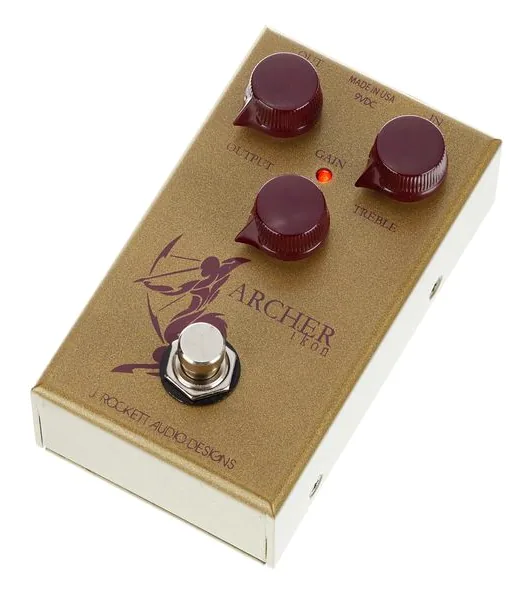
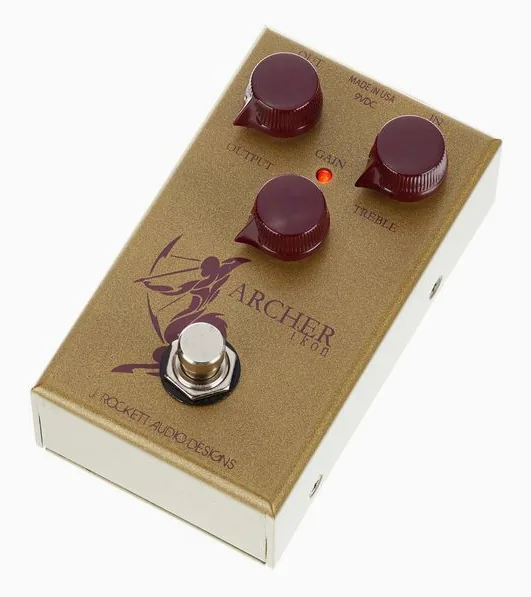
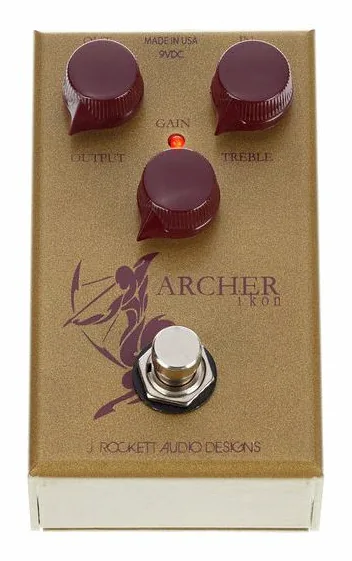
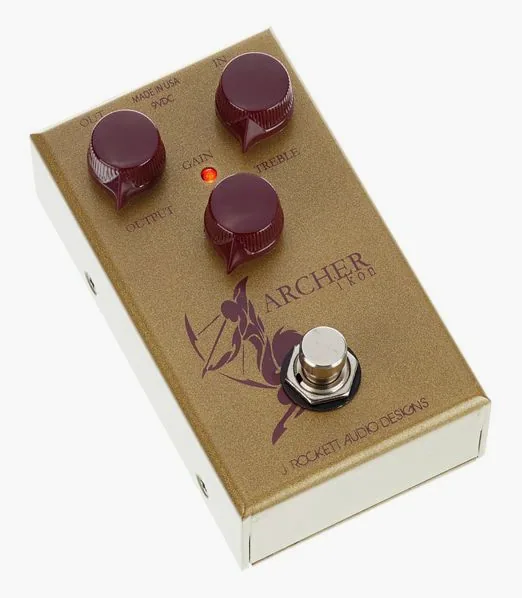
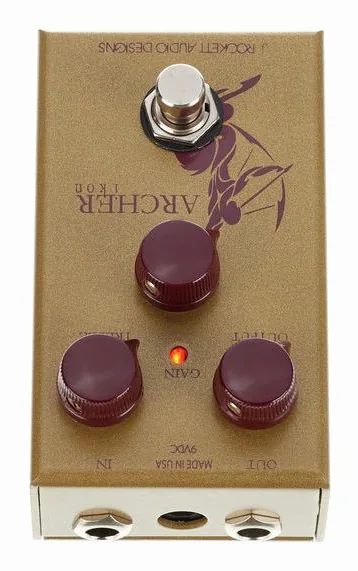
Out of the box, the Archer Ikon impresses with its dense 400-gram steel casing and robust feel, no flex, no play. The compact design (102 x 59 x 32 mm) fits easily on crowded boards, a clear advantage over its much bulkier inspiration. The footswitch actuates with a soft click. All jacks are stationed on the front, ideal for tight cabling arrangements. The pedal can be powered via a standard 9-volt battery or a center-negative 9V DC supply (2.1 mm barrel, not included). Note: battery replacement requires removing the backplate with a screwdriver, a minor hassle, though typical for this style.
The three controls, Volume, Tone (here labeled "Treble"), and Gain, offer an intuitive interface. The pots feel precise, with enough resistance to prevent accidental adjustment when stomping the switch, though some users found the gain knob a bit too close to the footswitch for comfort.
Circuit, Buffer, and Signal Handling
Rockett's use of Russian NOS diodes is the heart of its sound claim. Operating on an 18-volt internal circuit (from a 9V input), the pedal offers exceptional headroom. This high-voltage design keeps your clean tones intact and prevents mushy breakup, making the Archer Ikon equally at home as an "always on" buffer or a dynamic drive/boost at the front of your chain. Buffered bypass is standard here, a notable detail for players running long cable paths or multiple true bypass pedals, as it helps maintain signal clarity.
Sound and Tonal Range
- Clean Boost: With the gain knob at minimum, the pedal acts as a near-transparent signal booster, enhancing detail and presence without drastically coloring your base tone. Output level is substantial, so it can easily push a tube amplifier into its sweet spot. There's a subtle mid presence, distinct from a fully neutral boost, and the Archer Ikon avoids excessive compression, instead delivering a lively, responsive character.
- Medium Gain: As you bring up the gain, the pedal's celebrated mid-frequency boost becomes apparent. Unlike "pure" transparent drives, this pedal shapes the signal: there's mild compression, pronounced articulation in the low-mids, and a touch of grit that cuts through in a band mix. The interaction of the gain and volume controls is critical here. Dialing in both lets you blend clean and clipped signals, a signature aspect of the Klon circuit missed by many other clones.
- Full Overdrive: Maxing out the gain yields a smooth, musical crunch, rich in harmonics, fluid, and touch-sensitive. It doesn't reach aggressive distortion but offers enough bite for blues, roots rock, and classic rock contexts. The sound stays open, never veering into muddy or brittle territory. Humbucker guitars (like a Les Paul) fatten the sound further, while single coil pickups (Stratocaster, Telecaster) gain body and sustain without sacrificing clarity.
Users consistently report that the Archer Ikon excels at stacking, placed into, or after, other drives, it lends definition and "air" without competing with the subsequent pedal's voice. Many keep it as the first in their chain, using it as a preamp-style enhancer or as a subtle always-on tone shaper. If your amp is already near breakup, a nudge from the Ikon produces a creamy, harmonically detailed growl, and even at higher gain, the guitar's character remains present.
Comparison and Usability
Compared to the silver Archer (Rockett's "silver" model), the Ikon is described as warmer, rounder, and less sharp in the upper frequencies. Its smoother top end and slightly darker tilt make it favored for single coil guitars and "singing" blues or classic leads. If you want something with more attack or treble edge, the silver Archer or other bright-voiced drives might suit you better.
Versatility is a recurring high point: the Archer Ikon covers clean, edge-of-breakup, and full drive duties with minimal noise. However, true metal or modern hard rock tones are beyond its reach, a deliberate design choice, not a flaw. The limited gain range is a potential downside for players needing higher saturation, but in practice, the pedal's sweet spot resides in low to medium gain applications.
As for competition, the most-cited rival is the Wampler Tumnus, which is smaller and more affordable, though many experienced users prefer the Archer Ikon's voicing, construction, and nuanced touch response.
Final Thoughts
The J. Rockett Audio Designs Archer Ikon is a standout among Klon-inspired boost/overdrive pedals. Its sound is cohesive and three-dimensional, offering musical warmth, persistent mid-presence, and impressive dynamic sensitivity. You get a durable, pedalboard-friendly box that seamlessly crosses from transparent boost into creamy, responsive overdrive. Build quality is professional, and minute adjustments yield clear audible changes. Downsides are few: the gain knob's placement is slightly inconvenient, and the battery access requires a screwdriver. For those after the classic Klon-style voice, whether as a core overdrive, a boost, or a foundational tone enhancer, the Archer Ikon justifies its price and strong reputation.
- Pro: Superb voicing, clarity, and mid-focused warmth
- Pro: True "Klon-type" feel, responsive, musical, highly dynamic
- Pro: Compact and robust, easy to dial-in, always low noise
- Con: Battery access is awkward; gain knob close to footswitch
- Con: Limited high-gain capability, not ideal for heavy distortion
Bottom line: if you want the fabled gold overdrive/boost sound, the Archer Ikon delivers in both performance and build, making it a top pick for the core foundation of any serious pedalboard.
Shipping and duties
The retailer ships from its warehouse in Germany. Prices are shown in US dollars and do not include import duties. Orders under roughly $800 usually clear US customs without duty; above that, a duty of a few percent may be collected on delivery. 30-day money-back and a 3-year warranty apply.
Scores by area
Where it shines, where it stumbles
What convinced me
- Very close sound to the original Centaur pedal at a fraction of the price
- Robust all-metal construction with quality components and hardware
- Flexible range from clean boost to smooth, transparent overdrive
- Compact size fits easily on most pedalboards
- Buffered bypass is excellent for complex pedal chains
What bugged me
- Limited maximum gain; not suitable for heavy distortion or high-gain tones
- Access to battery compartment requires removing multiple screws
- Some find the midrange coloration too pronounced for transparent applications
- No included power supply and no pouch for storage
- Footswitch placement very close to gain control can be awkward on stage
Is it the right one for you?
Good pick if
This pedal is ideal for players seeking a Centaur-inspired boost or transparent overdrive, particularly fans of blues, country, classic, and indie rock. It's a strong choice for those who like to stack overdrives or need a versatile, dynamic pedal for gigging and recording. Those using tube amps looking to enhance subtle amp breakup or add presence and clarity in the mix will appreciate its unique color and robust build.Look elsewhere if
Not for guitarists after saturated high-gain distortion, extreme metal tones, or those requiring a fully neutral, uncolored boost. Those needing instant battery swaps on stage, very small pedalboard real estate, or ultra-affordable options may want to look elsewhere, as will players preferring modern digital multi-effects or heavy DSP shaping.Suggested level: Intermediate
Specifications
- Overdrive
- Yes
- Distortion
- No
- Fuzz
- No
- Metal
- No
- Effect types
- Booster
What other players say
Most users are impressed by the Archer Ikon's classic overdrive character and versatility as both an 'always-on' boost and dynamic, expressive drive. The durable metal construction and straightforward controls receive high praise, though some wish for more gain or easier battery access. Players highlight its ability to enhance amp breakup, add musical midrange, and integrate well with various pedal setups, especially for blues, rock, and country. While a few find the mid boost or high-end response too pronounced for their taste, the general consensus is that the pedal delivers high quality and authentic tone.
Very flexible: can go from (very lightly flavoured) boost to ballsy gainy tones
It’s worth the money spent! Before you buy this pedal, please think if it as a clean/slightly overdriven/overdriven pedal in your chain. It is best used with this in mind, the maxed out distortion vibe is not the best use of this pedal.
It sounds honky, a bit like a cocked wah pedal, I can hear a prominent peak in the mids. It is very dynamic and has a high input headroom. Buffer is ok (better than that of standard Boss pedals). Built (and weighs) like a brick.
Up close
Watch and listen
Before you decide
Questions players ask
How does the Archer Ikon differ from the standard Archer and other Centaur-style pedals?
The Ikon is voiced slightly warmer and darker than the standard Archer, with a touch more gain and midrange presence. It's praised for its smooth, creamy breakup and dynamic touch sensitivity, while remaining close in spirit to the original Centaur. Comparisons say it stands out against clones for organic response and quality.
Is the gain range sufficient for heavier genres or high-gain applications?
No, the Ikon is best as a low to mid-gain overdrive and clean booster. It doesn't deliver saturated distortion suitable for hard rock or metal on its own; it's intended to enhance breakup in tube amps or to stack with other drive pedals for layered tones.
Does it significantly alter the character of your guitar and amp?
While praised as a 'transparent' overdrive, the Ikon does add notable emphasis in the mids and a distinctive color at higher gain settings. Most players appreciate this signature, though strict transparency seekers may prefer other options.
How practical is it for use on a pedalboard?
Its small, rugged enclosure and front-mounted jacks make it pedalboard-friendly. The only complaints are the close spacing of the switches and knobs and the need for a screwdriver to replace the battery, but users find it more than durable enough for gigging.
What type of music and setups is it best suited for?
It's ideal for blues, classic rock, country, and fusion, as well as any setup needing clean lift or crunchy overdrive. It works especially well with tube amps and single coil or humbucker guitars, and is valued for 'always on' use or as the first stage in an overdrive stack.
The last word from the bench
The J. Rockett Audio Designs Archer Ikon is a highly respected pedal that authentically delivers the classic Centaur voice, excelling as a transparent booster and smooth overdrive across a wide range of amp/guitar setups. Its construction is virtually bombproof and even at its price, most users are convinced it's worth the investment. Tone chasers needing high-gain or ultra-modern sounds won't find them here, but for blues, classic rock, and honest amp pushing, it stands out. A true must-try for those wanting organic, sweetened drive with excellent dynamic control.
Hanging next to it
J. Rockett Audio Designs Archer Ikon
Today's price and delivery time are shown at the retailer.
 Guitar Gear Reviews