Boss RC-5 Loop Station
The Boss RC-5 Loop Station delivers professional features, deep connectivity, and excellent sound in an ultra-compact format, but the learning curve and software quirks hold it back from perfection.
★★★★★ 4.6/5 · 146 buyer reviews · 8 min read · updated 2026-10-06 · Tested by Cal Whitaker
Boss RC-5 Loop Station: Technical and Practical Review
High-End Audio and Extensive Loop Memory
The Boss RC-5 Loop Station sets itself apart with its technical specifications in a small pedal format. It supports up to 13 hours (780 minutes) of total stereo recording capacity with high-quality 32-bit analog-to-digital and digital-to-analog conversion and 32-bit floating point processing. This gives the RC-5 the headroom to avoid loss of resolution and noise even after multiple overdubs, a clear jump over previous generation loopers. In practical use, recorded layers retain consistent clarity. Guitar and bass lines remain crisp and articulate, even after five or more overdubs, something less precise pedals can muddy.
The unit's 99 loop memories are non-volatile, so users can save and recall complex arrangements on the fly. Each memory slot can store a unique combination of loops, rhythm settings, and naming conventions (useful for organizing live setlists or song demos). It's worth mentioning, though, that only one phrase can be played at a time, so seamless chaining of distinct verses and choruses is not natively possible within a single performance without using MIDI control or manual memory navigation.
Control Interface and Connectivity
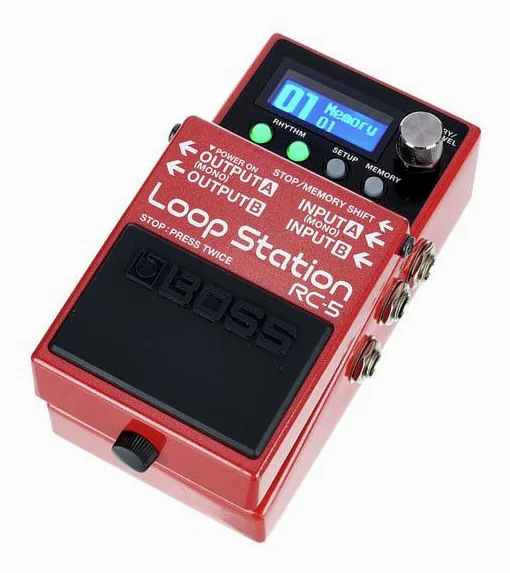
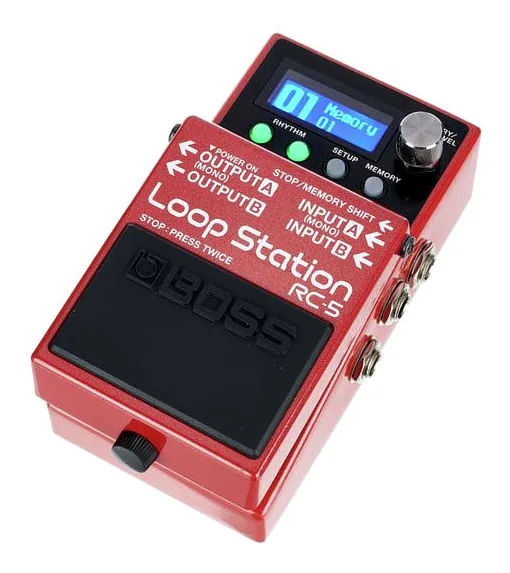
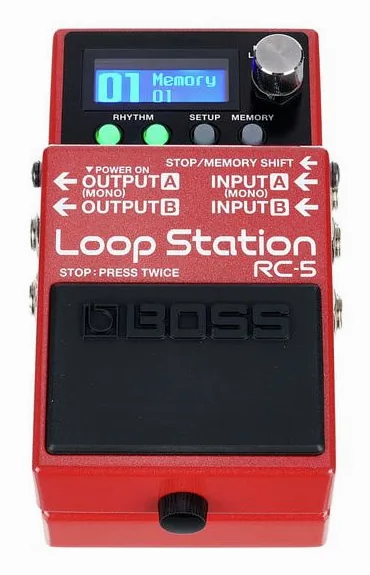
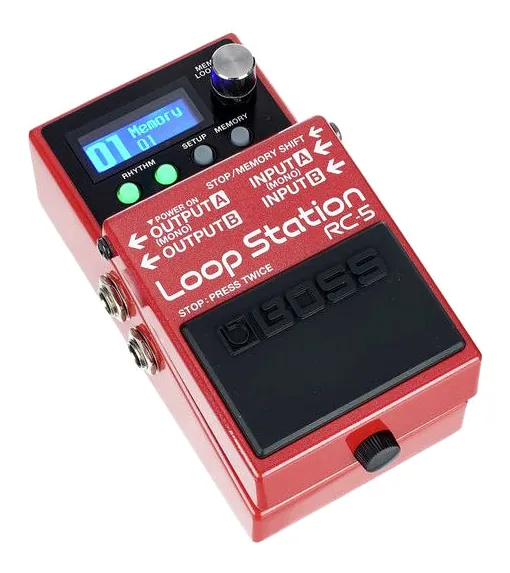
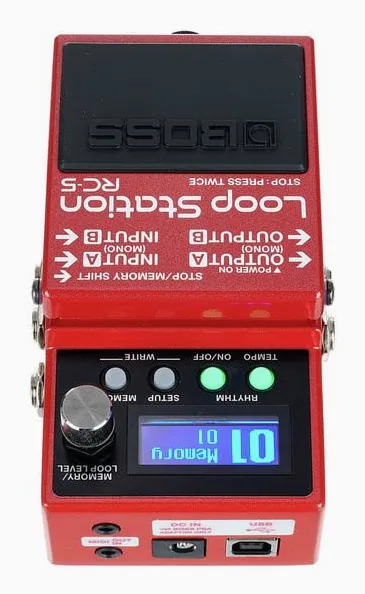
The RC-5 features a multicolored backlit LCD screen, which provides real-time visual feedback, including phrase status and key parameters like loop length, tempo, and memory slot. This aids live use: color changes for overdub, playback, or record are easily visible in dim rehearsal spaces or onstage. Physical controls include four push buttons (for memory access, setup, rhythm on/off, and tempo) and a single level/memory encoder.
The main footswitch functions as a multipurpose control for record, overdub, play, stop, and undo/redo. While this single-switch operation makes the pedal compact, it introduces an initial learning curve: double-taps, holds, and combinations trigger different operations. For heavy users or live performance, adding an external footswitch (like the FS-5U or FS-7 from Boss) is highly recommended. The RC-5's side stereo jack allows two external footswitches or an expression pedal, and these can be assigned to most core functions, except, notably, switching drum pattern variations, which is only accessible via MIDI.
In terms of connectivity, the pedal is equipped with stereo 1/4" input and output jacks, as well as dedicated stereo input/output for MIDI (on 3.5mm stereo jacks) and a USB Type-B port for saving/loading WAV files and firmware updates. USB integration further allows quick backup to a computer or import of backing tracks. For power, users can run a 9V battery or a standard 9V DC power adapter. Note that there's no included power supply and battery life is limited (roughly 1.5, 2 hours of use per standard alkaline battery).
Internal Rhythms and MIDI Synchronization
One signature feature is its built-in drum machine: 57 rhythm patterns, organized into seven drum kits, with A/B pattern variation and fills. For home practice or jamming, these patterns provide a synchronized beat and real metronome. For live use or complex time signatures, though, the RC-5's drum sounds are intentionally basic, serviceable for rock, blues, and pop, but limited for genres requiring groove nuance or non-standard meters. Patterns in triple time or odd signatures are fewer, and the sound engine reflects older drum machine character rather than organic kit realism.
The RC-5 excels on paper in MIDI synchronization: it can both follow external MIDI clock for tempo and send clock to other devices, allowing sync with drum machines or digital audio workstations. In practice, the implementation is a mixed bag. The MIDI mapping is powerful, but only eight control change numbers can be assigned, and critical "overdub" function is not assignable directly via MIDI. Some advanced users have criticized the documentation for poor MIDI explanations, causing time-consuming setup. Importantly, the pedal supports renaming phrase memories and a "reverse" loop playback mode via MIDI or manual control.
Time-stretching capability, changing tempo after recording, suffers noticeable digital artifacts when shifted even as little as 1 BPM, as reported widely. This makes tempo changes post-recording or MIDI sync to hardware/software with minor clock drift problematic for pro use.
Workflow and Practical Limitations
The RC-5's interface is clear after adaptation, but feature access requires menu navigation. Parameters such as fade-out, rhythm kit choice, and individual loop settings are stored per memory slot, not globally, requiring per-slot setup for consistent performance. Some users find this granular storage logical; others wish for universal default settings.
The compact physical layout means accidental adjustment of the main encoder or button presses is possible if the pedal isn't positioned thoughtfully on a pedalboard. Also, several users note that feedback on overdub regions is minimal: there is no visual waveform or display indicating where overdubs were made within a phrase, which can complicate live use of undo/redo on long loops.
A few users experienced rare data loss or loop memory corruption, though Boss's service response indicated these were isolated, infrequent issues with no confirmed hardware faults.
Sound Quality and Build
The RC-5 upholds Boss's reputation for tank-like build quality. The pedal is sturdy, and jacks and switches feel reliable. Sound quality remains a strong point, with transparent loop playback, no evident signal loss, and minimal noise floor. The dry audio path is fully digital but remains uncolored to most ears. Users uniformly praise the consistency of saved loops, even after dozens of overdubs, and appreciate the fade-out feature for silent operation when clearing loops.
Conclusion: Who Is It For?
The Boss RC-5 Loop Station is designed for players seeking vast memory, stereo operation, robust build, and strong rhythm/groove tools in a compact format. Its real strengths lie in recording quality, phrase storage, and expandability via external controls. MIDI integration is flexible but challenges some users due to documentation gaps and certain non-assignable MIDI portions. The lack of included power supply and the drum machine's limited realism are minor trade-offs against class-leading loop quality and depth of control. For live use, adding external switches or MIDI foot controllers unlocks more potential but adds cost and setup time.
For versatile loop recording, songwriting, and rehearsal, the RC-5 delivers on sonic excellence and expandability. Those demanding advanced MIDI control or seamless multi-phrase management should be aware of its specific workflow. Overall, it remains one of the most feature-rich and best-sounding compact looper pedals on the market at its current price point.
Shipping and duties
The retailer ships from its warehouse in Germany. Prices are shown in US dollars and do not include import duties. Orders under roughly $800 usually clear US customs without duty; above that, a duty of a few percent may be collected on delivery. 30-day money-back and a 3-year warranty apply.
Scores by area
Where it shines, where it stumbles
What convinced me
- Very high audio quality with advanced 32-bit processing
- Extremely compact and robust construction typical of Boss
- Extensive recording time (up to 13 hours) and 99 phrase memories
- Highly versatile, with stereo operation, MIDI sync, and external control support
- Easy integration with pedalboards and other hardware
What bugged me
- Rhythm/drum sounds are limited and often criticized for low realism
- Menus and navigation are not intuitive, with steep learning curve
- Documentation is incomplete and unclear, especially for MIDI use
- Not all features accessible via MIDI or external switches
- Power supply must be purchased separately and battery life is short
Is it the right one for you?
Good pick if
Ideal for multi-instrumentalists, solo performers, and producers seeking a compact yet powerful looper with deep MIDI connectivity and extensive phrase memory. Perfect for players willing to explore advanced features, and those integrating with complex pedalboard or studio setups. Also suited for songwriters and teachers needing to archive, recall, or manage many loops or backing tracks.Look elsewhere if
Not intended for total beginners who need a simple plug-and-play looper or anyone requiring sophisticated onboard drum sounds for live band performance. Also not suitable for users expecting multi-track simultaneous playback or those unwilling to invest time in learning menu-driven systems.Suggested level: Intermediate
Specifications
- Recording time in minutes
- 780 m
- Usb connector
- Yes
- Midi
- Yes
- Stereo
- Yes
- Xlr input
- No
- Incl. power supply
- No
What other players say
Customer feedback highlights the RC-5's excellent sound quality, sturdy build, and comprehensive recording features. Most praise its versatility, MIDI sync options, and rhythm patterns for practice. However, many report the user interface is difficult to master, menu navigation is not intuitive, and documentation is lacking, especially for MIDI programming. Criticisms also include the limited realism of onboard drums, inconsistent firmware updates, power supply not included, and rare but serious issues with losing saved loops. Despite these drawbacks, most users recommend the RC-5 for its audio performance, reliability, and professional options, especially when used with external switches and MIDI controllers.
The RC5 offers many advances over the RC3: MIDI control, real-time loop display, track renaming, drum simulation... For the price it’s impressive.
Sound quality is great and the interface is quite easy to navigate. Is it expensive? Yes. Is it worth it? I think so.
The menus and submenus are not intuitive and require adaptation, but once tamed, this pedal is truly complete and precise!
Up close
Watch and listen
Questions players ask
Can I use the Boss RC-5 Loop Station with other devices via MIDI?
Yes, the RC-5 features comprehensive MIDI in and out for syncing and control. However, documentation is incomplete, and certain functions such as entering overdub mode require workarounds or are not accessible via MIDI alone.
How good are the onboard drum and rhythm sounds?
The RC-5's rhythm patterns are useful for practice and basic backing, but do not match the realism or variety of dedicated drum machines. Most users find them adequate for home or rehearsal use, but not for demanding live performance.
Does the pedal come with a power supply?
No, a power supply is not included. You can use a standard 9V DC adapter or battery, but battery life is short, so an adapter is recommended for regular use.
How hard is it to learn and navigate the RC-5's features?
The unit is straightforward for basic looping, but advanced options require significant menu exploration and manual reading. Many owners turn to video tutorials to unlock its full potential.
Can the RC-5 play multiple loops or phrases simultaneously?
No, only one loop or phrase can be played at a time. While you can store up to 99 phrases, playback is limited to one at a time, making multiple song sections or layered arrangements manual to switch.
The last word from the bench
The RC-5 stands out for its robust build, exceptional sound quality, and rich connectivity, making it a versatile centerpiece for creative looping both live and in the studio. While its menu complexity, underwhelming onboard rhythms, and some MIDI limitations may frustrate, these are offset by powerful features and excellent flexibility. Reliability issues are rare but present. For most, the RC-5 is a top-tier choice as long as you are prepared to invest time into mastering its workflow.
Hanging next to it
Before you decide
Boss RC-5 Loop Station
Today's price and delivery time are shown at the retailer. Affiliate link, your price does not change.
 Guitar Gear Reviews