Boss DD-500 Digital Delay
Boss DD-500 Digital Delay delivers unmatched versatility, pro audio quality, and a robust feature set, but requires patience to master.
★★★★★ 4.7/5 · 48 buyer reviews · 8 min read · updated 2026-10-07 · Tested by Cal Whitaker
Boss DD-500 Digital Delay: Professional Delay Without Limits
The Boss DD-500 Digital Delay stands at the intersection of modern digital processing power and the intuition needed for live performance. Introduced in September 2015, this pedal goes far beyond the basic repeat functions of earlier delay units. Backed by Boss' rock-solid build, it offers a staggering range of sonic options and practical features at a price that positions it as a compelling alternative to higher-priced competitors.
Build and Interface
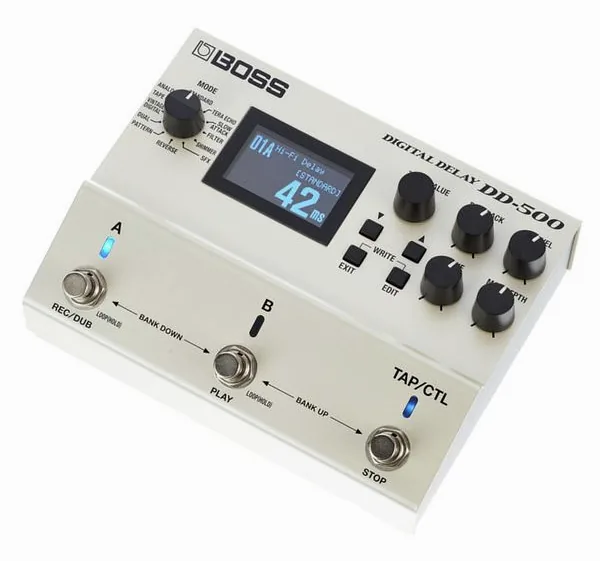
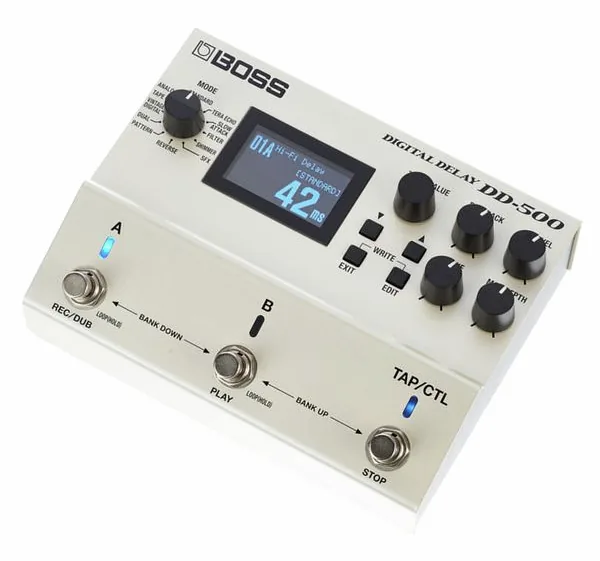
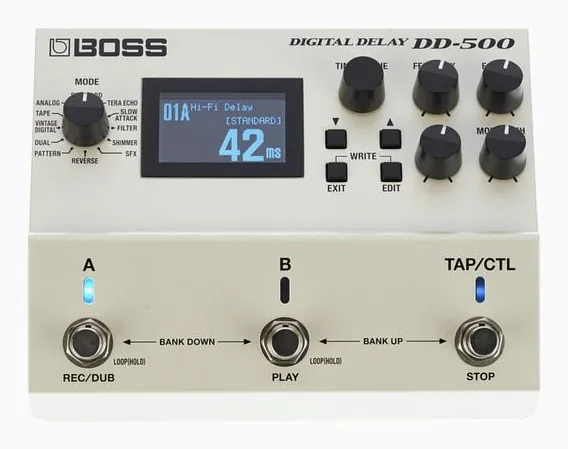
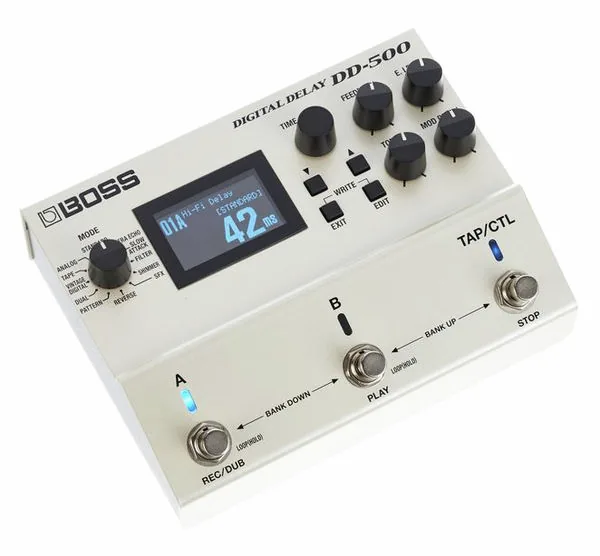
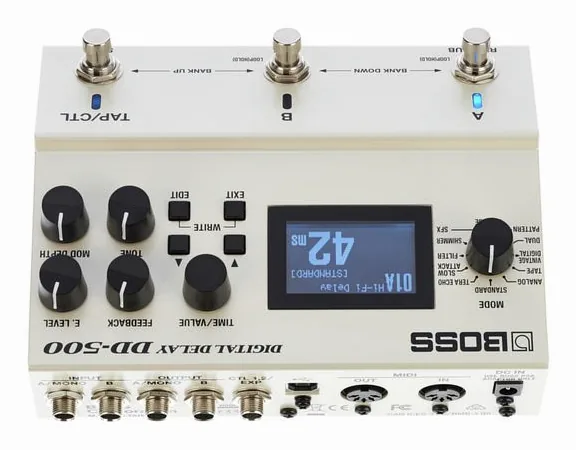
The chassis follows Boss' reputation for robust construction. At 170 x 138 x 62 mm and weighing in at 1 kg (just over 2 lbs), it is road-ready and designed to withstand years of heavy use. The form factor is "table-friendly," and the three large footswitches are spaced for confident stage operation. Five rotary knobs give swift access to essential delay parameters, no small feat for a pedal this deep. Some users did wish for more knobs, but most found surface-level control immediate and reliable. The bright, easy-to-read LCD display is a game-changer for menu navigation, patch organization, and real-time parameter monitoring, with adjustable brightness to suit venues from dark clubs to daylight stages.
Comprehensive Feature Set
At its core, the DD-500 is a digital delay pedal, not an analog simulator, but it incorporates algorithms for analog and tape characteristics. The twelve main delay engines span vintage and modern flavors, including studio-grade digital, tape echo, analog "bucket brigade" simulation, reverse, pattern, slow attack, Tera Echo, shimmer, modulated, and dual. Maximum delay time reaches an impressive 10 seconds, and you can save up to 198 user patches, enough for the most demanding shows or creative sessions.
- Stereo Operation: Studio-quality, full-stereo processing at 32-bit/96kHz gives pristine sound with width and clarity.
- Dual Delay Modes: Any two delay types can run simultaneously, in series or parallel, with routing options including full stereo split for complex signal chains or even use as an effects loop.
- Extensive Control: Assignable external switch or expression pedal via TRS jack allows flexible tap tempo, parameter control, or momentary effects. MIDI and USB expand integration for complex rigs or DAW processing. Tap tempo is available by foot or MIDI, and tempo can be set per patch or globally.
- Looper Functionality: The built-in phrase looper offers 120 seconds (mono, 48kHz) of loop time, with effects usable during looping, a boon for layering and practice, though seasoned loopers may find limitations in saving and manipulation compared to dedicated units.
- Power: Runs on four AA batteries or 9V DC (adapter not included, consumes 200mA), catering to portable and stationary rigs alike.
Editing and Workflow
Although the DD-500 is loaded with features, its workflow strikes a balance between surface-level instant gratification and deep-tweaking potential. Key parameters, delay time, feedback, effect level, tone, and modulation, are all one turn away from the top panel. For users who want more, diving into submenus reveals vast options: modulation rate and depth, ducking, comprehensive EQ (with adjustable low- and high-pass on repeats, wet, or total signal), LFO curves, and programmable footswitch assignments.
Almost every parameter can be modulated, MIDI-controlled, or automated, lending the DD-500 to experimental players, synth users, and studio hands as much as stage guitarists. Some reviewers highlight the "option within an option" approach, noting almost 20 tweakable settings per patch, exhilarating for sound designers, overwhelming for minimalists.
Preset management is robust, but the order can be confusing if not organized to match one's workflow. Desktop management via Boss' Librarian software streamlines patch editing and backup, particularly once user familiarity grows. For quick recall, the ability to reorganize and overwrite patches is practical, avoiding unnecessary pedalboard tap-dancing during a set.
Sound Quality and Creative Applications
The headline spec, 32-bit/96kHz processing, translates to noise-free operation and first-rate fidelity. Reviews overwhelmingly report that pristine digital sounds, lush analog emulations, and tape flavors are all present, with plenty of modulation and drift available. The DD-500 is known for spaciousness and clarity on clean settings and notable warmth when desired. Delay filtering, particularly pre-feedback EQ, allows dirty, textural feedback effects, feedback swells, and classic "runaway" repeats, which can be tamed with parameter assignments or external mute control.
Side capabilities elevate the pedal: the chorus, flanger, pseudo-reverb, tremolo, and shimmer settings open new sonic territory. While many found these secondary effects convincing, shimmer in particular earned mixed marks, adequate for layering, but not the highlight compared to other high-end ambient pedals. The stereo field can be tightly managed, with the option to send wet and dry signals separately; for users with "wet/dry/wet" setups, careful programming is required, as direct signal removal can be cumbersome across all presets.
Critiques and Considerations
- Learning Curve: The DD-500's vast capabilities come at the cost of complexity. Beginners may find the editing depth intimidating, especially compared to simpler analog delays or compact digital options.
- Tap Tempo and MIDI: Tap tempo is precise, but there are technical limits (for example, a maximum gap between taps of 1500ms), and global/per-patch MIDI sync functions are less versatile than some would like.
- Looper Limitations: The onboard looper is useful for practice, layering, and experimentation, but not a replacement for full-featured loop stations as it cannot save loops between patches.
Comparisons and Value
Against main digital delay competitors (Strymon Timeline, Eventide, Empress), the DD-500 is often praised for parity (and sometimes superiority) in core delay sounds at a lower price, albeit with somewhat more utilitarian design and less immediate "character." Many professionals now reach for the DD-500 not just as a guitar tool but as a studio effect for vocals, synths, and percussion, a testament to its clean audio path and deep modulation capabilities.
Conclusion: Best for the Tone Explorer
The Boss DD-500 Digital Delay is more than a "Swiss Army Knife" for delay. Its depth rewards those willing to explore, whether for layering spacey textures on stage, dialing in authentic tape slap, or building hybrid delay/modulated effects. Not for the minimalist, but for studio experimenters and demanding live performers, it's a benchmark. A clear recommendation for players seeking a single delay that does (almost) everything, with studio-quality fidelity and robust performance.
- Strengths: Sound quality, versatility, build, patch management, flexibility, value
- Trade-offs: Complexity, shimmer effect, tap/MIDI quirks, looper depth
Shipping and duties
The retailer ships from its warehouse in Germany. Prices are shown in US dollars and do not include import duties. Orders under roughly $800 usually clear US customs without duty; above that, a duty of a few percent may be collected on delivery. 30-day money-back and a 3-year warranty apply.
Scores by area
Where it shines, where it stumbles
What convinced me
- Extremely versatile with 12 high-quality delay algorithms, including digital, analog, tape, dual, pattern, and special effects like shimmer and Tera Echo
- Professional-grade stereo sound with 32-bit/96kHz processing and detailed parameter control, making it suitable for studio, live, and experimental use
- Dual delay processing can run two completely separate delays simultaneously (in series or parallel), programmable via MIDI and expression pedal
- Sturdy, durable construction with practical display and user interface, robust footswitches, and reliable build quality
- Extensive preset storage (up to 198 patches), useful for musicians with many needs or gigging/recording with setlists
What bugged me
- Steep learning curve due to extensive menu navigation and deep parameter editing; may be overwhelming for users seeking simplicity
- Looper feature is limited; cannot save loops and is best considered a secondary tool
- Some effect algorithms (shimmer, reverse delay) are not as convincing as leading competitors; shimmer in particular often described as weak
- Limited direct-access knobs for real-time control; more hands-on tweakability would be welcome for live players
- Tap tempo and MIDI sync functions have some operational quirks and may not be suitable for every workflow
Is it the right one for you?
Good pick if
Ideal for advanced musicians, sound designers, and studio engineers who need a wide range of customizable delay textures and deep parameter editing. Suits guitarists, synthesists, and anyone working with complex MIDI setups or dual-delay routing. Also recommended for those seeking a robust, reliable centerpiece for pedalboards or live rigs.Look elsewhere if
Not recommended for beginners or those seeking simple plug-and-play operation; the interface and feature set can be overwhelming. Musicians looking for a dedicated, hands-on looper or a single straightforward delay sound may prefer other, more focused pedals.Suggested level: Professional
Specifications
- Analog
- No
- Delay time
- 10000 ms
- Tap feature
- Yes
- Battery operation
- Yes
- Psu included
- No
What other players say
Customer reviews highly praise the Boss DD-500 for its exceptional versatility, robust build, and studio-grade sound, emphasizing how the pedal provides endless options for delay and modulation effects. Most users appreciate the comprehensive MIDI and preset functions, making it particularly strong for both live and studio contexts. However, some find the interface complex, citing a steep learning curve and wish for more direct-access knobs. The looper is considered a helpful extra rather than a core function, with users recommending it for advanced players who are willing to invest time into programming their ideal sounds.
This really is a 'Swiss Army Knife' of pedals... it is capable of so much more. Chorus, Flanging, Pseudo Reverb, Doubling, Shimmers and pitch changes... really this is a very good box if you want something to cover virtually every processing need.
High quality build, high quality sound, more affordable than competitors, easy tweaking thanks to the display, very versatile.
If you want a simple delay this maybe is too much. For those who like to tweak and experiment, endless possibilities.
Up close
Watch and listen
Before you decide
Questions players ask
Is the Boss DD-500 suitable for live performance?
Yes, the pedal is built for stage use with sturdy footswitches and assignable controls, but extensive menu navigation may slow down some live workflows unless patches are prepared in advance.
How does the sound quality compare to other high-end digital delays?
Sound quality is excellent overall, rivaling more expensive brands such as Strymon and Eventide, though some effects (notably shimmer and reverse) are less highly rated.
Can I use the looper for full performances?
The looper works for basic practice or layering, but lacks loop saving and has limited editing features, dedicated looper pedals are better for full performance needs.
Is it easy to use for beginners?
The DD-500 is feature-rich and may be daunting for beginners; users familiar with multi-effect pedals or those prepared to read the manual will adapt more quickly.
Can I control external gear with its MIDI and expression capabilities?
Yes, the DD-500 features deep MIDI implementation for parameter automation, preset switching, and can send/receive MIDI clock and CC messages, as well as allowing control over parameters with an expression pedal or external footswitch.
The last word from the bench
The Boss DD-500 stands among the most versatile and capable digital delay pedals on the market, offering a deep and customizable palette for everything from vintage warm echoes to pristine modern textures. Its robust construction and broad connectivity make it suitable for studio, stage, or pedalboard centerpiece. However, its complex interface and deep editing may be daunting for some; prepared users will find tremendous creative potential. If you seek endless delay sculpting options and solid value in pro-quality hardware, this should be on your shortlist.
Hanging next to it
Boss DD-500 Digital Delay
Today's price and delivery time are shown at the retailer.
 Guitar Gear Reviews