Hotone Ampero II Stage
The Hotone Ampero II Stage is a fully loaded, intuitive amp modeler and effects unit with excellent sound and broad connectivity, but DSP and support limitations hold it back.
★★★★★ 4.7/5 · 47 buyer reviews · 9 min read · updated 2026-10-07 · Tested by Cal Whitaker
Overview: Scope and Positioning
The Hotone Ampero II Stage launched in December 2023 at a street price of $599, targeting guitarists, bassists, and travel-ready musicians who need a comprehensive floor-based effects and amplifier modeling solution. With its metal chassis, large clear touchscreen (5-inch, 800x480 pixels), and host of connectivity options, it signals ambition, going after the big names, yet coming in beneath the high-end wallets of Fractal, Line 6, and Neural DSP. Below I'll break down where it shines, where it stumbles, and what to expect if you bring the Ampero II Stage into your setup.
Build Quality and Interface
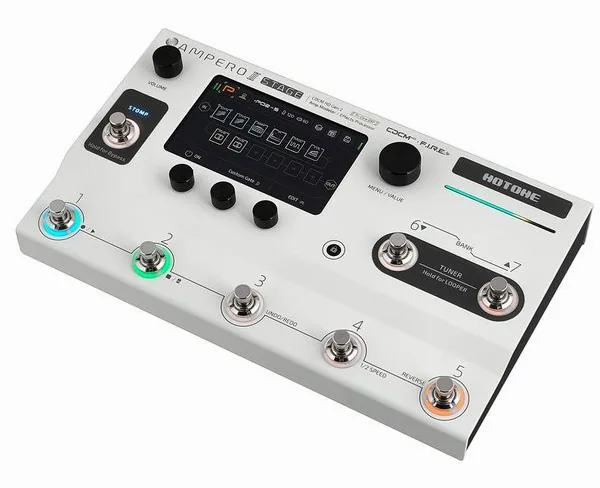
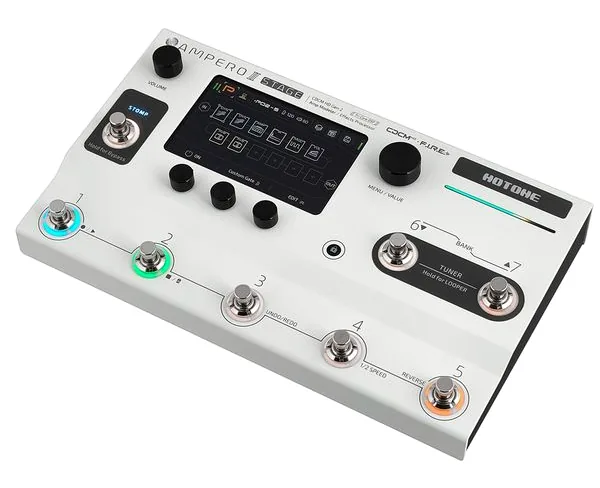
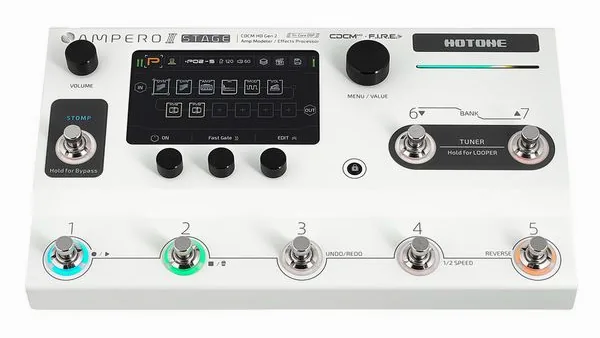
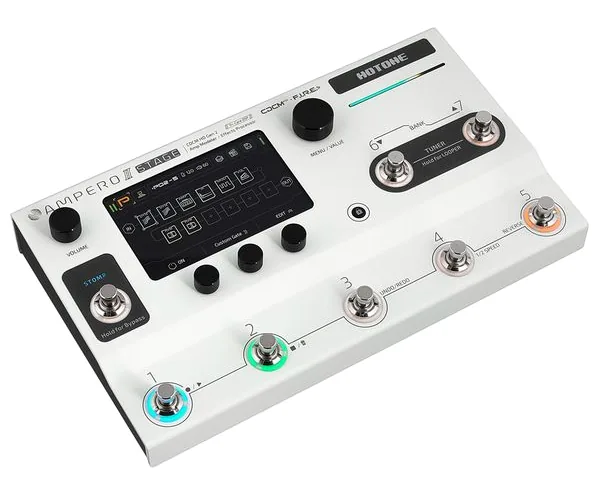
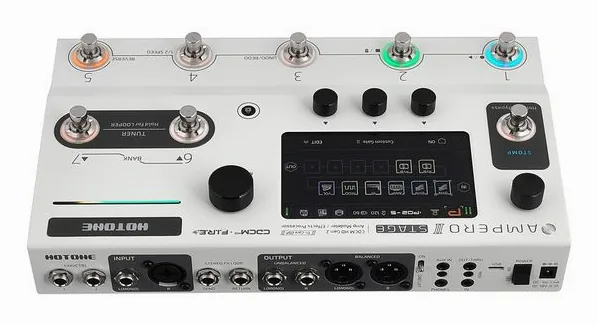
Physically, the unit impresses. The casing is thick, powder-coated metal, and all connection points are solid, no wobble or fragile jacks. At 1.9 kg and roughly the size of a laptop, it's compact enough for a pedalboard but doesn't feel cramped. The footswitches are silent and spaced well enough to avoid missteps. The knobs, though well-mounted, are slightly sharp-edged according to some users, noticeable more under bare hands than with shoes or socks.
The 5-inch touchscreen is a highlight, with crisp resolution and rapid response. Almost all core navigation, preset tweaking, and signal path building can be done from the screen, with three additional rotary encoders for quick adjustments. Editing onboard almost never feels like a chore, and Hotone's desktop editor mirrors this smooth experience. Bluetooth app support is available for iOS at present, letting you edit, store, or transfer presets from your phone or tablet (Android app status TBA).
Connectivity and Routing
The Ampero II Stage's back panel is one of the strongest in its class. Inputs include a main 6.35 mm jack, an XLR/TRS combo (with microphone preamp and phantom power plus five operational modes), a 3.5 mm auxiliary input, four external effect jacks (send/return in stereo, pedal/switch inputs), and MIDI in/out via mini-jack. Outputs feature not just two unbalanced 6.35 mm jacks, but also dual XLRs, perfect for live PA or studio recording setups. A 3.5 mm headphone jack allows for silent practice or monitoring, and a USB-C port handles firmware updates, preset management, and full audio interface functionality. The included power supply delivers 9, 18 V DC (center negative), and there's no battery bay; mains only.
The signal chain flexibility is outstanding: you can run up to 12 blocks per preset, freely assign blocks before/after splits, and implement four-cable method routing. There's also true ground lift and a built-in tuner, looper (up to 60 seconds), and drum machine.
Modeling and Effects: What You Get
The numbers impress: over 90 amplifier models, more than 68 cabinet models, upwards of 100 pedal models, and 460+ effect types. Microphone simulation covers a range of common mic types and positions. Guitar, bass, and acoustic simulation are all present; you can easily switch instruments or even set up parallel chains for two different sources if desired.
Third-party impulse response loading is supported via the Hotone editor. Some users report a few limitations here, namely, the unit only accepts IRs formatted at 44.1 kHz, 24-bit, with simple filenames (no spaces or special characters), and loading them can be fussy if you don't prep files correctly. But once set up, the range of tones is broad, and integration with libraries like York Audio, OwnHammer, and others is straightforward.
Recent firmware updates introduced capture mode compatibility, including with Neural Amp Modeler (.NAM) files. Onboard tone capture ("Tone Catch") is functional, though the official Hotone cloud library is limited in scope compared to platforms like Cortex Cloud.
Sound Quality and Playing Feel
Users consistently highlight one of the Stage's best attributes: sound and playability right out of the box. Even without tweaking, presets are usable, spanning high-gain, vintage clean, crunchy blues, and ambient textures. The amp and preamp models exhibit surprisingly dynamic touch response that feels close to a real tube amplifier, especially when running into a power amp or real cab. The "cloud" reverb algorithms and digital delays were repeatedly cited as near "pro-level," rivaling much pricier standalone pedals, and effects switching is gapless between scenes within a preset.
There's some brightness by default, most prefer cutting highs with the onboard equalizer, warming up tones especially for live PA or direct recording. For heavy players, Soldano, Marshall, and Mesa models punch above their weight. Most users find at least five usable amps in any needed category, and the cabinet/microphone fine-tuning has real impact on depth and realism.
That said, some players who demand ultimate realism (especially previous Kemper users) note that direct amp captures sound better than Hotone's modeled amps. And onboard acoustic and vocal processing lags behind its guitar offerings, adequate for basic demos or rough work but not "studio" clean.
DSP Power and Limitations
The DSP is a double-edged sword. For typical setups, amp, cab, several effects, CPU overhead is reasonable, and everything runs smoothly. However, using captured amps/profiles or heavy reverb/ambient effects can max out the processor fast, occasionally leaving you unable to add a second delay or complex chain, especially with more than one capture or dual-amp setup. The unit's allocation (12 blocks max, but heavy blocks limit how many can be used fully) means some elaborate rigs require compromise: most won't notice in typical rock, blues, or metal, but for ambient, worship, or experimental genres, the limit appears sooner than with pricier flagships.
Firmware continues to update, with recent improvements in latency and scene management, but some deep bugs and optimization issues persist, and feature requests gather dust, Hotone's pace is slow, and official support is notably lacking. Don't buy if you expect a responsive helpdesk or vibrant Western community; most support is peer-driven and mainly in Chinese forums.
Workflow: Scenes, Assignments, MIDI
The Ampero II Stage lets you store up to five "scenes" per preset, think snapshots with different combinations of effect on/off states and parameters. Scene assignment to footswitches is flexible, and you can mix tap tempo, effect toggling, or scene calls per preference. However, there are quirks: returning to a scene sometimes does not restore the stored parameter values, but rather the last-used states. This could disrupt those who program detailed setlists or complex performance workflows.
MIDI control is complete in theory, but documentation is scant, and MIDI Out is still unreliable for some, limiting integration with other MIDI-based gear or DAW automation.
Verdict: Who Is It For?
The Hotone Ampero II Stage is, in practice, a highly capable all-in-one processor with intuitive editing, above-average build quality, and a vast library of stock effects and amps. Its user interface, both on pedal and via software, is among the best currently available. For home studio players, working musicians needing fast setup changes, or anyone tired of menu-diving, this floorboard outperforms legacy rivals like Boss and Line 6 HX Stomp in daily usability.
It falls short for those needing ultra-flexible DSP routing, fully programmable MIDI, or instant technical support. Acoustic/vocal performance is an add-on, not a highlight. Hotone's sluggish firmware updates and limited global community are the biggest caveats for long-term ownership.
- PROS: Excellent screen and interface, broad models and effects, strong sound quality, great routing, dual XLR outs, IR/capture support, ease of use onboard and via app.
- CONS: DSP headroom can bottleneck ambitious rigs, support is minimal, MIDI features/documentation lag behind rivals, IR loading requires extra prep, vocal/acoustic tools are basic.
For players wanting quick, roadworthy results without endless tweaking, the Ampero II Stage justifies its price. Programmers or tinkerers needing deep MIDI/scene logic or extensive real-time processing power may run up against its boundaries. For everyone else: plug in, power up, and play, this floorboard delivers where it matters most.
Shipping and duties
The retailer ships from its warehouse in Germany. Prices are shown in US dollars and do not include import duties. Orders under roughly $800 usually clear US customs without duty; above that, a duty of a few percent may be collected on delivery. 30-day money-back and a 3-year warranty apply.
Scores by area
Where it shines, where it stumbles
What convinced me
- Extremely intuitive user interface with 5-inch responsive touchscreen
- Wide variety of amp models, cabinets, and effects (over 460 effects, more than 90 amps, 68 cabinets)
- Supports user impulse responses and amp profiling/capture (NAM compatibility)
- Flexible routing with full four-cable method and multiple input/output options
- Robust metal construction and compact, stage-ready form factor
What bugged me
- Limited DSP processing power; running captures or dual-amp setups restricts effects usage significantly
- Lack of integrated expression pedal (requires external pedal for wah/volume control)
- Customer support and official community engagement are very weak
- Some MIDI features and scene management are underdeveloped (scene recalls last state, not saved state; MIDI documentation is poor)
- Presets from other Hotone models are not directly compatible with the Stage
Is it the right one for you?
Good pick if
Ideal for guitarists needing a versatile, all-in-one amp and effects solution with flexible routing and user-friendly editing. Great for players who value compactness, stage-readiness, and the ability to load their own impulse responses and profiles. Hobbyists and semi-professionals will appreciate the excellent value and modern interface for home, studio, and gigging use.Look elsewhere if
Not recommended for those seeking flawless, deep amp captures and unlimited DSP power for complex, dual-amp or ambient chains. Also not suited for users demanding strong after-sale support, extensive community sharing, or those who want seamless integration of presets with earlier Hotone models. Analog purists and pro touring musicians seeking maximum reliability or subtle effect switching may want to consider premium competitors.Suggested level: Intermediate
Specifications
- Design
- Floorboard
- Tube(s)
- No
- Amp modeling
- Yes
- Effects
- Yes
- Headphone output
- Yes
- Direct out
- Yes
- Midi interface
- Yes
- Integrated expression pedal
- No
- Connections for pedals or switches
- Yes
- Aux-input
- Yes
- Integrated tuner
- Yes
- Usb-port
- Yes
- Drum-computer
- Yes
- Drumcomputer
- Yes
What other players say
Customers widely praise the Ampero II Stage for its excellent ease of use, rich selection of amps and effects, and robust metal construction. The touchscreen interface and Bluetooth/mobile connectivity receive substantial positive remarks for convenience. Sound quality is considered very good, with both amp modeling and capture features holding up well for most genres. Users consistently highlight the flexible routing, numerous input/output options, and the value delivered for the price. However, recurring criticisms focus on DSP limitations, inefficient factory presets, lack of manufacturer support, and minor hardware or software annoyances, such as insufficient MIDI documentation and heat buildup. Still, most owners express high satisfaction and recommend it for both home and stage use, especially if you're willing to tweak settings.
The unit feels sturdy, built from thick metal with solid footswitches.
I’m really excited about the touchscreen and the incredibly intuitive interface.
Sound: simply great. Very good amps and effects.
Up close
Watch and listen
Before you decide
Questions players ask
How many simultaneous effects and amp models can you use on the Ampero II Stage?
You can run up to 12 blocks (effects/amps) simultaneously, but using amp captures or intensive effects will reduce the available DSP, sometimes restricting you to fewer blocks.
Is the unit suitable for live performance and direct out to PA systems?
Yes, the Stage offers dedicated stereo outputs, XLR balanced outs, and headphone/aux options, making it ideal for live setups and silent practice, as well as routing with real amps via the four-cable method.
How does the Ampero II Stage compare to Line 6, Kemper, and Neural DSP units?
While amp and effect quality is comparable in many cases, the Hotone falls a bit short on DSP headroom and ongoing software support, but excels in user interface and price-to-performance ratio.
Can I use my own impulse responses (IRs) or amp profiles?
Yes, user IRs and third-party profiles (NAM format) are supported, though the system is picky about file formats and sometimes demands manual conversion.
Does it have an integrated expression pedal or can it be added?
It doesn't include an onboard expression pedal, but you can connect external pedals or switches via dedicated jacks for volume, wah, or other control functions.
The last word from the bench
Hotone Ampero II Stage stands out for its versatile features, strong build, and user-friendly touchscreen interface. The breadth of available sounds and editing options is impressive, especially for the price. However, limited DSP power means compromise when using amp captures or complex chains, and official customer support is lacking. For players needing a powerful all-in-one that's enjoyable to use and easy to set up, it's a top contender, provided you're aware of its technical and support caveats.
Hanging next to it
Hotone Ampero II Stage
Today's price and delivery time are shown at the retailer.
 Guitar Gear Reviews